
Law, Statecraft & Classical Sanskrit
Sanskrit was never only a sacred language. Over roughly two millennia, it became a transregional medium for grammar, philosophy, law, government, medicine, astronomy, drama, poetry, aesthetics, sex, and courtly display. Its prestige connected courts and intellectual communities whose spoken languages differed, rather as Latin later did in Europe, without making the subcontinent monolingual.
Grammar before almost everything else
Panini’s Ashtadhyayi, usually dated to the fourth century BCE, describes Sanskrit through nearly 4,000 compressed rules. It is not a primer. It is a generative system using ordered operations, technical markers, recursion, and metarules to derive valid word forms and compounds from roots and affixes. Katyayana’s critical notes and Patanjali’s Mahabhashya turned it into a continuing tradition of linguistic analysis.
The achievement matters beyond its resemblance to formal systems. In Indian philosophy, claims about ritual, scripture, knowledge, and reality repeatedly became claims about what words mean and how sentences produce understanding. Grammar was not an auxiliary discipline. It was one of the places where metaphysics happened.
Dharma and the mistake of calling it a law code
The Dharmasutras and later Dharmashastras discuss right conduct, social classification, life stages, inheritance, penance, kingship, legal procedure, purity, and ritual obligation. The Manusmriti, composed in a recoverable form around the early centuries CE, became the most famous and politically explosive example.
Calling it “the Hindu law code” gives it a centralized authority it did not possess. It is a prescriptive Brahmanical text among competing texts, commentaries, regional customs, royal orders, guild rules, and community practices. Its provisions are evidence of an ideology and a legal imagination, not a transcript of how every village or court operated. Colonial administrators nevertheless searched Sanskrit texts for an equivalent to English law and elevated selected Brahmanical authorities. They helped turn Manu into both a supposedly definitive Hindu code and a definitive object of anti-caste attack. Ambedkar publicly burned it in 1927.
The Arthashastra

The Arthashastra is attributed by tradition to Kautilya or Chanakya, Chandragupta Maurya’s adviser, but the surviving work is a layered compilation probably completed centuries after the Mauryan period. Its subject is artha: material power, government, revenue, security, and the maintenance of a kingdom.
It describes taxation, irrigation, mines, forests, trade, courts, salaries, fortifications, diplomacy, intelligence networks, covert operations, and war. Its reputation for ruthlessness is earned, but incomplete. The ruler’s power depends on productive land, functioning administration, protection from officials’ corruption, and subjects prosperous enough to tax. The work is cold-eyed because it treats government as a system of incentives and information rather than as a sequence of moral anecdotes.
It was rediscovered in manuscript and published only in the early twentieth century, after which nationalists embraced it as proof that India possessed a tradition of realist statecraft comparable to Machiavelli. That comparison is useful until it turns either author into a slogan.
Theater, poetry, and aesthetics
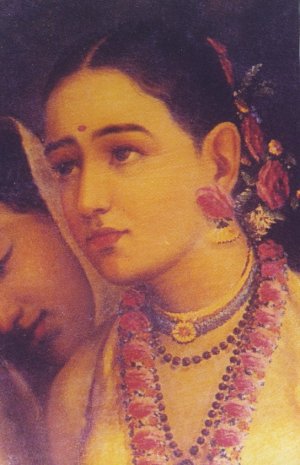
The Natyashastra, composed and expanded over the centuries around the beginning of the common era, treats drama as a total art that joins speech, gesture, music, dance, costume, architecture, and audience response. Its theory of rasa, the aesthetic flavor or emotion savored by a cultivated spectator, became one of the central ideas in Indian aesthetics. Later thinkers, especially Abhinavagupta, made the experience of rasa into a sophisticated account of how art turns particular grief, love, courage, or disgust into something shareable and contemplative.
Classical drama survives most famously in Kalidasa’s Shakuntala, where a story from the Mahabharata becomes a courtly meditation on desire, memory, and recognition. Kalidasa’s Meghaduta, a message entrusted by an exiled lover to a cloud, maps longing across the geography of India. Bhasa, Shudraka, Bhavabhuti, Bana, Bharavi, Magha, and others created a literature organized around density of language, formal virtuosity, and the ideal of kavya, crafted literary expression.
Sanskrit drama often places Sanskrit and Prakrit in the mouths of different characters, depending on gender and status. The prestige of literary language, therefore, records a multilingual society even as it reproduces its hierarchy.
Desire and ordinary life
Vatsyayana’s Kamasutra, probably composed around the third or fourth century CE, is famous for the part that occupies the least of it. It is a work about cultivated urban life: courtship, marriage, adultery, courtesans, household arrangements, cosmetics, music, conversation, and the arts through which elite men and women were expected to make themselves desirable. The sexual positions are one section inside a larger social manual.
The text is neither a timeless account of Indian openness nor a modern handbook of equality. It assumes class privilege, slavery and servitude, arranged marriage, and a social world structured around male householders, even as it preserves unusually direct discussions of women’s desire, courtesans’ economic strategy, and same-sex acts. Its afterlife says as much about colonial and modern fantasies of India as its contents say about the world that produced it.
What the archive leaves out
Sanskrit’s geographic reach and abundance of manuscripts can make it appear to be the whole of classical Indian intellectual life. It was not. Pali, the Prakrits, Tamil, Kannada, Apabhramsha, Persian, and many oral traditions carried arguments and experiences that the Sanskrit archive did not. Even in Sanskrit works, the people described are not the same as those able to write, preserve, and interpret the text.
The point of adding this page is therefore not to enlarge a Sanskrit canon until it once again stands for India. It is to show that the same language that carried revelation also carried bureaucracy, satire, romantic longing, scientific argument, and advice for adulterers.