
Buddhist & Jain Canons
Buddhist and Jain traditions emerged from the same broad north Indian world in the middle of the first millennium BCE. Both rejected the Vedas as revelation, organized communities of renouncers and lay supporters, treated rebirth as a problem to be escaped, and produced large textual traditions in languages other than Vedic Sanskrit. That does not make them two versions of the same movement. They disagree about the self, matter, karma, liberation, and almost everything that follows.
The Buddhist textual worlds
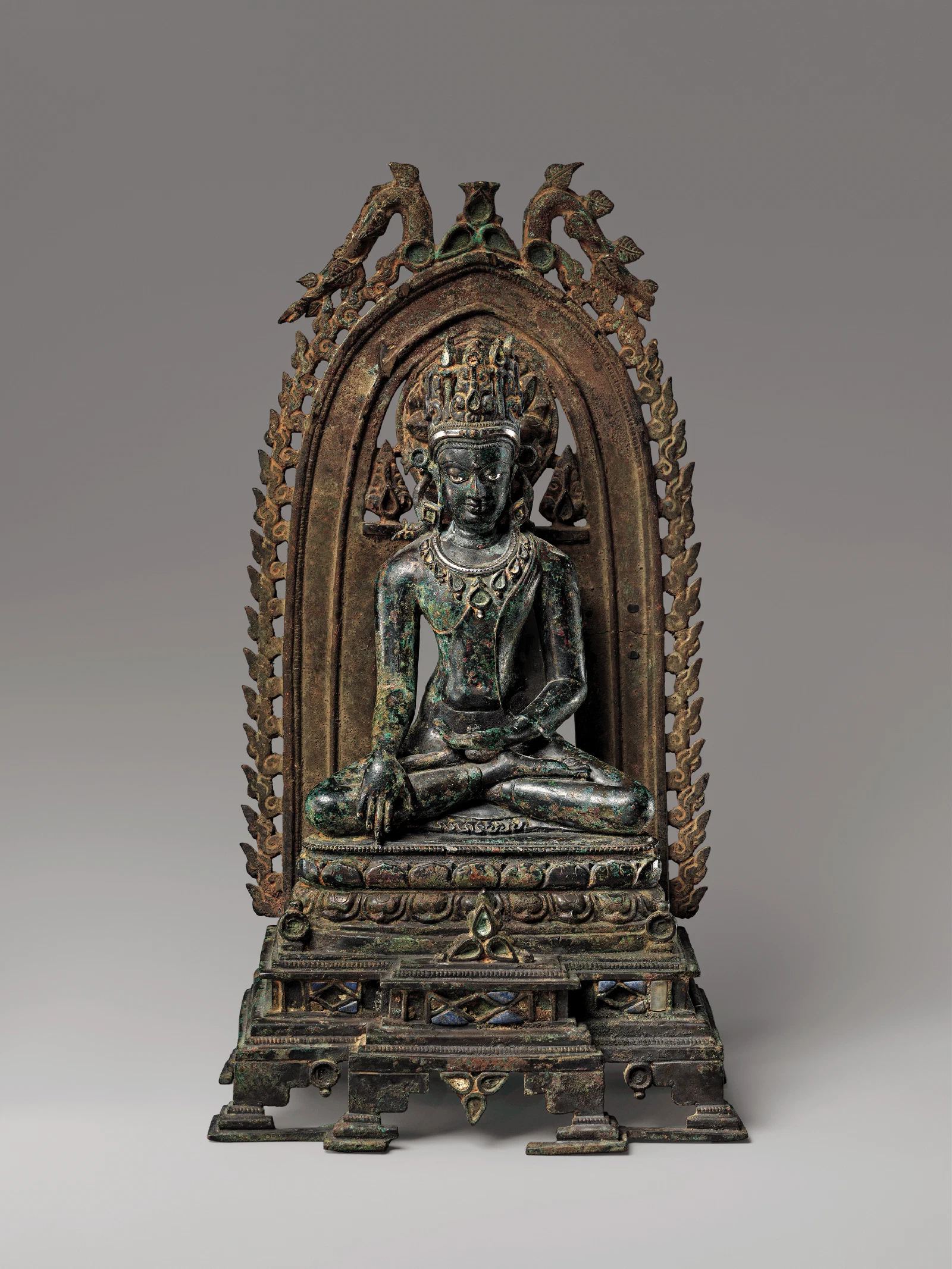
There is no single Buddhist Bible and no surviving complete canon from ancient India. Early Buddhism was divided into schools with their own recensions of discourses, monastic rules, and systematic analysis. The only early canon preserved complete in an Indian language is the Pali Tipitaka of the Theravada tradition, transmitted to Sri Lanka and written down there in the last centuries BCE after a long oral history.
Its “three baskets” are the Vinaya Pitaka, rules and origin stories for monastic discipline; the Sutta Pitaka, discourses, verses, narratives, and dialogues attributed to the Buddha and close disciples; and the Abhidhamma Pitaka, systematic analysis of experience and doctrine. The Sutta collection includes both compact works, such as the Dhammapada, and long, layered compilations. It does not present one philosophical system in textbook order. Repetition, stock formulas, and numbered lists are part of an oral technology built to keep teachings stable.
Other early schools survive in fragments, Sanskrit manuscripts, and translations. The Chinese Agamas preserve collections parallel to the Pali Nikayas, making comparison possible where the traditions diverge. Gandhari manuscripts from the northwest, written on birch bark, are among the oldest Buddhist manuscripts recovered anywhere. Much of what India lost physically survived because monks and translators carried it into Central Asia, China, Tibet, Sri Lanka, and Southeast Asia.
Beginning around the turn of the common era, Mahayana sutras presented themselves as further teachings of the Buddha. The Prajnaparamita literature makes emptiness central; the Lotus Sutra argues for one encompassing vehicle and the universal possibility of buddhahood; Pure Land texts center devotion to Amitabha; the Avatamsaka imagines reality as an infinitely interpenetrating field. Many were composed in Sanskrit, repeatedly translated, and became more influential outside India than within the subcontinent where they began.
Later Indian Buddhist universities generated philosophy of extraordinary technical range: Nagarjuna on emptiness and dependent arising; Asanga and Vasubandhu on mind and experience; Dignaga and Dharmakirti on logic and knowledge; Shantideva on the bodhisattva path. Tantric Buddhist texts and ritual systems then traveled with Indian teachers to Tibet and the Himalayas. Tibetan collections preserve translations of Indian works whose Sanskrit originals disappeared.
The Jain canons
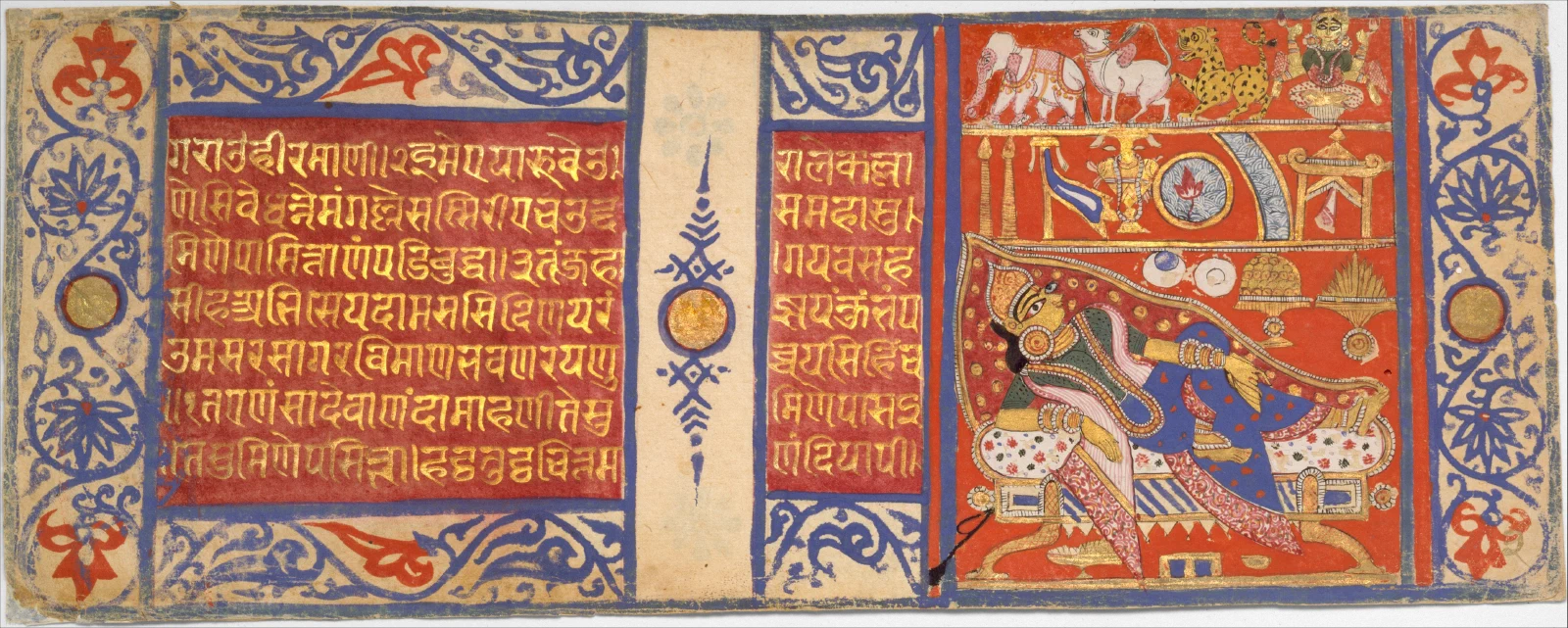
Jain textual history begins with a disagreement about loss. The Shvetambara tradition holds that teachings transmitted from Mahavira were collected and eventually fixed in a canon of Agamas, with the surviving recension associated with a council at Valabhi in the fifth or sixth century CE. The Digambara tradition holds that the original canon was lost much earlier and does not accept the Shvetambara Agamas as authentic.
That division produced different authoritative libraries. Shvetambara collections include monastic rules, doctrine, stories, cosmology, and conduct for laypeople in Ardhamagadhi and other Prakrits. The authority of the Digambara rests on early works, including the Shatkhandagama and Kasayapahuda, followed by a large commentarial tradition. Both orders read the Sanskrit Tattvartha Sutra, attributed to Umasvati or Umasvami, the closest Jainism has to a concise work of doctrine accepted across the principal sectarian boundary.
Jain authors wrote in Prakrit, Sanskrit, Apabhramsha, Kannada, Tamil, Gujarati, Hindi, and other languages. Their libraries cover logic, grammar, mathematics, medicine, narrative, cosmology, biography, and ethics as well as explicitly religious teaching. Because Jain monastic and merchant communities preserved manuscripts with unusual care, Jain libraries became repositories for non-Jain works that might otherwise have vanished.
The stories are part of the argument. Jain retellings of the Ramayana and Mahabharata relocate familiar heroes inside Jain cosmology, remove or morally transform divine violence, and deny that any tradition owns a narrative merely because its version became dominant. The Paumachariya makes Ravana a tragic Jain layman and has Lakshmana, not Rama, kill him. This is not a marginal parody. It is scripture interpreting scripture across a contested religious world.
Why these texts belong together here
Vedic authority is often used to define the boundary of “orthodox” Indian philosophy. Buddhist and Jain texts show how much Indian thought was produced outside that boundary and through argument against it. Brahmanical philosophers refined theories of language, logic, self, and knowledge in direct engagement with Buddhist and Jain opponents; the opponents did the same. Reading only the Vedas, Upanishads, and epics leaves half the debate inaudible.