
Ramayana
What it is. The story of Rama, prince of Ayodhya, exiled for fourteen years, whose wife Sita is abducted by the rakshasa king Ravana and recovered after a war. It is the more compact and emotionally direct of the two Sanskrit epics, and its retellings have spread widely across Asia.
Except that it isn’t one text. This is the thing to understand before anything else: there is no single Ramayana. There are hundreds, in Sanskrit, Tamil, Awadhi, Bengali, Telugu, Kannada, Thai, Khmer, Javanese, Malay, Tibetan, Lao, and Filipino, and they don’t agree, sometimes not on anything you’d think was essential.
A.K. Ramanujan’s 1991 essay “Three Hundred Ramayanas” is my preferred short introduction to this plurality, and it has its own instructive afterlife: it was removed from Delhi University’s history syllabus in 2011 after protests, which rather proves its point.
| Version | Language | Date | Notable difference |
|---|---|---|---|
| Valmiki | Sanskrit | c. 5th–4th c. BCE core | The base text. Books 1 and 7 are generally held to be later additions |
| Dasaratha Jataka | Pali | c. 4th c. BCE – 3rd c. CE | Buddhist. Rama and Sita are siblings; no abduction, no war |
| Paumachariya (Vimalasuri) | Prakrit | c. 1st–5th c. CE | Jain. Ravana, a noble Jain layman destroyed by his own passions; Lakshmana killed him, not Rama |
| Iramavataram (Kamban) | Tamil | 12th c. | Ravana is treated with real grandeur and pathos |
| Ramcharitmanas (Tulsidas) | Awadhi | 16th c. | Intensely devotional, presenting Rama’s divinity throughout. The version most familiar across much of North India |
| Ramakien | Thai | 18th c., earlier roots | Hanuman is a considerably more worldly figure |
| Reamker | Khmer | c. 16th–17th c., earlier roots | Sita’s ordeal and estrangement dominate the ending |
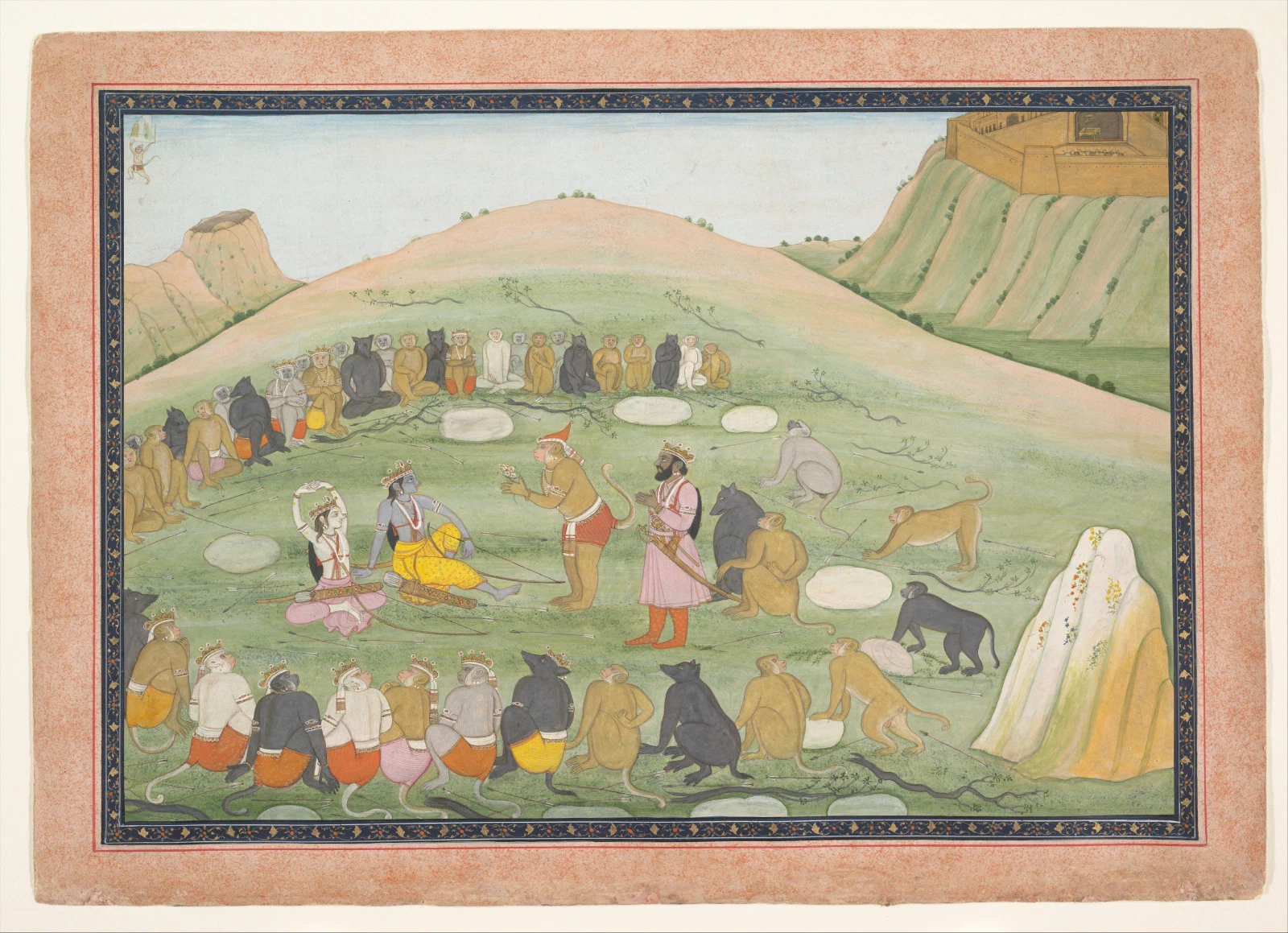
What’s it arguing about? Duty against desire; the cost of ideal kingship; and, increasingly for modern readers, the treatment of Sita. In the received Valmiki text, Sita enters the fire at the end of Book 6 after Rama repudiates her, and the fire god returns her as proof of her purity; Book 7, widely regarded as a later stratum, has Rama banish her while pregnant after hearing a subject’s gossip. These episodes do not appear in every Ramayana. Many tellings soften or omit them, some refuse them outright, and women’s folk-song traditions across India retell the story from Sita’s side.
Where it shows up now. Ramanand Sagar’s 1987 television serial drew tens of millions of viewers and helped define modern popular images of Rama, Sita, and devotional kingship. Periyar and the Dravidian movement inverted the story, reading Ravana as a southern king and Rama as a northern invader. And Ayodhya: the campaign over Rama’s claimed birthplace, the demolition of the Babri Masjid there in 1992, the Supreme Court’s 2019 decision awarding the disputed site for a temple while calling the demolition an egregious violation of the rule of law, and the temple consecrated in 2024. The dispute has been a central religious question in modern Indian politics.