
Astronomy
Indian astronomy began as a practical problem of time. Rituals had to happen on the right day, and the right day was defined by the moon, the sun, and the seasons at once, which do not divide evenly among themselves. Everything else followed from the arithmetic required to reconcile them.
The calendar problem
The earliest layer, jyotisha, is one of the auxiliary disciplines attached to the Vedas, and its job was scheduling. It tracked the moon’s passage through the nakshatras, a division of the sky into twenty-seven or twenty-eight segments marked by star groups. It worked out how to insert an extra month periodically so that a lunar reckoning would not drift out of step with the solar seasons.
That problem is not trivial. A lunar month is roughly 29.5 days, and a solar year is roughly 365.25 days, so twelve lunar months fall about eleven days short. Correcting this requires an intercalation rule, and getting it right requires long-term observation. The tradition also used a tithi, a lunar day defined by the angular separation between the sun and the moon rather than by sunrise, which does not correspond to a fixed number of hours and can be skipped or repeated. Anyone who has wondered why Indian festival dates move should note that this is the reason.
The siddhantas
From roughly the early centuries CE, a different kind of text appears: the siddhanta, a systematic astronomical treatise offering mathematical models for planetary motion, eclipse prediction, and calendrical computation. These were not commentaries on ritual. They were technical works whose parameters could be, and were, revised when they disagreed with observation.
Aryabhata’s Aryabhatiya (499 CE) is the pivotal text. In a few hundred compressed verses it gives a sine table, methods for computing planetary positions, an accurate value of π, and two claims worth pausing on: that the apparent daily rotation of the stars results from the earth’s own rotation, and that eclipses are caused by shadows, the moon entering the earth’s shadow and the moon’s shadow falling on the earth, rather than by the demon Rahu swallowing the luminaries. The second claim directly contradicted the mythological account and was made in a widely taught text.
Brahmagupta, writing in 628, criticized Aryabhata on several points, including the rotation of the earth, and supplied his own models along with the foundational arithmetic of zero. Later astronomers, Lalla, Bhaskara I, Bhaskara II, and the Kerala school under Madhava and his successors from the fourteenth century, continued to revise techniques and parameters. The Kerala mathematicians’ infinite series for trigonometric functions were developed partly because more accurate sine values made better astronomical tables.
None of this happened in isolation. Hellenistic astronomical material, including the zodiac and epicyclic models, entered Sanskrit texts in the early centuries CE, and some of these texts explicitly acknowledged their Greek origin. Persian and Arabic astronomical tables, instruments, and terminology circulated through Sultanate and Mughal courts, and Sanskrit and Islamic practitioners compared results without merging into a single school.
Jai Singh’s observatories
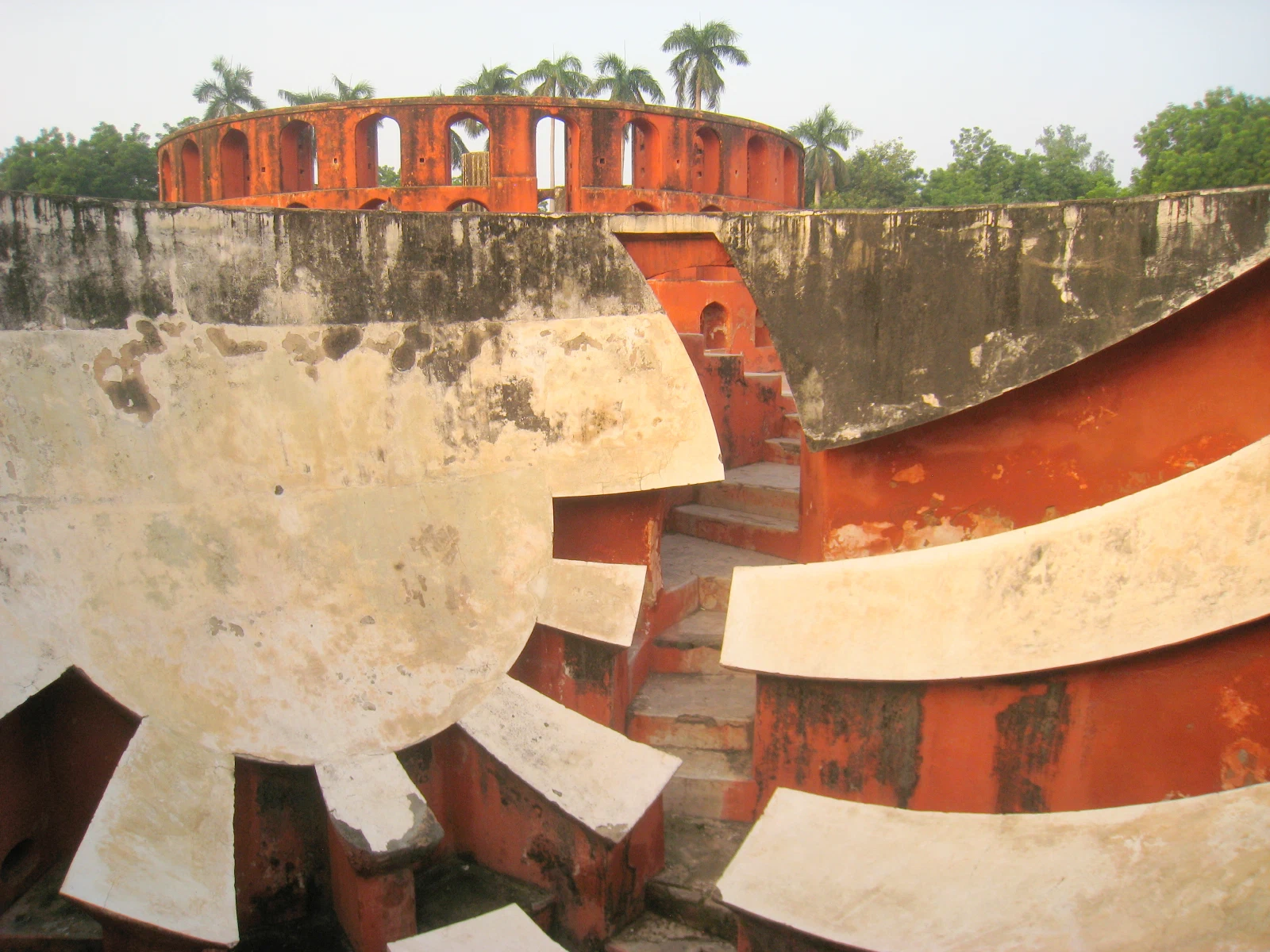
Sawai Jai Singh II, ruler of Amber and founder of Jaipur, built masonry observatories at Delhi, Jaipur, Ujjain, Mathura, and Varanasi in the early eighteenth century. The instruments are architecture: enormous sundials, graduated marble arcs, and hemispherical bowls sunk into the ground, built at that scale because a larger instrument divides its scale more finely and reads more precisely than a small brass one.
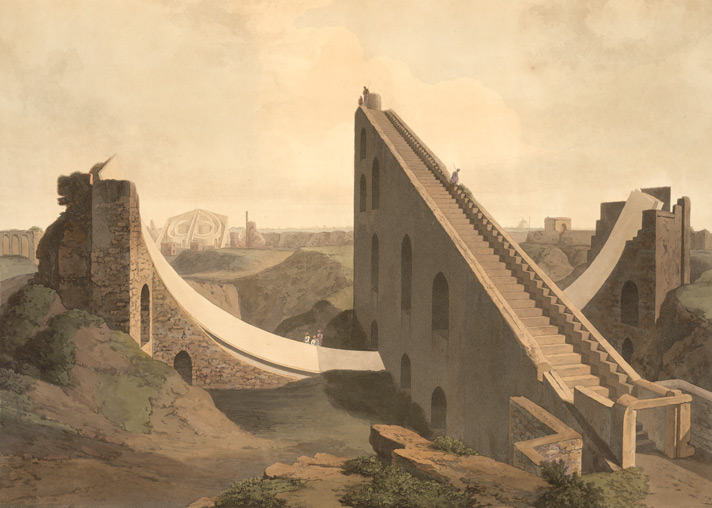
Jai Singh commissioned translations from Sanskrit, Persian, and European sources, sent for astronomical works from Europe, and had astronomers from several traditions compare their tables. The project was, in one sense, already behind: telescopic observation was transforming European astronomy while these instruments were being built, and Jai Singh knew of the telescope. In another sense, it was the most serious observational program anyone in the subcontinent had mounted, and Indian astronomers used the resulting tables for decades.
The most durable product of the whole tradition, though, is not a treatise or an observatory. It is the panchanga, the regional almanac that still coordinates lunar days, solar transitions, festivals, eclipses, and auspicious times, and is still published and consulted annually in every major Indian language.
The modern institutions
Modern astronomy in India arrived by a different route and initially served other ends. An observatory operated at Madras from the late eighteenth century, tied to longitude determination, navigation, and the survey of the subcontinent. Its work shifted toward solar physics with the establishment of the observatory at Kodaikanal at the end of the nineteenth century, chosen for its clear skies, where John Evershed identified the radial flow in sunspots now called the Evershed effect.
Independent India built out from there: optical telescopes at Kavalur in Tamil Nadu and, much later, at Hanle in Ladakh at high altitude in a cold desert, radio facilities including the Giant Metrewave Radio Telescope near Pune and the array at Gauribidanur, the research institutes at Bangalore, Pune, and Ahmedabad, and space-based instruments including the AstroSat observatory launched in 2015 and the Aditya-L1 solar mission launched in 2023. Indian institutions are also part of the international gravitational-wave collaboration, with a detector planned on Indian soil.
This is not an unbroken march from the Vedas to a spacecraft, and the nationalist version that presents it that way has to skip several centuries and a complete change in what counted as evidence. It is a sequence of distinct traditions, translations, borrowed instruments, institutional breaks, and revised standards.
Astrology, honestly
Astronomy and astrology in India share infrastructure, and pretending otherwise misrepresents how scholars organized and transmitted that knowledge. A table accurate enough to predict an eclipse also supplies the planetary positions for a horoscope. The same word, jyotisha, covers both computation and prediction, the same practitioners often did both, and courts patronized the work for both reasons.
That shared history does not make astrological claims about personality or fate empirically true. It does mean that the useful move is to separate the components rather than accept or reject the whole: the observational record, the mathematical models, the calendrical machinery, and the predictive claims about human affairs are four different things with four different evidential standards, and only the last one fails. Treating jyotisha as an indivisible block, whether to defend it or dismiss it, obscures a genuinely impressive computational tradition.
I have built a set of tools for working with the traditional system at ArsAstro, which is the much longer version of that exercise.