
The Indus Valley
The Indus civilization covered a larger area than contemporary Egypt and Mesopotamia combined, built some of the most carefully engineered cities of the Bronze Age, and left no identified monument to any ruler. It is one of several early civilizations whose writing remains undeciphered, and its surviving inscriptions are exceptionally short, so almost everything said about it is inferred from objects rather than from texts its people are known to have written.
Before the cities
The sequence begins long before the cities, at Mehrgarh on the Kachi plain in what is now Balochistan, where farming, herding, and settled village life are attested from around 7000 BCE. Wheat and barley, cattle, sheep, and goats, and eventually cotton, pottery, and copper working developed there over several thousand years. Mehrgarh also produced the earliest known evidence of drilled human teeth, which is a fact about Neolithic dentistry that few people are prepared for.
Village cultures spread across the Indus plains through the fourth millennium, and around 2600 BCE, they were rapidly reorganized, by archaeological standards, into cities.
The mature phase
Between roughly 2600 and 1900 BCE, more than a thousand settlements spread across the Indus basin and beyond it, from the Makran coast to the upper Ganga-Yamuna divide and south into Gujarat. Harappa, excavated first and giving the civilization its alternative name, and Mohenjo-daro in Sindh are the best known. Rakhigarhi in Haryana may be the largest of all. Dholavira in Kutch and Lothal in Gujarat, Kalibangan in Rajasthan, and Ganweriwala in Cholistan complete the picture of a network rather than a capital and its provinces.
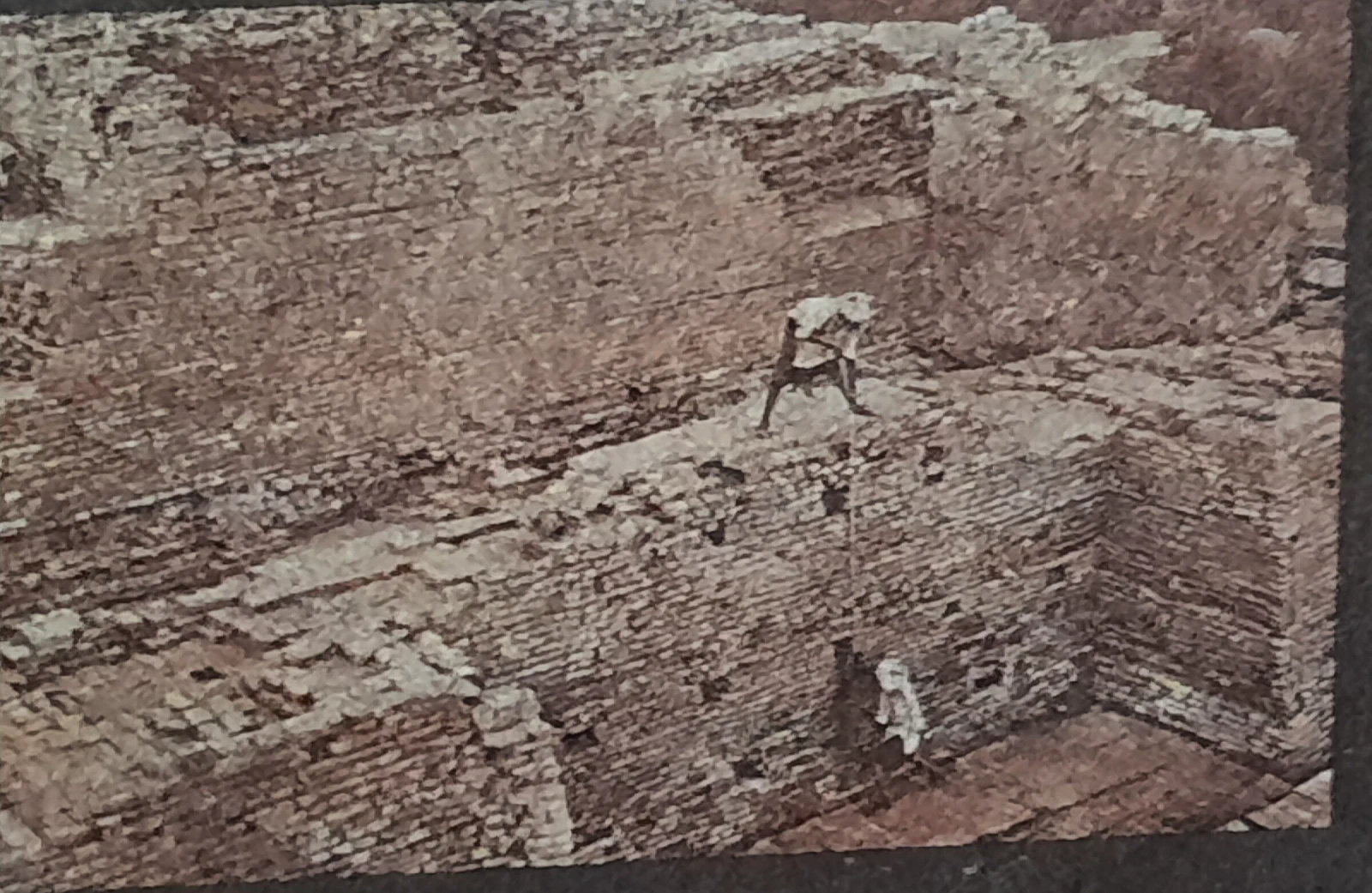
What is remarkable is the standardization. Cities were laid out on approximate grids with streets meeting at right angles. Baked bricks were made to a consistent proportion, roughly one to two to four, across sites hundreds of kilometers apart. Weights, cut from chert in a regular series, were standardized to a degree that implies inspection and enforcement. Drainage is the detail that most impresses visitors: covered brick sewers ran under the streets, individual houses had bathing platforms and latrines connected to them, and the whole arrangement is more comprehensively engineered than what most of the region had four thousand years later.
Mohenjo-daro’s Great Bath, a watertight brick tank with steps at both ends, is the largest structure of its kind, and its purpose is unknown; ritual bathing is the standard guess, and it is a guess. Dholavira had an elaborate system of reservoirs cut into rock, and a large signboard of inlaid signs that nobody can read.
The absence of kings
The negative evidence is the most interesting thing about the Indus cities. There are no palaces that can be identified as such, no monumental temples, no royal burials with grave goods marking a ruler, no depictions of a king receiving tribute, no triumphal art, and no clear evidence of an army or of large-scale warfare. At the same time, Egypt and Mesopotamia produced enormous quantities of exactly this material.
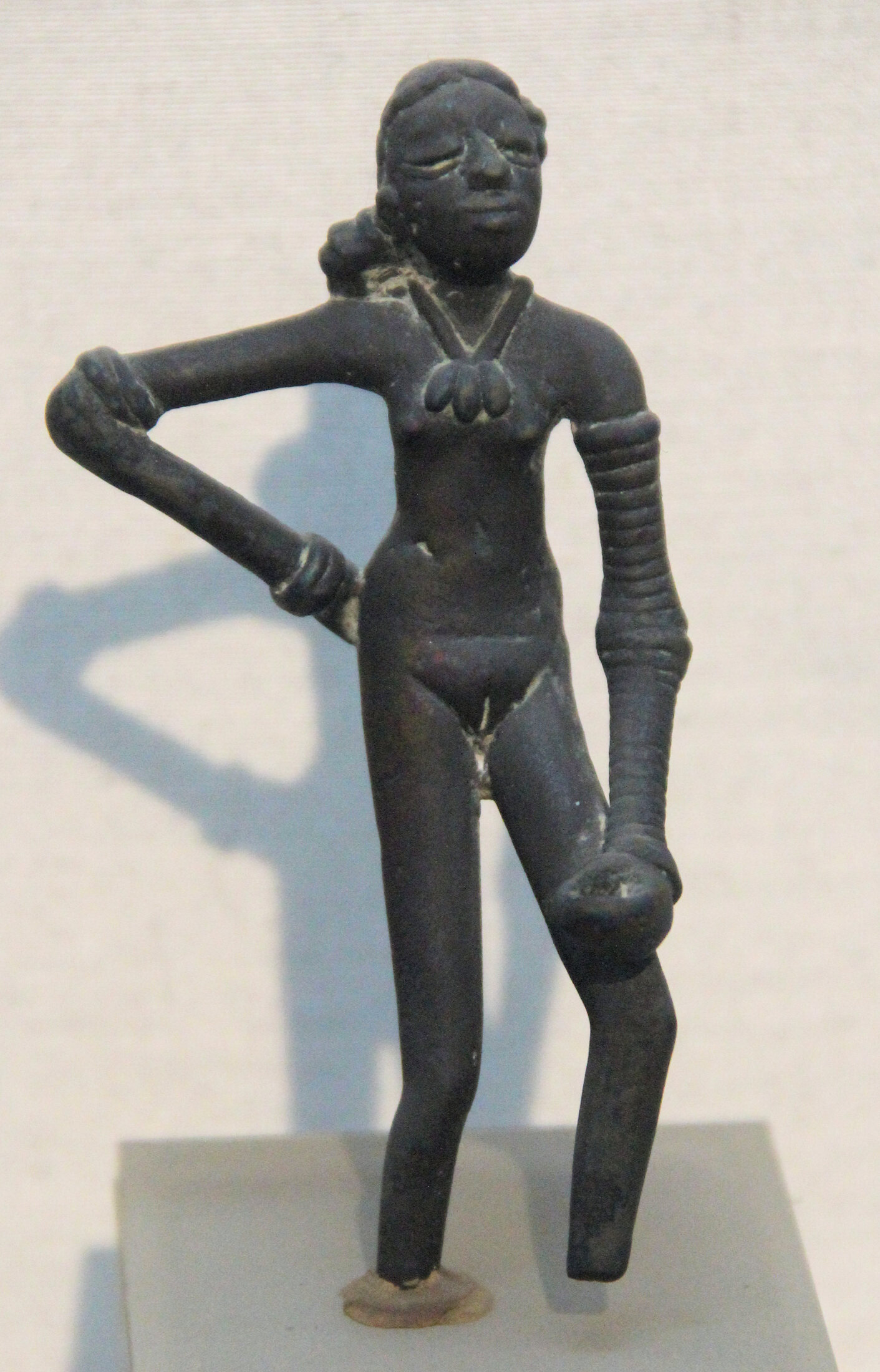
Something coordinated the standardization of bricks, weights, and city planning across a very large area, and whatever it was did not advertise itself as early states usually do. Proposals range from a priestly elite to a merchant oligarchy to a confederation of relatively egalitarian cities. All are speculation constrained by the same silence.
Burials, where found, are relatively modest and fairly uniform, which supports a less stratified reading, though comparing burial practices across cultures is notoriously unreliable for measuring inequality.
Seals, trade, and the script
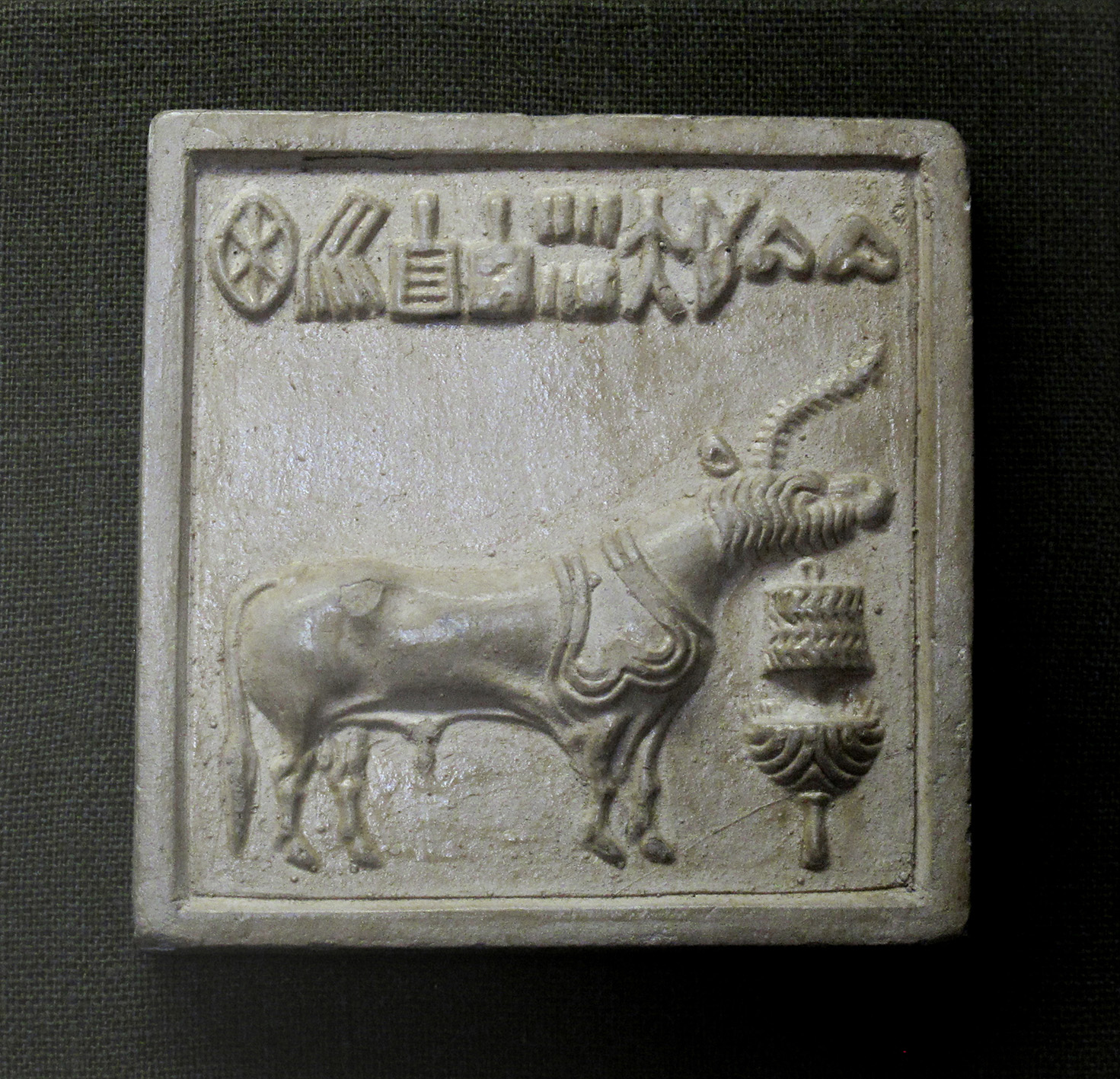
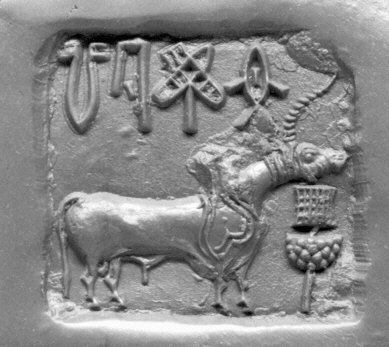
Thousands of small square steatite seals survive, carved with animals, most often a one-horned bovine creature usually called the unicorn, along with bulls, elephants, rhinoceroses, tigers, and occasional composite figures, and a line of signs.
One much-discussed seal shows a horned figure seated in what appears to be a yogic posture, surrounded by animals; it was named the “Pashupati” seal by its excavator after a form of Shiva, and that name has done a great deal of interpretive work it cannot support.
The seals were used in trade, and trade reached far. Indus goods, carnelian beads, shell, timber, and probably cotton, appear in Mesopotamia, and Mesopotamian texts refer to a trading partner called Meluhha, which most scholars identify with the Indus region. There was a settlement of Meluhhan traders in Mesopotamia. Lothal has a large brick basin generally interpreted as a dock.
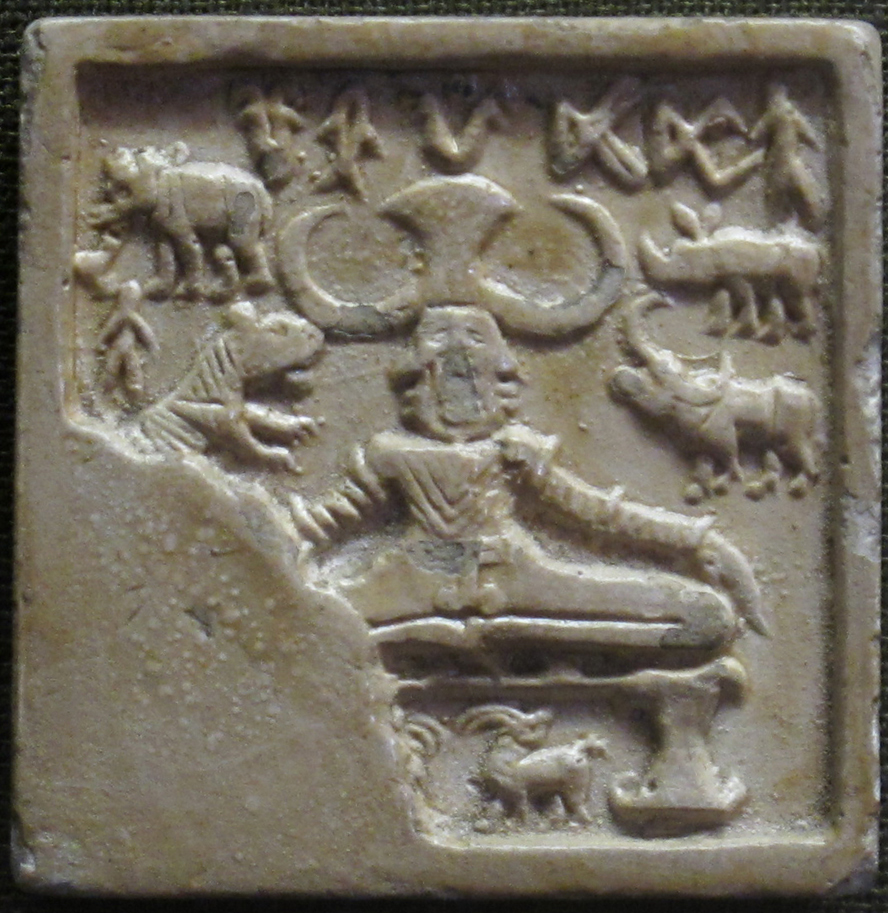
The script remains undeciphered, and the obstacles are structural rather than a matter of effort. There is no bilingual text of the kind that unlocked Egyptian and Old Persian. The corpus is enormous in number of objects but tiny in text: inscriptions average about five signs and rarely exceed twenty-six. The sign inventory, around four hundred to seven hundred, depending on how variants are counted, fits neither an alphabet nor a pure syllabary comfortably. And the underlying language is unknown, with Dravidian the most commonly proposed candidate, Indo-Aryan proposed by others, and a lost language family entirely possible.
A minority position holds that the signs are not writing at all but a non-linguistic system of symbols, comparable to heraldry or accounting marks. That argument has been contested vigorously. Anyone announcing a decipherment should be assumed wrong until the claim survives scrutiny, which none have so far.
In January 2025, the Tamil Nadu government offered a million-dollar prize to anyone who could crack it, which tells you both how open the question remains and how much identity is riding on the answer.
Decline
Contrary to previous writings, invaders did not destroy the cities. Mortimer Wheeler’s mid-twentieth-century reading of scattered skeletons at Mohenjo-daro as evidence of a massacre by invaders has been comprehensively dismantled; the remains are from different periods and show no consistent battle trauma.
What happened instead was a gradual deurbanization from around 1900 BCE. Cities were abandoned or shrank, standardization broke down, long-distance trade contracted, and the population dispersed into smaller settlements, shifting east and south. Writing fell out of use.
The likeliest drivers are environmental and economic. Palaeoclimate evidence indicates a weakening of monsoon rainfall over several centuries. The Ghaggar-Hakra river system, along which a very large number of sites lie and which some identify with the Sarasvati of the Rigveda, appears to have been fed by seasonal monsoon rain rather than by glacial meltwater and to have dried substantially. The collapse of Mesopotamian demand would have damaged the trade. None of these needs to be the sole cause; a diversified agricultural society can absorb a bad century, and probably could not absorb several compounding pressures at once.
The migration argument
This is where archaeology meets contemporary politics, and it is worth separating what is disputed from what is not.
Linguistics has long held that Indo-Aryan languages, including Sanskrit, belong to the Indo-European family and entered South Asia from outside, from a homeland most reconstructions place in the Pontic-Caspian steppe, with the closest relatives being the Iranian languages. The Vedic corpus reflects a pastoral, chariot-using, horse-centered society quite unlike the urban Indus material, and horses are conspicuously absent from Indus remains.
Genetics has since provided independent evidence, and two papers published in 2019 did most of the work. A study in Science, led by Vagheesh Narasimhan, analyzed 523 previously unsampled ancient individuals from across Central and South Asia; a study in Cell published the genome of a single individual buried at Rakhigarhi, a Harappan city. Read together with the linguistic and archaeological evidence, they support three conclusions.
The Rakhigarhi individual carries no detectable steppe-pastoralist ancestry, and none from the sampled Iranian farming populations that moved westward with agriculture; the genome instead combines a much earlier Iranian-related lineage with ancestry related to ancient South Asian hunter-gatherers. Steppe-pastoralist ancestry reached South Asia through Central Asian intermediaries during the second millennium BCE, after the mature cities had declined, at a time and in a distribution that fit the linguistic evidence for Indo-Aryan arriving from outside. And most present-day South Asian populations can be modeled as mixtures of Indus-periphery-related, steppe-related, and ancient South Asian hunter-gatherer-related ancestry, with the Indus-related contribution usually the largest of the modeled sources and the steppe contribution a minority showing evidence of male bias.
The caveats are real and worth stating: genetics cannot tell us whether any given stage of movement was peaceful, and one Rakhigarhi genome cannot represent every Harappan city.
The mainstream reading is therefore a migration rather than an invasion: movement of people, over generations, into a region that had already deurbanized, with cultural and linguistic consequences out of proportion to the numbers involved. The “Aryan invasion” framing, a nineteenth-century construction shaped by contemporary race theory, does not align with the evidence and is not supported by current scholarship.
An “Out of India” position, holding that Indo-European languages originated in the subcontinent and spread outward, is advanced by some writers but has not accounted for the linguistic or genetic evidence. The political stakes are obvious in both directions: one reading makes Vedic culture indigenous, another links the Indus to a Dravidian south displaced from the north, and in these debates, critics have never produced the archaeology or the genetics to settle a modern argument about who belongs.
The honest summary is that the Indus civilization was neither Vedic nor a mere precursor to anything. It was its own thing; it contributed to what followed in ways visible in agriculture, urban technique, and possibly ritual, and until someone reads the script, it will remain the most substantial silence in Indian history.