History

Beginnings, and what ancient DNA changed

The earliest hard evidence of civilization on the subcontinent comes from the Indus Valley: Mohenjo-daro, Harappa, Rakhigarhi, Dholavira, and some fifteen hundred other sites, flourishing between roughly 2600 and 1900 BCE. At its height, it covered close to a million square kilometers, contemporaneous with Egypt and Sumer and longer-lived than either. The cities show gridded streets, standardized brick, covered drainage, granaries, and public water tanks. The script, with some 5,000 inscriptions, remains undeciphered. In January 2025, the Tamil Nadu government offered a million-dollar prize to anyone who could crack it, which tells you both how open the question is and how much identity is riding on the answer.

What came after is the part where the old story was wrong, and where new evidence has made the correction unusually clear.

For most of the twentieth century, the standard account was the Aryan Invasion Theory: a wave of light-skinned Indo-European speakers conquering the subcontinent, displacing its darker inhabitants southward, and founding Indian civilization proper. This was constructed in the nineteenth century; it mapped suspiciously neatly onto the racial thinking of those who constructed it, and it is not what happened.

What did happen is now visible in the genetics. In 2019, a study in Science led by Vagheesh Narasimhan sequenced 523 previously unsampled ancient individuals from across Central and South Asia, the largest ancient-DNA study of the region ever done. In the same year, a study in Cell published the genome of an individual buried at Rakhigarhi, a Harappan city. Together, they show three things:

So: a migration, yes, and a linguistically consequential one. An invasion, a conquest, a racial replacement, or a founding, no. The largest single ancestral component of nearly everyone on the subcontinent today is the people who built the Indus cities. The Harappans are not the prologue to Indian history. They are most of its ancestry.

There is a counter-position, usually called Out of India, holding that Indo-European languages originated in the subcontinent and spread outward. It has real advocates and considerable political energy behind it. It also has to explain away the steppe ancestry, the absence of Indo-European substrate features anywhere along the supposed route out, the non-Indo-European substrate features in Sanskrit, and the Gandhara Grave Culture material in the Swat valley. It doesn’t, and I don’t think it can.

The Rigveda, composed in early Sanskrit by descendants of these arrivals and their neighbors, dates to roughly 1500–1200 BCE and is among the oldest surviving religious texts anywhere. Over the following centuries, social distinctions among Vedic communities hardened into the stratified structure that became caste. How that happened, and to what extent it continued earlier Indus-era social organization, are genuinely open questions. See Caste.

Two tracks, not one

The rest of this page runs two parallel narratives, because running only the northern one, as most textbooks do and as the earlier version of this page did, misrepresents about a quarter of the country.

By the sixth century BCE, the Gangetic plain had consolidated into the sixteen mahajanapadas, and iron, coinage, and cities appeared together. Magadha absorbed its rivals; its capital, Pataliputra, under the Nandas, was the richest city in India when Chandragupta Maurya took it around 321 BCE, five years after Alexander had marched through the northwest and turned back. Chandragupta, advised by Chanakya, whose Arthashastra remains one of the coldest-eyed works of statecraft ever written, built an empire reaching to Kabul. His grandson Ashoka extended it further, then, after the Kalinga war, renounced conquest and turned to Buddhism, a shift recorded in rock edicts across the subcontinent and in the lion capital at Sarnath, which independent India adopted as its national emblem.

At the same time, and largely independently, urban society was developing in the far south. Excavations at Keeladi, on the Vaigai near Madurai, have produced carbon dates reaching back to around the sixth century BCE, several centuries earlier than Tamil urbanism was previously placed, along with Tamil-Brahmi inscribed potsherds, brick structures, and industrial-scale evidence of weaving and bead-making. Roughly 20,000 artifacts have been recovered since 2014.

Keeladi is also, at the moment, a political fight. The excavation report for the first two seasons was submitted in 2023 and remains unpublished; the Archaeological Survey of India has asked for revisions on stratigraphy and dating methodology, the excavator has refused to make them, and the dispute has run for years between the Union government and Tamil Nadu, with the state treating the site as proof of Tamil antiquity and the Center treating the claims as premature. Both sides are doing archaeology and identity politics simultaneously. Worth knowing, when you read anything about it.

The Sangam poems, the oldest surviving Indian literature outside Sanskrit, belong to this world, as do the Cheras, Cholas, and Pandyas, and a maritime trade with the Roman Mediterranean substantial enough that the Periplus of the Erythraean Sea gives sailing directions to the pepper ports of Kerala, and that Roman gold coins turn up in Tamil Nadu in hoards.

Empires, and the long middle

The Mauryan empire dissolved within decades of Ashoka’s death. What followed was not decline so much as multiplicity: Indo-Greek kings in the northwest, Scythian and Parthian rulers after them, and then the Kushans, under whom the Gandhara school of Buddhist sculpture flourished, producing the Hellenistic drapery and modeled faces that give the Buddha his enduring visual form. That Greek inheritance came down from the Indo-Greek kingdoms, but the art itself dates to the Kushan period, from the first to the fourth centuries CE.

The Guptas reunified much of the north by the fourth century, over a period conventionally called a golden age: Kalidasa’s poetry, Aryabhata’s astronomy, the founding of Nalanda. Alchon Hun incursions from the late fifth century contributed to the Gupta collapse, along with fiscal strain and provincial fragmentation. The mathematics kept going after the dynasty didn’t. The decimal place-value system was in use across this period, and Brahmagupta, writing at Bhillamala in 628 CE, some eighty years after the Guptas were finished, gave zero its own arithmetic in the Brāhmasphuṭasiddhānta. The golden age is real; it just doesn’t end where the invoices stop.

The north split again into regional dynasties. The Deccan and the south, meanwhile, were not interludes between northern empires but continuous polities in their own right: Satavahanas, Pallavas, Chalukyas, Rashtrakutas. The Cholas dominated the southeast for roughly four centuries, built the Brihadeeswarar temple at Thanjavur, produced the bronze Nataraja, ran a sophisticated system of local village assemblies, and in about 1025 sent a naval expedition against Srivijaya in Sumatra, which was straightforwardly a military raid, whatever the more decorous accounts say. Indic religious and artistic influence had by then been spreading through Southeast Asia for centuries anyway, mostly through trade and Brahmin and Buddhist itinerancy, and its monuments (Angkor, Borobudur, Prambanan) are among the largest anywhere.

Sultanates, Mughals, and the Persianate world

From the twelfth century, Turkic and Afghan military elites moved into the north. Muhammad Ghori lost the first Battle of Tarain in 1191 and won the second in 1192, defeating Prithviraj Chauhan; the Delhi Sultanate followed, ruled in turn by the Mamluks, Khaljis, Tughlaqs, Sayyids, and Lodis. In 1526, Babur defeated the last Lodi at Panipat and founded the Mughal Empire.

The Mughals are usually described as ruling for three centuries. Nominally, that’s true, since the last emperor was deposed in 1857. Effectively, imperial power collapsed after Aurangzeb died in 1707, was gone as a military force after Plassey in 1757, and by 1803, the emperor was a British pensioner in his own palace.

Akbar consolidated through conquest and alliance, marrying into Rajput royalty, abolishing the tax on non-Muslims in 1564, and convening religious debates that his own clergy found alarming. His grandson Shah Jahan built the Taj Mahal. Shah Jahan’s son Aurangzeb reimposed the jizya in 1679 and ordered the destruction of several Hindu temples. That is the reign that most shapes how this whole period gets argued about today.

The current scholarly handling of this, and the one I find most convincing, comes from Richard Eaton, who went through the recorded cases of temple desecration under Indo-Muslim rule and found that they track political relationships rather than doctrine: temples patronized by rulers in rebellion or at war were targeted; temples in loyal territory were generally left alone, and sometimes received state patronage from the same rulers. That’s a materially different claim from either “religious fanaticism explains it” or “it didn’t happen,” and both of those are positions people hold loudly. Aurangzeb’s reign also strained the empire against the rising Marathas under Shivaji, and the Mughals never recovered.

If you read one book on the thousand years from the Ghaznavids to the East India Company, make it Eaton’s India in the Persianate Age, 1000–1765.

Company, Crown, and the end

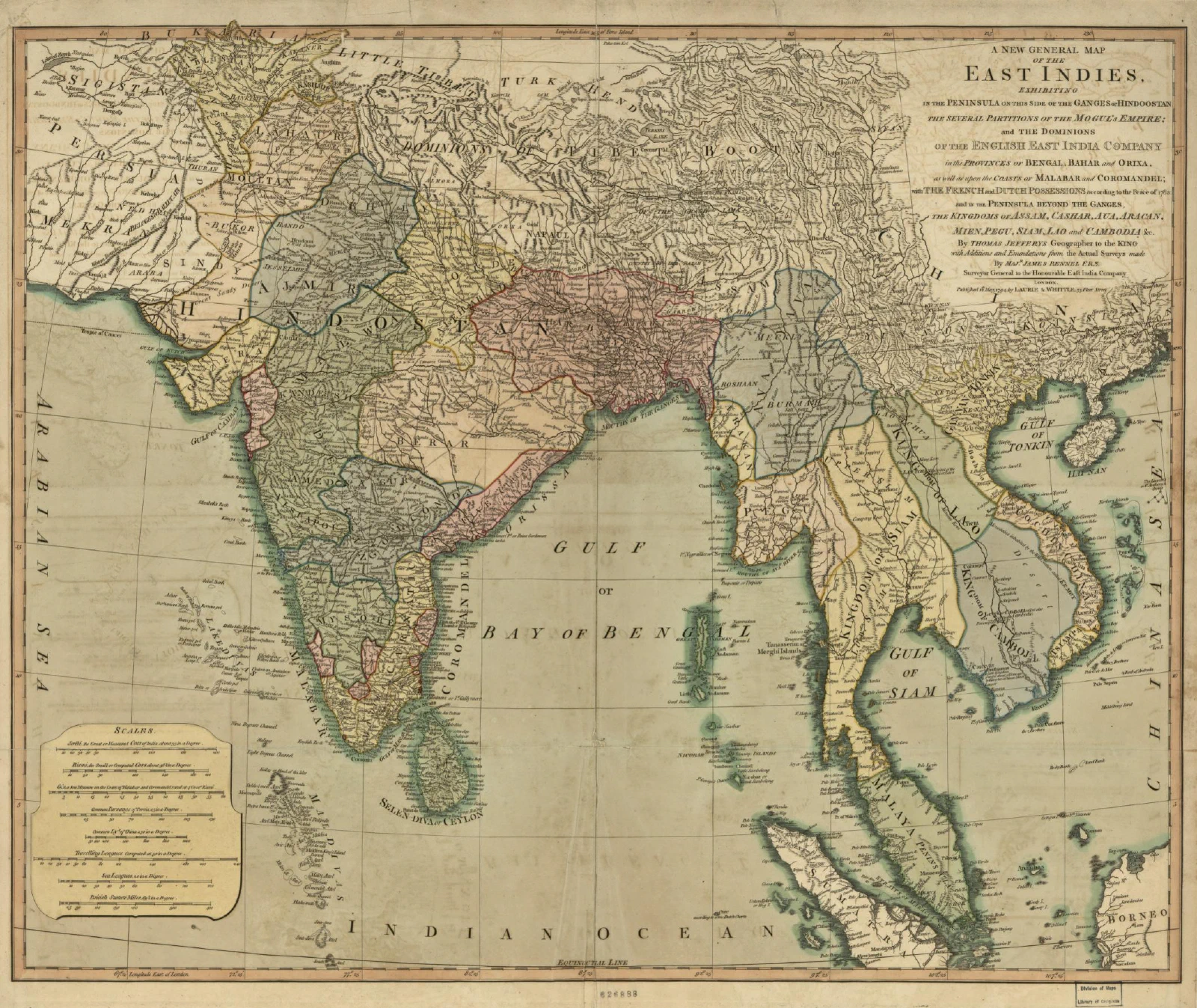
Portuguese, Dutch, French, and English trading companies established coastal footholds from the sixteenth century. The English East India Company, chartered in 1600, moved from trade to territorial power over the course of the eighteenth century.

It’s worth being precise about how, because the compressed version gets it wrong. Plassey in 1757 did not hand the Company Bengal’s revenues; it installed a client nawab and made the Company the kingmaker behind him. The revenues came eight years later. After Buxar in 1764, the Mughal emperor granted the Company the diwani of Bengal, Bihar, and Orissa in 1765: the legal right to collect and keep the tax revenue of the richest province in India, while nominally remaining the emperor’s revenue officer. A trading company acquired a treasury and a standing claim on thirty million people without ever formally becoming a state. Everything that follows runs on that money.

By 1818, the Marathas’ defeat made the Company the paramount power in India. The 1857 uprising, sparked by grievances across Indian society and ignited by the greased-cartridge rumor, ended with the Crown taking direct control in 1858, abolishing Mughal and Company rule in a single stroke.

The independence movement was built over six decades. The Indian National Congress was founded in 1885; the Jallianwala Bagh massacre in 1919 destroyed whatever remained of liberal faith in British intentions; Gandhi’s campaigns of non-violent non-cooperation, above all the 1930 Salt March, made the moral case impossible to answer and the administrative case increasingly expensive.

But the standard account, which credits non-violence alone, has been substantially revised. The Bengal famine of 1943, which killed around three million people under a wartime administration that kept exporting rice, destroyed the last of the Raj’s legitimacy. Subhas Chandra Bose’s Indian National Army, and the public trials of its officers at the Red Fort in 1945–46, demonstrated that Indian soldiers would fight against the British. The Royal Indian Navy mutiny of February 1946 spread across dozens of ships and shore establishments. The Raj relied on Indian troops and Indian clerks, and by 1946, the British could no longer be confident of either. A war-exhausted Britain, newly governed by Attlee, decided to leave, and then left faster than almost anyone wanted.

Independence came on 15 August 1947, together with Partition. Somewhere between ten and twenty million people moved; estimates of the dead range from 200,000 to a million. It remains one of the largest forced migrations in human history, and the border it drew is still one of the most militarized in the world.

Further reading: Vagheesh Narasimhan et al., “The formation of human populations in South and Central Asia,” Science (2019). Richard Eaton, India in the Persianate Age, 1000–1765 (2019). Ramachandra Guha, India After Gandhi (2007). Nayanjot Lahiri, Ashoka in Ancient India (2015). For the south specifically, Sanjay Subrahmanyam’s work on maritime trade, and Anirudh Kanisetti’s Lords of the Deccan (2022).