
The Republic
How India assembled a state after Independence, built a mass democracy, and continued to argue over citizenship, development, identity, and power.
India did not become a fully formed nation-state at midnight on August 1947. It became two dominions amid Partition, with borders still being drawn, several hundred princely states outside the former provinces, millions of refugees moving in both directions, war beginning in Kashmir, and a constitution still to be written. The republic was assembled while it was already operating.
Integration and the Constitution
Most princely rulers signed instruments of accession in 1947, surrendering defense, foreign affairs, and communications to the new Union. Vallabhbhai Patel and V.P. Menon managed the process through pressure, guarantees, negotiation, and, in Junagadh and Hyderabad, the threat or use of force. Jammu and Kashmir acceded after armed raiders entered from Pakistan; the first Indo-Pakistani war ended in 1949 with the former princely state divided and its final status unresolved.
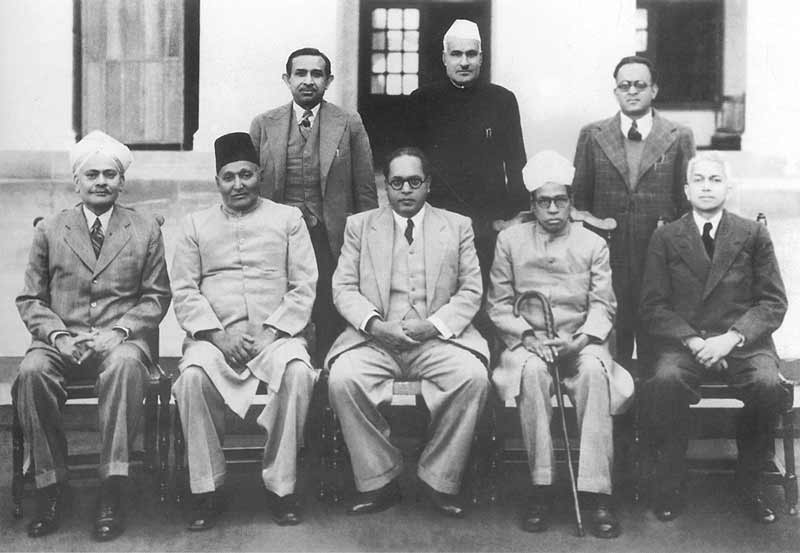
The Constituent Assembly, elected indirectly under the last colonial arrangements but containing most of the major currents of the freedom movement, met from December 1946 to November 1949. B.R. Ambedkar chaired the Drafting Committee. The Constitution came into force on 26 January 1950 and created an extraordinary combination: parliamentary government, a federal division of powers with a strong center, judicially enforceable fundamental rights, affirmative action, independent courts and election machinery, and universal adult suffrage from the first election.
It also carried compromises. Preventive detention survived the end of colonial rule. Property rights constrained early land reform until amendments narrowed them. Personal laws remained divided by religious community. Emergency provisions gave the Union powers that could overwhelm federal and individual rights. The Constitution abolished untouchability while leaving the social order that produced it to be transformed by politics, law, and time.
Nehru’s settlement
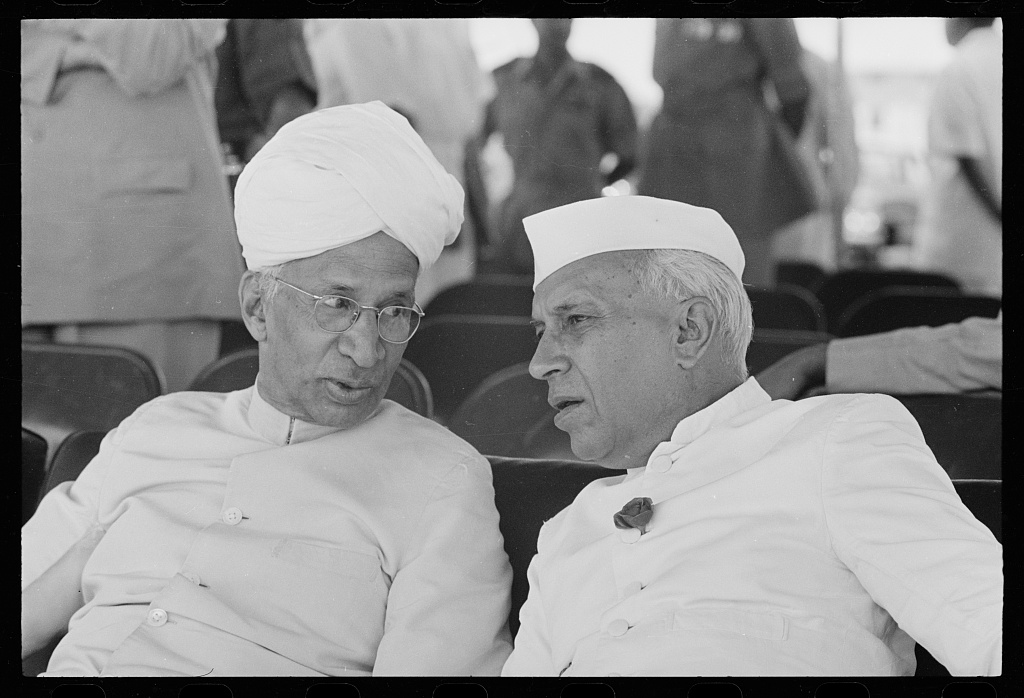
Jawaharlal Nehru served as Prime Minister from 1947 until he died in 1964. His governments established the institutional style of the early republic: regular elections, parliamentary debate, a professional civil service, an independent foreign policy, public investment in heavy industry and science, and a secular national identity that treated religious citizenship as equal in law even when practice fell short.
The economy was neither Soviet nor free-market. Private property and firms remained, but the state controlled commanding industries, foreign exchange, trade, infrastructure, and investment priorities through Five-Year Plans. Nehru’s government built steel plants, dams, laboratories, the atomic energy program, the Indian Institutes of Technology, and large public enterprises to make political independence tangible. The costs were bureaucracy, protectionism, weak competition, and insufficient attention to primary schooling, public health, and labor-intensive manufacturing.
The linguistic reorganization of states became the republic’s most successful concession to identity. After Potti Sriramulu’s death during a fast for a Telugu-speaking state, Andhra was created in 1953; the States Reorganization Act of 1956 redrew much of the map. Fears that linguistic states would break India proved largely unfounded. Giving durable identities a government of their own made the Union easier to inhabit.
Foreign policy centered on non-alignment, anticolonial solidarity, and strategic autonomy. It did not keep India out of war. Conflict with Pakistan began in Kashmir in 1947–48; the brief 1962 war with China ended in a humiliating Indian defeat and permanently changed defense policy. Nehru died two years later with the authority of his settlement damaged but its institutions intact.
Food, war, and centralization
Lal Bahadur Shastri succeeded Nehru, led India during the 1965 war with Pakistan, and died in 1966. Indira Gandhi then defeated the Congress organization that had expected to control her, split the party, abolished the princely privy purses, nationalized major banks, and concentrated authority around the Prime Minister’s Office.
The Green Revolution changed the material basis of the state. New wheat and rice varieties, irrigation, fertilizer, procurement prices, credit, and public distribution enabled India to shift from recurrent dependence on imported grain to self-sufficiency. It raised yields dramatically in Punjab, Haryana, and western Uttar Pradesh, and later in other regions. It also favored farmers with irrigated land, narrowed crop diversity, depleted soil and groundwater, and tied agriculture more tightly to state purchasing and subsidies.
In 1971, India intervened in the war that created Bangladesh after Pakistan’s army launched a brutal campaign in its eastern wing, and millions of refugees entered India. The military victory gave Indira Gandhi enormous authority. Economic distress, corruption protests, and a court ruling invalidating her election eroded it. On 25 June 1975, she declared a national Emergency.
For twenty-one months, the government suspended civil liberties, jailed opposition leaders, censored the press, and used constitutional amendments to protect executive power. Sanjay Gandhi’s influence drove coercive sterilization and slum-clearance campaigns that fell hardest on people experiencing poverty. The Emergency ended not through a coup or assassination but because Indira called an election in 1977 and lost it. The Janata coalition that replaced her fractured quickly, and she returned in 1980. Still, the vote established an essential fact: even a government that had turned off democracy could be removed through democracy.
The violent 1980s
The decade opened conflicts that the center could not simply sweep under the rug. In Punjab, militancy, factional politics, and the demand for greater autonomy culminated in Operation Blue Star, the army’s assault on armed militants inside the Golden Temple complex in June 1984. Sikh soldiers mutinied; Indira Gandhi’s Sikh bodyguards assassinated her in October; Congress politicians and organized mobs then participated in days of anti-Sikh killing, especially in Delhi. The state failed first to prevent the violence and then for decades to punish much of it.
Assam’s mass movement against undocumented immigration ended in the 1985 Assam Accord after years of agitation and the 1983 Nellie massacre. Insurgencies and counterinsurgency continued elsewhere in the Northeast. In Kashmir, a disputed 1987 state election helped destroy faith in electoral politics; armed insurgency expanded from 1989, followed by militancy, mass displacement of Kashmiri Pandits, and a heavily militarized response.
Rajiv Gandhi, Prime Minister after his mother’s assassination, won the largest parliamentary majority in Indian history and promised technological modernization. His government lowered some controls and expanded telecommunications, but the Bofors scandal damaged its reforming image. Its choices in the Shah Bano and Ayodhya disputes also showed a Congress government trying to manage religious constituencies through concessions that satisfied none of them. Rajiv lost power in 1989 and was assassinated by the LTTE during the 1991 election.
Mandal, Mandir, and markets
Three forces reorganized politics around 1990.
Mandal meant the decision by V.P. Singh’s government to implement reservations in central government employment for Other Backward Classes. Upper-caste student protests were intense, but the policy endured. It accelerated the rise of parties led by communities that had votes and local power but little representation in the upper state bureaucracy. After Mandal, politicians, journalists, and scholars could no longer explain national politics solely in terms of Congress, the Hindu-Muslim conflict, or class.
Mandir meant the movement led by the BJP and allied Hindu organizations to build a Ram temple at the site of the Babri Masjid in Ayodhya. Volunteers demolished the mosque on 6 December 1992 while senior leaders watched. Communal violence followed across the country. The campaign transformed the BJP from a marginal parliamentary party into a contender for national power.
Markets meant the 1991 economic reforms. With foreign-exchange reserves nearly exhausted, P.V. Narasimha Rao’s government and Finance Minister Manmohan Singh devalued the rupee, reduced trade barriers, removed much industrial licensing, and opened more of the economy to private and foreign investment. The reforms did not abolish the state; they changed what it tried to control. Growth accelerated, consumer markets expanded, and services and information technology flourished. Employment, public services, and regional equality did not automatically follow.
The coalition republic
From 1989 to 2014, no single party dominated every national election. Minority and coalition governments depended on regional parties rooted in Tamil Nadu, Andhra Pradesh, Uttar Pradesh, Bihar, West Bengal, Punjab, Maharashtra, and elsewhere. The period could look unstable from Delhi and from state representatives. Economic reform continued under governments of different ideologies because its broad direction had acquired political support even when individual privatizations or trade decisions did not.
The BJP first led a durable coalition under Atal Bihari Vajpayee from 1998 to 2004. India conducted nuclear tests in 1998, Pakistan answered, and the two countries fought the limited Kargil War the following year. Vajpayee combined Hindu-nationalist politics with coalition restraint, infrastructure building, and an unsuccessful but real attempt at peace with Pakistan.
The Congress-led United Progressive Alliance governed from 2004 to 2014 with Manmohan Singh as Prime Minister. Its first term paired rapid growth with a rights-based welfare architecture: the rural employment guarantee, the Right to Information, the Forest Rights Act, and, later, the Right to Education and food security legislation. Its second term was damaged by inflation, corruption allegations, administrative paralysis, and a mass anti-corruption movement that treated institutional reform as a moral uprising. A new party grew from that movement in Delhi; the larger national beneficiary was the BJP.
Modi and the return of the majority
Narendra Modi led the BJP to a parliamentary majority in 2014 and a larger one in 2019, the first single-party majorities since 1984. His government combined centralized executive authority, Hindu-nationalist politics, large welfare programs, infrastructure construction, and digital systems capable of operating at a continental scale. Bank accounts, Aadhaar-linked benefits, mobile connectivity, and the Unified Payments Interface changed how people interacted with both government and money.
The record also includes abrupt and costly exercises of power. Demonetization in 2016 invalidated most cash in circulation with little warning. The Goods and Services Tax created a national indirect-tax system but imposed a difficult transition on smaller firms. In 2019, Parliament removed Jammu and Kashmir’s statehood and special constitutional status, detained political leaders, and restricted communications. The Citizenship Amendment Act introduced a religious criterion for fast-tracked citizenship from three neighboring countries, prompting nationwide protests. The government repealed the 2020 farm laws after a year of sustained protests.
The COVID-19 lockdown in March 2020 stopped most activity with only hours of notice, sending millions of migrant workers toward their home villages without normal transport. India later manufactured and administered vaccines on an enormous scale, but the Delta wave in 2021 overwhelmed hospitals and crematoria. The two episodes displayed the same state at its most commanding and its most exposed.
The Ram temple at Ayodhya was consecrated in January 2024. In the general election that followed, the BJP remained the largest party but fell from 303 seats to 240, below the 272 required for a majority. Modi began a third term at the head of an NDA coalition dependent on regional allies. After a decade in which national politics appeared to be moving back toward one-party dominance, the electorate restored coalition government without removing the governing party.
What the republic settled, and what it did not
India has maintained electoral government across a scale and diversity that many observers in 1947 considered impossible. It integrated most princely states, reorganized internal borders repeatedly, survived assassinations and wars, reduced mass famine, built scientific and industrial capacity, and transferred power between parties through elections. Those are achievements, not background conditions.
The unresolved questions are just as old: whether citizenship is civic or religious; whether the Union can accommodate Kashmir and the Northeast without permanent coercion; whether caste remedies can dismantle caste power; whether growth can produce secure work and public goods; whether courts, media, election administration, and civil services can remain independent of an increasingly powerful executive; and whether states and cities have enough authority to solve problems the center cannot.
The Constitution did not answer these questions once. It created the arena in which they continue to be fought.