
Welfare & the Digital State
India does not have one welfare system. It has constitutional commitments, statutory entitlements, Union schemes, state programs, local institutions, courts, banks, contractors, and millions of workers who carry benefits the last mile. Some programs provide food or a service; some create a legal claim to work; others transfer cash or subsidize insurance. Their reach is vast, but a name in a database is never identical to food in a kitchen, work at a job site, or medicine in a hospital.
From relief to claims
The Constitution’s Directive Principles ask the state to secure livelihood, public assistance, nutrition, health, and education, but most are not individually enforceable in the same way as Fundamental Rights. Welfare expanded through politics and administration: the Public Distribution System, school feeding, social pensions, subsidized housing, rural works, public health services, and state-specific programs. From the 1990s, litigation over the right to food and campaigns for information, work, and education helped convert parts of that landscape into statutory claims.
A legal entitlement changes the citizen’s position. Officials are not merely offering charity; they owe something defined by law. But enforceability still depends on records, grievance systems, courts, political attention, and the ability to wait for a delayed payment. An entitlement can be universal within a category while the category itself remains narrow. It can also be generous on paper and rationed through budgets or administrative friction.
Grain, ration cards, and portability
The National Food Security Act, 2013, legally entitles up to 75 percent of the rural population and 50 percent of the urban population to coverage under the Targeted Public Distribution System. Antyodaya Anna Yojana households are entitled to 35 kilograms of grain per household each month; other priority households receive five kilograms per person. The Union procures and allocates grain, while states identify eligible households, issue cards, license fair-price shops, and run distribution and grievances.
Those national coverage ceilings were apportioned using 2011–12 consumption data and a population count tied to the 2011 Census. As the population grew, a fixed ceiling could leave new households outside even when their circumstances matched those already included. States may add beneficiaries or commodities at their own cost, so the ration basket and access rules differ.
The One Nation One Ration Card system allows an eligible household to draw its grain from an enabled shop outside the home state. It lets family members split a monthly entitlement between locations. That is especially important for circular migrants. Portability does not remove every barrier: a household must still be in the NFSA database, transaction systems must work, and a dealer must have grain. It solves the location of a recognized claim, not the prior question of recognition.
Work as a legal claim and a new law
The Mahatma Gandhi National Rural Employment Guarantee Act of 2005 made the state responsible for providing up to 100 days of unskilled manual work per rural household on demand, with an unemployment allowance when work was not provided within the statutory period. Its public muster rolls and social-audit provisions made records themselves a democratic instrument. The program funded roads, ponds, water conservation, and land improvements while providing rural workers with an income floor and, in some places, greater bargaining power.
That legal framework changed on 1 July 2026. The Viksit Bharat–Guarantee for Rozgar and Ajeevika Mission (Gramin) Act, 2025, usually shortened to VB–G RAM G, came into force nationwide and repealed MGNREGA. The new Act raises the statutory guarantee to 125 days per rural household. Existing verified job cards remain valid during the transition, and work open on 30 June was carried forward. Every state and Union Territory had notified its implementing scheme by July 2026.
Observers cannot yet judge the change by its outcomes. Increasing the number of guaranteed workdays matters only if officials provide work when people demand it, pay wages on time, honor claims for unemployment allowances, prepare local plans that create useful assets, and conduct audits to verify records. Current descriptions should therefore distinguish between what the new law promises and the evidence that will eventually show how it operates.
Food at school, care near home
India’s national school meal program began in 1995 as the National Programme of Nutritional Support to Primary Education. Following Supreme Court orders in the right-to-food case, cooked meals rather than dry grain became the norm. Now called PM POSHAN, the program links nutrition to attendance and learning in eligible government and government-aided schools. States choose menus and add resources, while cooks and helpers turn grain allocations into daily meals.
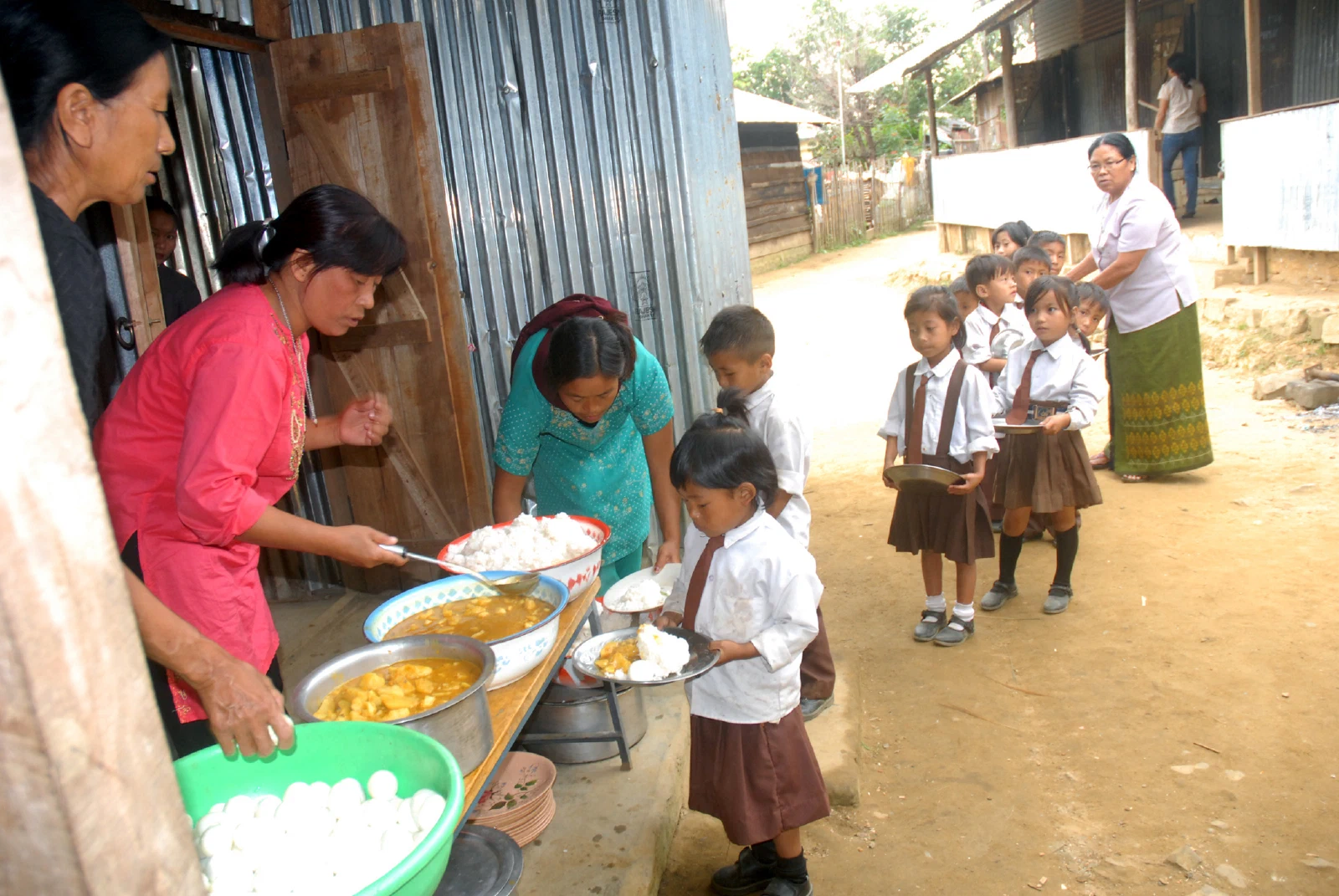
The Integrated Child Development Services network works through anganwadi centers, providing supplementary nutrition, a platform for preschool activities, growth monitoring, and links to health services for young children and pregnant or lactating women. Accredited social health activists, auxiliary nurse-midwives, anganwadi workers, and school cooks make public systems legible at the household level. Most of these cadres are women; several are officially treated as volunteer or honorarium workers rather than regular employees. The welfare state consequently relies on undervalued care labor to deliver its most human services.
The NFSA embeds nutritional entitlements for children and pregnant and lactating women, but nutrition alone is not enough. Clean water, sanitation, disease, dietary diversity, maternal health, discrimination at meals, and control over household food all affect whether calories become healthful. A food-security system can prevent hunger while still failing to provide an adequate diet.
Cash, insurance, and fragmented protection
Cash transfers are attractive because they can reach a bank account without moving a physical commodity. Union programs include social pensions for low-income older people, widows, and people with disabilities; PM-KISAN income support for eligible landholding farm families; maternity benefits; scholarships; and subsidies transferred after purchase. States add pensions, income support, transport concessions, food, health coverage, or cash for categories defined by age, occupation, caste, gender, disability, and income.
Publicly financed health insurance, especially Ayushman Bharat–Pradhan Mantri Jan Arogya Yojana and state schemes, can protect eligible households from some hospital costs. It does not replace primary care, public hospitals, outpatient medicines, prevention, or the income lost while ill. An insurance card is valuable only where an appropriate provider exists and will deliver the covered treatment without additional charges.
This is not a comprehensive system in which one institution ensures everyone against unemployment, illness, disability, and old age. Formal employees may receive provident fund and insurance protections tied to payroll work; informal and self-employed workers navigate separate schemes. Eligibility databases overlap without forming a guaranteed floor. A household can receive grain and cooking-gas support yet lack a pension, safe housing, or nearby health care.
Aadhaar, DBT, and the authentication gap
Direct Benefit Transfer began in selected districts in January 2013 to send subsidies and benefits to accounts and reduce duplicate or fictitious records. It grew alongside the Pradhan Mantri Jan Dhan Yojana expansion of bank accounts, mobile connectivity, and Aadhaar, a twelve-digit identity number based on demographic and biometric data. Parliament gave Aadhaar a statutory basis in 2016.
These are different layers often compressed into the word “digital.” Aadhaar can establish that a number corresponds to a person; authentication checks submitted data against the identity system. A scheme database decides whether that person is eligible. Account mapping decides where money is sent. A bank, cash point, or fair-price shop completes the transaction. Success at one layer does not prove success at the next.
The architecture can enable fast payments, detect duplicate entries, and allow a migrant to authenticate away from home. It can also fail because fingerprints are difficult to read, a name or date differs between records, a phone number changes, the wrong account is linked, a bank account becomes dormant, or connectivity disappears. The legally important question is what happens after failure. If an alternative identity process and a human grievance route work, technology is one channel. If authentication failure ends the claim, a delivery tool has silently become an eligibility condition.
In its 2018 Aadhaar judgment, the Supreme Court upheld the Act’s use of Aadhaar for subsidies, benefits, and services funded from the Consolidated Fund, while striking down Section 57’s provision that allowed private bodies to demand authentication merely through a contract. Later legislation and regulation continued to reshape permitted uses. The judgment did not declare that every Aadhaar-linked implementation was accurate or lawful; individual schemes still have to observe the Act, data-protection rules, and constitutional rights.
A state that can see and be seen
Digitization changes accountability in both directions. Transaction logs can reveal a ration shop that never opens, a delayed wage, or a payment sent to the wrong account. Public dashboards can make aggregate performance visible. Yet the claimant may not see the record that produced a rejection or know which agency can correct it. Centralized data can make the state’s decision more consistent while making the reasoning harder to contest.
Large linked datasets also reveal residence, work, payments, health, and household relationships. Collecting only what a program needs, limiting reuse, securing records, and allowing correction are therefore part of welfare delivery, not separate technical concerns. A person should not have to trade unnecessary surveillance for food or a pension.
The strongest public systems combine administrative capacity with fallbacks and opportunities for contestation. They provide offline procedures when networks fail, issue dated receipts, disclose information proactively, conduct social audits, allow independent review, and empower officials to correct mistakes. Portability matters, but so does giving people a place to be heard. The digital state is most legitimate when it helps rights travel without allowing responsibility to disappear.