
Society & State
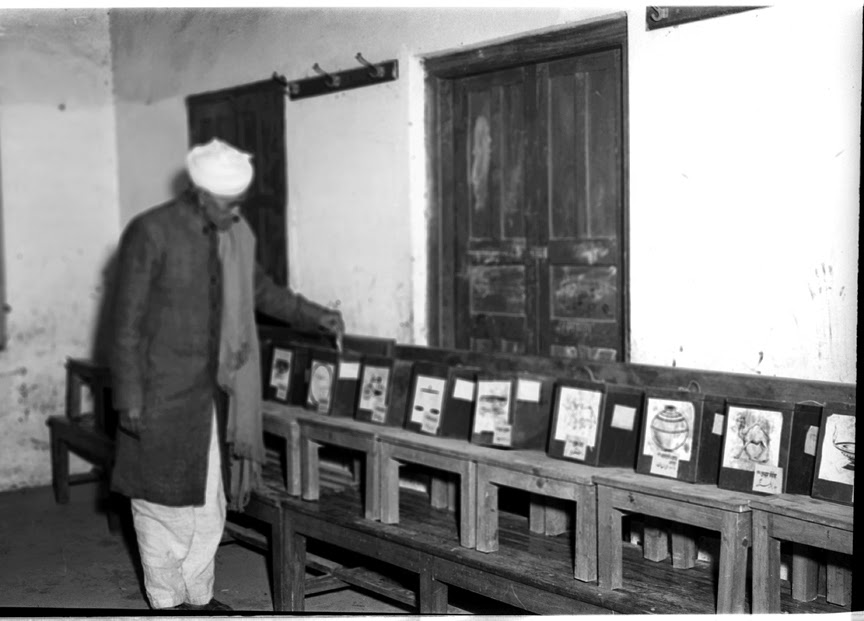
India began universal adult suffrage before it was rich, broadly literate, or administratively ready for it. The first general election, held over four months in 1951–52, asked a mostly poor electorate to choose among thousands of candidates using a new roll, paper ballots, and symbols designed for voters who could not read. That decision was not the inevitable last step of the independence movement. It was a wager, and it established the scale on which every later argument about the republic takes place.
A Union of States
The Constitution calls India a Union of States. It creates a parliamentary republic: a President as constitutional head of state, a Prime Minister and Council of Ministers responsible to the elected Lok Sabha, a second chamber representing the states, and an independent judiciary empowered to review legislation and executive action. Power is divided among the Union, the States, and the Concurrent lists, but the center is stronger than in many federations and can reorganize state boundaries through ordinary legislation.
The arrangement is federal, but not symmetrical. Some border and tribal regions have special constitutional structures; Delhi and other Union Territories are under different forms of central control; and the balance between governors, state ministries, Parliament, and the courts is continually debated. Municipalities and village panchayats received constitutional status only in the 1990s and remain heavily dependent on state governments for money and authority. Constitution and federalism follow how the written division becomes a negotiated political system.
India’s federalism works partly because linguistic demands were eventually accommodated rather than suppressed. The reorganization of states beginning in 1956 allowed political boundaries to bend around durable linguistic identities. It did not settle every boundary or autonomy dispute. Still, it made being Tamil, Marathi, Telugu, or Gujarati compatible with competing for power inside the Union rather than only against it.
Democracy and parties
For its first two decades, the Congress system incorporated factions broad enough to serve as both government and opposition. That dominance weakened after the 1960s and broke nationally in 1977, when voters removed Indira Gandhi after the Emergency. Regional parties became permanent national actors. Coalition governments dominated from 1989 to 2014; the Bharatiya Janata Party then won two consecutive parliamentary majorities under Narendra Modi before falling short of one in 2024 and forming a third government with its National Democratic Alliance partners.
Elections are intensely competitive, turnout is high, and governments lose. Those facts coexist with pressure on institutions, unequal campaign resources, criminality in politics, political control of police, defections, restrictions on dissent, and a media system whose independence varies enormously by language, owner, and market. Indian democracy is neither an empty ritual nor a finished achievement. It is a real mechanism operating under real strain.
The administrative state
The republic inherited the colonial civil service, district administration, police, criminal law, and habit of governing through files. It repurposed that machinery for development: dams, steel plants, universities, agricultural extension, public distribution, elections, censuses, and affirmative action. The state can conduct a national election involving hundreds of millions of people and still fail to staff a local clinic. Capacity is strong in some functions, regions, and departments, and startlingly thin in others.
The welfare state has expanded through subsidized food, rural employment guarantees, school meals, pensions, housing, cooking gas, health insurance, and direct cash transfers. Aadhaar, bank accounts, mobile phones, and digital payment infrastructure made benefits easier to deliver at a national scale while creating new problems of exclusion, surveillance, authentication failure, and dependence on centralized systems. The older state asked for a ration card and a stamped form; the newer one often asks for a biometric match. Both can fail at the last mile. Welfare and the digital state traces the entitlement from law and database to school, ration shop, worksite, and bank account.
Economy and work
After Independence, India built a mixed economy around planning, public-sector heavy industry, import controls, and private firms operating behind protection. The strategy created industrial and scientific capacity but also led to shortages, licensing requirements, and slow growth. Agricultural research, irrigation, fertilizer, procurement, and credit drove the Green Revolution from the mid-1960s onward, making the country far less dependent on imported grain while concentrating benefits and environmental costs on particular crops and regions.
The 1991 balance-of-payments crisis forced a break: tariffs fell, licensing receded, foreign investment increased, and private services expanded. Information technology and business services made Bengaluru, Hyderabad, Pune, Gurgaon, and other cities part of a global labor market. Manufacturing grew less dramatically than reformers expected. Agriculture still supports far more people than its share of national income would suggest, and most workers remain outside stable salaried employment with formal contracts or social insurance.
The headline is not simply growth but unevenness. Southern and western states generally built stronger health, education, and industrial systems than much of the northern and central belt, though no regional rule is complete. A globally connected technical class, a large domestic middle class, precarious urban workers, small farmers, and people dependent on public transfers all inhabit the same economy and experience it differently. Economy and work examines the distance between growth and a secure job.
Education, health, and hierarchy
Literacy and school enrollment rose enormously after Independence, but school quality, language of instruction, caste and gender discrimination, and the race for private credentials remain unsettled. Elite public institutes coexist with underfunded local schools. Coaching has become a parallel education system because a small number of examination ranks control access to scarce university places and government jobs.
Health follows a similar pattern. India produces doctors, medicines, and vaccines on a global scale, while many households still rely on expensive private care for everyday illnesses. Sanitation, nutrition, air, water, and working conditions often matter more to health than the hospital system, which is one reason economic growth alone has not erased large differences in life chances.
Caste is the most elaborately institutionalized hierarchy, but it interacts with class, religion, region, tribe, and gender rather than replacing them. The Constitution established formal equality and affirmative action; social life still transmits advantage through marriage, property, schooling, language, neighborhood, and personal networks. India can change rapidly in public while remaining conservative within the family.
More than 700 people-groups are grouped under the state-specific legal category Scheduled Tribe, but they share neither a single language, religion, nor political history. The history of Adivasi India is held together less by a common culture than by recurring struggles over land, forest, autonomy, development, and the gap between constitutional protection and its enforcement.
Family and gender
The household is a welfare institution, workplace, care system, and structure of authority. Marriage remains overwhelmingly within caste and community, even as education, cities, migration, and personal choice put pressure on those boundaries. Women’s access to schooling, political office, property, paid work, and public space has expanded, but violence, unpaid care, unequal nutrition, and restrictions on mobility continue to shape ordinary life. Personal laws make family questions inseparable from religion and state policy.
India has also recognized categories that the older law tried to suppress. The Supreme Court recognized transgender people as a third gender in 2014 and decriminalized consensual same-sex relations in 2018. Formal recognition does not settle employment, family, housing, or safety, but it changes what can be demanded from the state.
A public sphere in many languages
There is no single Indian public conversation. Hindi and English national media overlap with large and politically distinct Bengali, Tamil, Telugu, Malayalam, Marathi, Kannada, Urdu, and other spheres. Cinema, television, newspapers, WhatsApp, YouTube, and short-video platforms carry different mixtures of reporting, entertainment, religious instruction, propaganda, and rumor. A claim can dominate one language’s public life while barely registering in another.
That fragmentation can deepen polarization, but it also prevents any one metropolitan elite from owning the national conversation completely. India is held together not by everyone hearing the same argument, but by institutions that force different arguments to meet.
-
Adivasi India
Hundreds of peoples grouped under one legal category, and the recurring fight over land, forest, autonomy, and development.
-
Constitution & Federalism
A parliamentary republic with a strong Union, powerful states, unequal federal arrangements, and a Constitution that changes through politics as well as amendment.
-
Economy & Work
Planning and liberalization, farms and software, formal firms and household workshops—and why growth does not answer the question of who gets a secure job.
-
Welfare & the Digital State
Food, school meals, employment, pensions, cash transfers, and the databases that can make an entitlement portable—or make a claimant disappear.