
Economy & Work
India’s economy is often narrated as a clean turn from socialist planning to capitalist reform. The actual economy kept both. Public banks finance private firms; state governments compete for investment while controlling land and electricity; food prices depend on public procurement; global software companies coexist with household production; and a person may move between farming, construction, street trade, and salaried work in the same year. The central question is not whether India has grown. This is why rapid growth has produced far fewer secure jobs than the size of its workforce requires.
What the numbers hide
Gross domestic product measures paid production, not security, bargaining power, unpaid care, or the quality of a job. A self-employed farmer, an unpaid relative helping in a shop, a delivery rider, a government teacher, and a software engineer all count as employed, though their risk exposure is radically different. Official labor surveys must choose a reference period and decide whether intermittent or subsidiary work counts as work. Those definitions are necessary, but a rising employment rate does not automatically translate into a rise in stable employment.
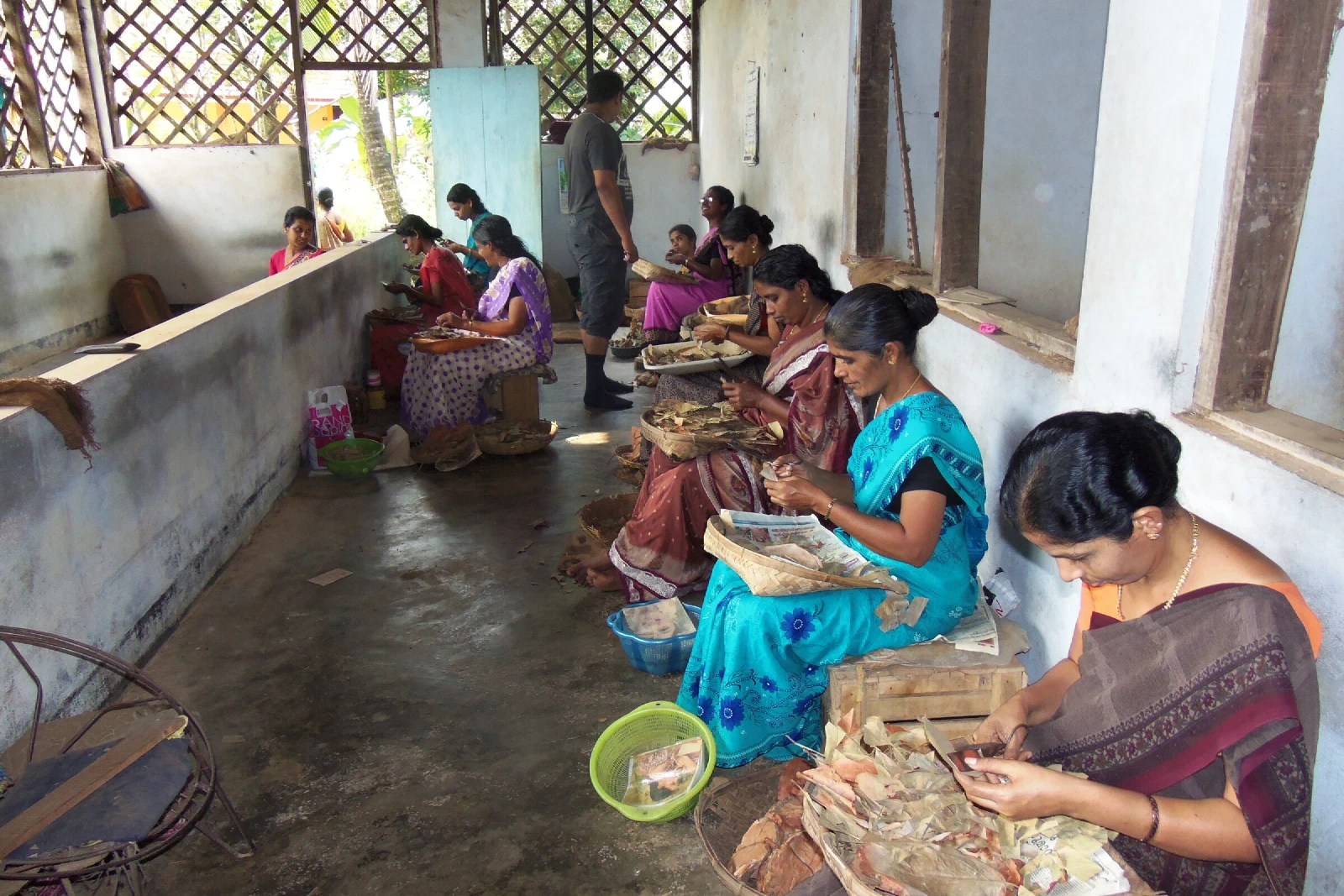
The same caution applies to the phrase informal economy. It can describe an unregistered enterprise, a worker without a contract or social insurance, production inside a household, or employment inside a formal company arranged through a contractor. Informal does not mean marginal or illegal. It describes how much of the economy actually operates: through small firms, family labor, piece rates, seasonal movement, and personal credit, often linked directly to large registered businesses.
Planning a mixed economy
Independence left India with railways, ports, textile and jute industries, a few large business houses, and very little capital equipment, electricity, or modern infrastructure relative to its population. The postcolonial state chose a mixed economy. Five-Year Plans directed investment; public enterprises entered steel, heavy machinery, energy, mining, telecommunications, aviation, and banking; tariffs and import controls protected domestic production; and industrial licenses decided which large firms could expand and where.
The strategy did not simply imitate the Soviet Union. India retained private property and large private firms, avoided agricultural collectivization, and operated within the constraints of electoral politics. Through planning, the state built technical institutes, laboratories, dams, power generation facilities, and industrial capacity that the private sector could not have financed at scale. At the same time, it entrenched discretionary licensing, protected inefficient producers, restricted imports of both consumer and capital goods, and turned scarcity into a routine administrative problem.
Agriculture followed a different path. States implemented land reform unevenly, and many landlords found ways to evade it, but the reforms nevertheless changed tenancy and formally abolished zamindari intermediaries. Beginning in the mid-1960s, the Green Revolution combined high-yield seeds, irrigation, fertilizer, public credit, minimum support prices, and state procurement to transform agricultural production. It ended India’s dependence on emergency grain imports. Still, it concentrated its earliest gains in irrigated wheat and rice regions and later locked procurement, water use, and agricultural politics around those crops.
1991, before and after
By 1991, high fiscal deficits, external borrowing, an oil-price shock, and dwindling foreign-exchange reserves produced a balance-of-payments crisis. The government devalued the rupee, reduced tariffs and import licensing requirements, opened more sectors to foreign investment, and dismantled much of the industrial licensing regime. The change was real. Indian firms faced more competition and gained access to imported technology; private investment expanded in telecommunications, automobiles, aviation, finance, and infrastructure; and global trade became a much larger part of the economy.
But liberalization was neither a single event nor the disappearance of government. Public banks, state-owned firms, agricultural procurement, administered prices, subsidies, and public infrastructure remained central. Later governments of different parties continued reform while also building new welfare systems. The Goods and Services Tax in 2017 created a more unified indirect tax system; in 2016, the government withdrew legal tender status from the existing ₹500 and ₹1,000 notes, which accounted for about 86 percent of currency by value. Both changes were felt most immediately by small firms and cash-dependent workers, which is where macroeconomic policy encounters ordinary transactions.
India’s most visible post-reform success came in information technology and business services. English-language higher education, a time-zone advantage, telecommunications, and diasporic networks made Bengaluru, Hyderabad, Pune, Chennai, Gurgaon, and Noida nodes in global production. Pharmaceuticals, automobiles, refining, and specialized manufacturing also became internationally competitive. Yet services are not one sector: a software exporter and a street vendor appear under the same broad heading while operating in different economies.
Farms, factories, construction, and services
Agriculture’s share of output has fallen far below its share of employment. That gap is the core of structural transformation: workers must either become more productive in agriculture or move into more productive non-farm work. India has done both, but unevenly. Construction absorbed large numbers of migrant workers because it requires limited formal credentials and follows investment geographically. Manufacturing grew, but not enough in labor-intensive, large-scale production to reproduce the employment transitions seen in several East Asian economies.
Migration is often circular rather than permanent. A worker may leave a village for a construction site, factory, restaurant, mine, or household job, return for planting or a festival, and keep land or family ties as insurance. Census categories and urban residence rules poorly capture that movement. The cities and migration page follows what this does to housing and municipal government; the diaspora page follows the longer journeys abroad.
Women expose the limits of the labor statistics most clearly. Women’s schooling has risen, and fertility has fallen, yet paid employment remains constrained by safety, transport, household care, social respectability, occupational segregation, and a shortage of acceptable local jobs. Surveys have recently recorded more women working, especially in rural areas, but much of the increase is in self-employment and unpaid work in household enterprises. Counting that labor is better than making it disappear. It is not the same thing as economic independence.
Several regional economies
There is no national development sequence through which every state is progressing at different speeds. Tamil Nadu combined manufacturing, urbanization, and broad welfare provision. Kerala paired high social development with migration and remittances while generating fewer industrial jobs at home. Gujarat and Maharashtra built dense industrial and commercial corridors; Karnataka and Telangana became major technology centers. Punjab and Haryana’s Green Revolution model produced high farm incomes but later led to ecological stress. Parts of Bihar, Uttar Pradesh, Jharkhand, Odisha, Madhya Pradesh, and the Northeast follow different combinations of agrarian pressure, mining, public employment, remittances, and outward migration.
These are tendencies, not rankings. Prosperous states contain precarious workers and poor districts; lower-income states contain productive cities and industrial clusters. State capacity, caste and land relations, ports, power supply, education, public health, women’s mobility, and historical investment all shape what kind of growth becomes possible.
The unresolved problem is achieving employment that balances productivity, security, and mobility. A job can raise output while leaving a worker one illness away from debt. Social protection can reduce risk without creating a path to better work. Growth can finance education and infrastructure while also widening regional and class differences. India’s economic argument is therefore not against the state. It is about which institutions create broad enough growth to change the bargaining position of the people doing the work.