
Bhakti, Sufi & Sikh Poetry
Between the early medieval period and the eighteenth century, poets composed and performers sang religious poetry in nearly every major language of the subcontinent. They carried it through temples, shrines, streets, fields, courts, workshops, and congregations. Brahmins and rulers, women and artisans, leatherworkers and weavers, Muslims devoted to Hindu gods, and Hindus drawn to Sufi teachers all contributed to this tradition. However, later communities often claimed ambiguous figures exclusively for one tradition or another.
“Bhakti movement” is a useful label if it does not imply one organization marching north on a schedule. These were regional traditions separated by centuries, language, theology, caste politics, and institutions. What they shared was devotion addressed to a present deity in a voice meant to be heard.
The southern beginnings
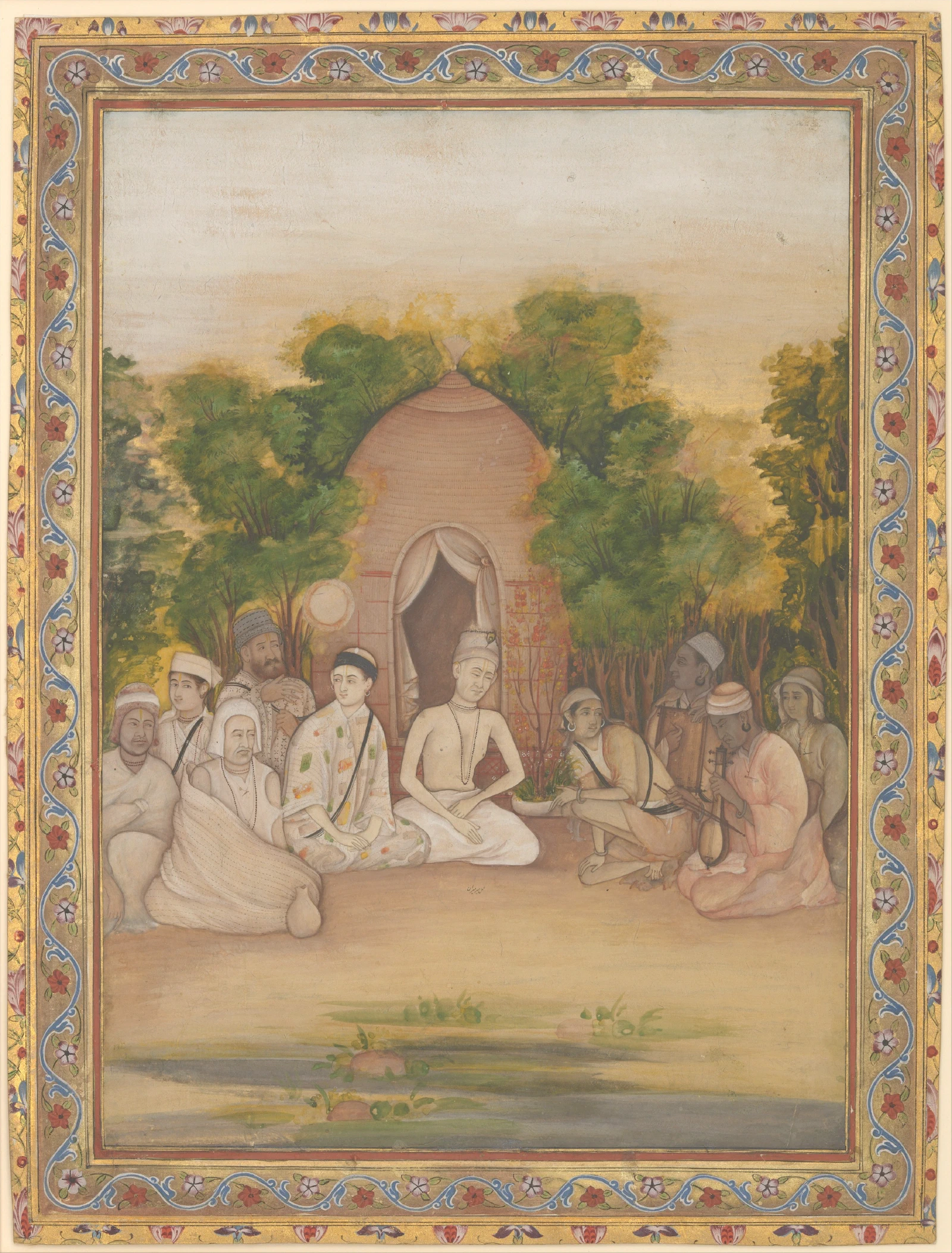
The Tamil Alvars, devoted to Vishnu, and Nayanars, devoted to Shiva, composed from roughly the sixth through the ninth centuries. Their poems map divinity onto particular temples and landscapes: the god is universal and also resident in this town, under this tree, available through this image. Later compilers organized the poems into canons, and temple systems incorporated them alongside Sanskrit ritual.
The poetry could challenge religious rivals and social hierarchy while also supporting new orthodoxies. Nandanar, a Dalit devotee barred from seeing Shiva, became a powerful figure precisely because later tellings disagreed over whether devotion overcomes caste or requires the devotee to be purified before admission. Bhakti opened voices that Sanskrit institutions had excluded; it did not automatically dismantle the institutions.
Kannada vachana poets in the twelfth century further advanced the social argument. Basava, Akka Mahadevi, Allama Prabhu, and other Virashaiva or Lingayat writers rejected elaborate ritual and caste status in compressed prose poems addressed to a personal form of Shiva. Akka Mahadevi’s poems join devotional and erotic exposure while refusing ordinary marriage and clothing. Their plain surface is crafted and frequently difficult.
A continent of vernaculars
In Maharashtra, Jnaneshwar rendered philosophy into Marathi, Namdev and Tukaram composed abhangs for Vithoba, and Janabai wrote devotion through domestic labor. In Gujarat, Narsinh Mehta imagined equality among devotees. In Rajasthan and north India, Mirabai rejected royal and marital claims for Krishna; Surdas built a lyrical world around Krishna’s childhood; Tulsidas’s Ramcharitmanas made Rama devotion available in Awadhi on a scale the Sanskrit epic never reached.
The so-called nirguna poets addressed a god without attributes and attacked empty external identity. Kabir, traditionally a Muslim weaver, mocked Brahmin and mullah with equal precision. Ravidas, associated with a leatherworking caste, imagined Begumpura, a city without sorrow, taxes, fear, or second-class citizens. Their verses survive in multiple collections with unstable attribution because of oral circulation, performance, and sectarian compilation, which continually altered the corpus.
In Bengal and Odisha, Chaitanya-centered Vaishnavism developed an ecstatic theology of Radha and Krishna; Jayadeva’s earlier Sanskrit Gita Govinda supplied a shared poetic grammar. Assam’s Shankardeva built congregational institutions around vernacular drama and song. The regional list can keep expanding because there was no single center from which the phenomenon once radiated.
Sufi words and shared audiences
Sufi orders brought Persian, Arabic, and Central Asian intellectual traditions into conversation with Indian languages and performance. Amir Khusrau wrote chiefly in Persian, while later tradition made him a founding figure for Hindavi poetry and qawwali. Baba Farid’s Punjabi verses were included in the Guru Granth Sahib. Poets such as Shah Abdul Latif in Sindhi and Bulleh Shah in Punjabi used love, separation, the guide, and the journey to unsettle fixed religious and social identities.
The shrine was as important as the book. Chishti hospices and dargahs offered teaching, feeding, music, patronage, and burial in the context of the continuing presence of a saint. Poetry moved through sama, attentive musical audition, and later qawwali traditions. Orthodox critics periodically attacked music and shrine practice; modern reformers on several sides attacked shared devotion as contamination. The persistence of the shrines is evidence that doctrinal policing never had the field to itself.
Shared vocabulary does not make bhakti and Sufism interchangeable. Islamic monotheism, Quranic revelation, prophetic tradition, Hindu deity forms, rebirth, avatar theology, and temple practice remain substantial differences. The interesting history lies in how poets and listeners crossed a boundary that institutions continued to maintain.
The Guru Granth Sahib
The Sikh Gurus created both a distinct revelation and an archive of this wider devotional world. Guru Nanak’s hymns move across Punjabi and related linguistic registers, reject caste and empty ritual, and insist on one formless creator encountered through the divine Name, honest work, and shared life. His successors developed a community, script, centers of worship, and a line of authoritative teaching.
Guru Arjan compiled the Adi Granth in 1604. It contains hymns by Sikh Gurus and by Hindu and Muslim devotional figures, including Kabir, Ravidas, Namdev, and Sheikh Farid, arranged primarily by musical mode. Guru Gobind Singh ended the line of human Gurus and vested final authority in the scripture and the corporate community. As the Guru Granth Sahib, the text is not merely read. It is enthroned, opened, sung, addressed, carried, and treated as the living Guru.
Its inclusion of non-Sikh poet-saints is sometimes used to dissolve Sikhism into a general synthesis. That misses the editorial and theological act. The Gurus did not preserve an anthology of agreeable sayings; they placed selected voices inside a Sikh scriptural order. Openness and distinct authority coexist.
Poetry after print
Print stabilized versions that performance had kept variable, attached poems more firmly to named authors, and helped reform movements define clean religious canons. Nationalism then recruited Kabir as a secular critic, Mira as a rebel woman, Tulsidas as a Hindu unifier, and Sufi poets as evidence of composite culture. Each use reveals something real and leaves something behind.
The poems remain alive because people continue to sing them, not just read them. They resonate in classical concerts, village gatherings, films, protest meetings, temples, gurdwaras, and dargahs. Their textual history remains inseparable from the human voice.