
Dance
India’s national cultural institutions recognize eight classical dance forms. Their modern stage versions were standardized, renamed, or reframed during the twentieth century to very different degrees. Bharatanatyam and Odissi were substantially reconstructed by revivalists, often while distancing the forms from hereditary communities that had kept related practices alive; other forms had stronger institutional continuities. That process is not a footnote to the history. It is part of the history.
The Natyashastra
The shared theoretical root is the Natyashastra, a Sanskrit treatise on drama, dance, and music attributed to Bharata and composed sometime between roughly 200 BCE and 200 CE. It is an unusually practical document: it covers stage construction, costume, categories of gesture, types of character, the handling of music, and the classification of emotional states.
Its most influential idea is rasa, usually translated as flavor or essence. The performer does not simply feel an emotion and transmit it. Specific, learned combinations of gesture, expression, situation, and music are meant to produce in a prepared audience a distilled aesthetic experience of that emotion, at a remove from the raw thing. The treatise enumerates a set of these, including the erotic, the comic, the sorrowful, the furious, the heroic, the fearful, the disgusting, and the marvelous, with a ninth, tranquility, added by later commentators. That framework has shaped Indian aesthetics far beyond dance, and it remains the vocabulary in which performance is discussed and judged.
Two other concepts recur. Nritta is pure rhythmic movement with no narrative content, and nritya is expressive dance that conveys meaning, largely through abhinaya, the art of expression, using codified hand gestures called mudras or hastas, eye movement, and facial expression. A trained performer can narrate an episode from the epics in silence.
The eight
Bharatanatyam (Tamil Nadu) is the most widely taught, built on sharp geometry, a deeply bent stance, and alternation between rhythmic passages and expressive ones. Kuchipudi (Andhra Pradesh) grew from a village tradition of danced drama and retains more theatrical narrative. Odissi (Odisha) uses a characteristic tribhanga, a three-bend posture of head, torso, and hips, that echoes temple sculpture. Kathak (north India) developed in both temple and Mughal court settings, is danced upright rather than in a low stance, and is built around footwork, spins, and rhythmic conversation with the tabla.
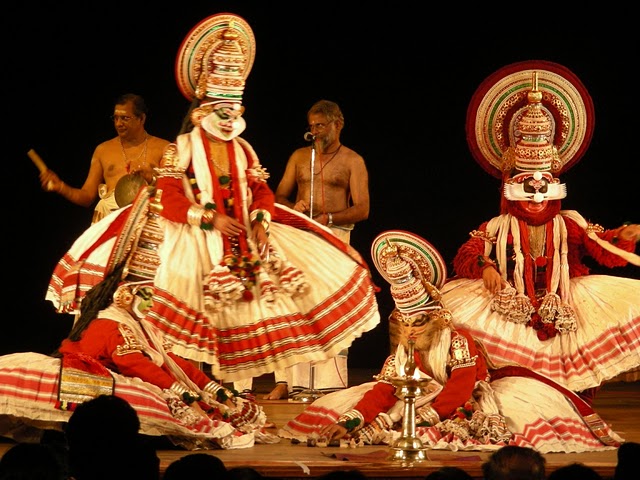
Kathakali (Kerala) is danced drama with elaborate makeup and costume, performed traditionally through the night, with vocalists narrating while performers act. Mohiniyattam (Kerala) is slower and more lyrical. Manipuri (Manipur) is gentler in attack, tied to Vaishnava devotion and to the region’s own ritual traditions. Sattriya (Assam) comes from the monasteries founded in the tradition of Sankaradeva in the sixteenth century and was recognized as classical only in 2000.
The list itself is a state artifact, maintained by national cultural bodies, and additions to it have been argued over. Being on it brings funding, festival slots, and university departments.
The devadasi question
For centuries in the Tamil and Telugu country, a substantial part of the repertoire that became Bharatanatyam was held by devadasis, women dedicated to temples who performed ritual and artistic duties, held property rights unusual for women of the period, and were trained to a professional standard. Their position was also bound up with hereditary obligation and with sexual arrangements involving temple and courtly patrons, and it is not honestly describable as either straightforward exploitation or straightforward autonomy.
Nineteenth-century missionary and reformist campaigns attacked the institution as prostitution under religious cover. Anti-dedication legislation followed, culminating in Madras Presidency in 1947. The system was abolished. What happened to the art was that it was taken up, taught, and performed largely by women from respectable upper-caste families, foremost among them Rukmini Devi Arundale, who founded Kalakshetra in 1936, removed material considered erotic, added proscenium staging and a temple-derived visual idiom, and made the form acceptable to a new middle-class audience.
The result is genuinely double. A tradition was preserved and enormously expanded, taught to hundreds of thousands, and carried worldwide. It was also taken from hereditary practitioners who were left without their livelihood, and its history was rewritten to lead from ancient temple sculpture to the modern concert stage with the intervening centuries and the women who lived them edited out. E. Krishna Iyer, a lawyer who campaigned to save rather than abolish the dance, is a partial counterexample, and the recovery of devadasi memory by later scholars is comparatively recent.
Folk and ritual forms
The classical eight are a small fraction of what is danced. Bhangra and giddha in Punjab, garba and dandiya-raas in Gujarat, lavani in Maharashtra, bihu in Assam, chhau across the Jharkhand-Odisha-Bengal border region with its masks and martial movement, ghoomar in Rajasthan, and a very large number of community-specific forms across central India and the Northeast.
Ritual performance sits partly outside the dance category altogether. Theyyam in northern Kerala involves a performer, usually from a community placed low in the caste order, becoming a deity for the duration of the ritual and receiving worship from those who outrank him socially. Kutiyattam, also in Kerala, is a Sanskrit theatre tradition of extraordinary slowness and antiquity and was among the first traditions inscribed on UNESCO’s intangible heritage list.
The classical/folk distinction is not neutral. It tracks Sanskrit textual sanction, court and temple patronage, and caste, and it was applied energetically during the same twentieth-century period that produced the revival. Some forms crossed the line upward. Others did not, and the reasons had little to do with technical difficulty.