
Music
India has two classical music systems that share a theoretical foundation but disagree about nearly everything built on it, and a popular music, largely made for films, that reaches more people than both combined. Accounts that treat the third as an afterthought have the proportions exactly backward.
Raga and tala
Two concepts organize the classical traditions.
A raga is not a scale and not a tune. It is a set of constraints and obligations governing which notes are available, how they may be approached and left, which are emphasized, which are ornamented, and how, and what characteristic phrases identify it. Two ragas can use identical pitches and remain entirely distinct because the rules of movement differ. Within those constraints, a performer improvises, so a raga is closer to a grammar for a musical dialect than to a composition.
A tala is a cycle of beats organized into groups, with a defined first beat that carries structural weight. Cycles range from a handful of beats to well over a hundred. Because the cycle repeats, the drummer and the melodic soloist can travel very far apart and then arrive together. The moment of arrival is a large part of what an audience is listening for.
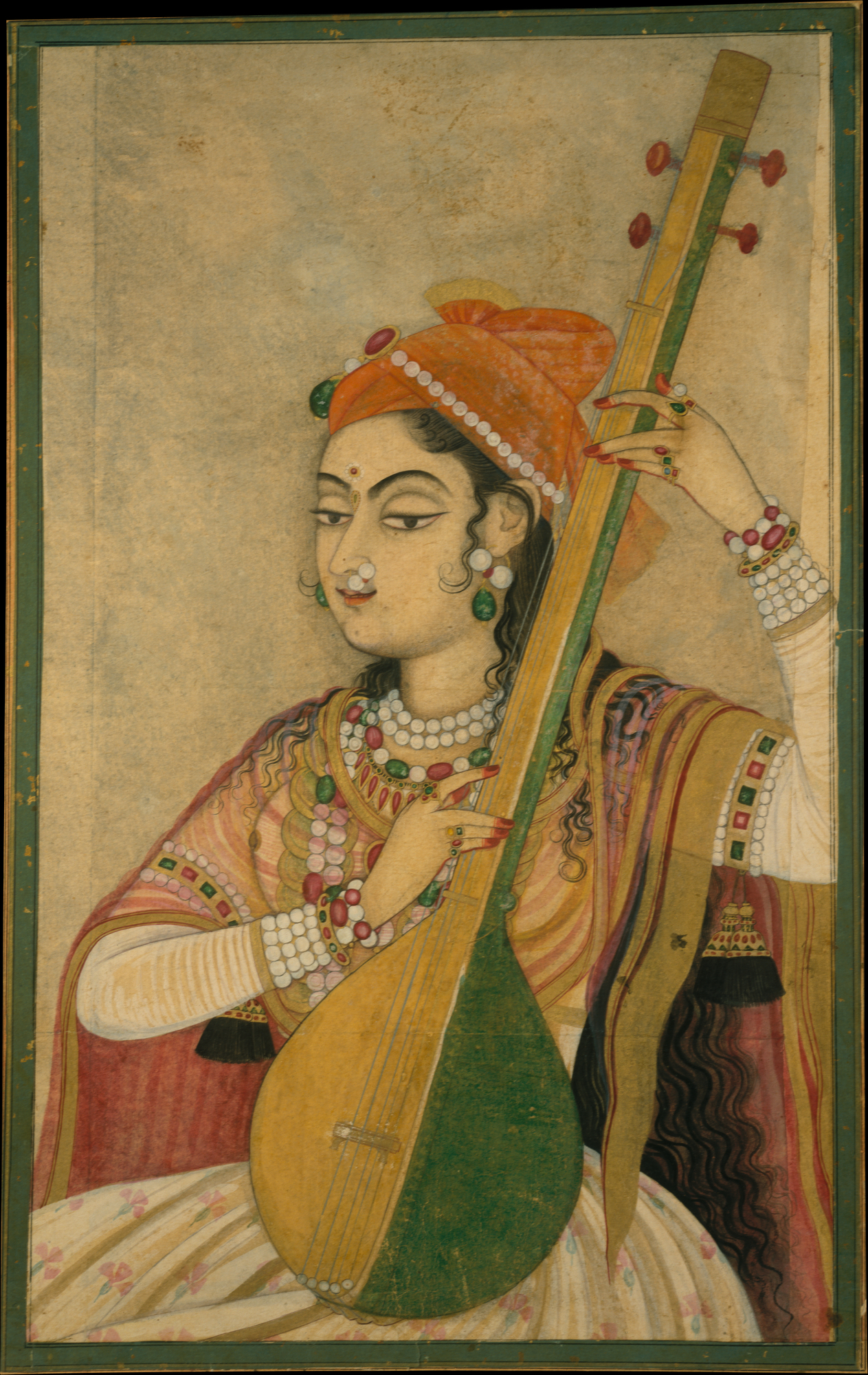
Underneath both sits a continuous drone, usually a tanpura, which fixes the tonic. Indian classical music does not modulate to other keys; the tonic never moves, and everything is heard against it. That single decision explains much of why the music sounds the way it does.
Two systems
Hindustani music developed in the north under Mughal and later princely and court patronage, absorbing Persian and Central Asian influence. Its principal vocal form, khayal, unfolds slowly, and a full performance may spend a long stretch in unmetered exploration before the drum enters. Instruments include sitar, sarod, sarangi, santoor, bansuri, shehnai, and the tabla. Performers belong to gharanas, lineages that transmit repertoire, technique, and interpretive preference through long apprenticeship, and identifying a singer’s gharana by ear is a recognized connoisseur’s game.
Carnatic music developed in the south, more closely tied to temple and devotional contexts, and is more compositional. The kriti, a fixed song usually in Telugu, Sanskrit, Tamil, or Kannada, is the central form, and improvisation happens in defined slots around it rather than throughout. The trinity of Tyagaraja, Muthuswami Dikshitar, and Syama Sastri, all active around the turn of the nineteenth century, supplied the core repertoire. Instruments include the veena, a European violin adopted and played while sitting on the floor, flute, nadaswaram, mridangam, and ghatam, a clay pot.
The systems diverged over centuries rather than splitting at a single moment, and their theoretical vocabularies remain close enough that a trained musician can read across the boundary, while the other side’s practice remains thoroughly foreign.
Devotion and the vernacular
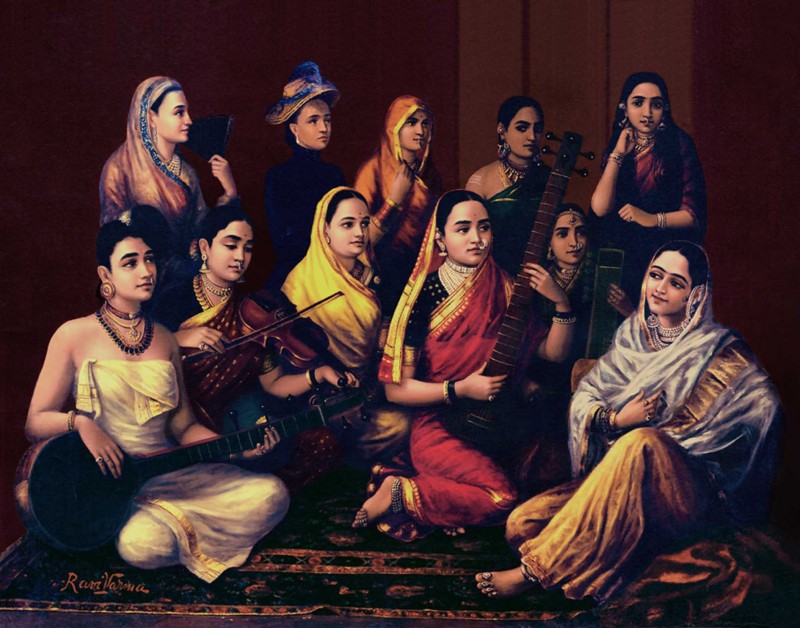
A great deal of Indian music is religious without being liturgical in any formal sense. Bhajan and kirtan traditions set devotional poetry to accessible melody for group singing. Qawwali, developed at Sufi shrines in the Delhi region and associated with Amir Khusrau, uses repetition, hand-clapping, and rising intensity to drive listeners toward absorption; it moved from shrine courtyards to recordings and films without ceasing to be performed at shrines. Sikh shabad kirtan sets scripture from the Guru Granth Sahib to prescribed ragas, and the poetry itself was composed to be sung. The Bauls of Bengal are wandering singers whose songs carry a heterodox theology that fits no institutional religion.
Regional and occupational traditions are enormous and largely uncatalogued: harvest songs, wedding songs sung by women, work songs, ballads recounting local heroes, Rajasthani hereditary musician communities performing for patron families across generations, Marathi abhang, Bhojpuri and Punjabi forms that have since been absorbed into commercial pop, and rock, gospel, and hip-hop scenes across the Northeast and the metros.
The boundary between classical, folk, devotional, and popular is porous in both directions, and the hierarchy implied by those labels is a modern construction. The twentieth-century project of establishing classical music as respectable middle-class art involved separating it from hereditary performing communities, particularly women from devadasi and courtesan backgrounds who had carried much of the repertoire and were largely written out of it. What is now performed in concert halls to seated, silent audiences was, not long ago, performed in very different rooms for very different people.
Film music
Sound arrived in Indian cinema in 1931, and songs arrived with it immediately. Film music has been the popular music of India ever since, and for most of that period, there was no significant commercial alternative: the film industry was the recording industry.
Playback singing, in which a professional vocalist records a song that an actor mimes on screen, became standard by the 1940s and made singers unusually prominent stars in Indian cinema. A small number of playback singers, Lata Mangeshkar and Mohammed Rafi above all, recorded across so many decades and languages that their voices became the default sound of Indian popular song for two generations. Composers, credited as music directors, worked with equal reach: Naushad, S.D. Burman, Shankar-Jaikishan, R.D. Burman, Ilaiyaraaja in the Tamil industry, and A.R. Rahman, whose arrival in the early 1990s changed the sonic vocabulary of the whole field.
Film music absorbed everything within reach: raga structure, folk melody, qawwali, Latin dance rhythms, jazz orchestration, disco, synth-pop, and eventually hip-hop production. Purists have complained about this for 90 years, and the complaint keeps missing the point of the form. Film music is also the most effective vehicle Hindustani ever had for reaching people who do not speak it, and the reason a Malayalam speaker in Kerala can sing along to a Hindi song from the 1970s.
Recording, cassettes, and after
Distribution technology repeatedly reorganized who could be heard. The gramophone recording arrived at the start of the twentieth century and forced performances to a three-minute limit, reshaping the classical repertoire more than any theoretical debate. All India Radio became a national patron and gatekeeper after Independence, with a policy of promoting classical music and, for a period, restricting film songs. This restriction pushed listeners toward Radio Ceylon.
Cheap cassette technology in the 1970s and 1980s broke the oligopoly. Recording and duplication became affordable enough for regional, devotional, and caste-specific music to reach markets no national label would have served, and the resulting explosion of local production is one of the most significant events in Indian cultural history that most histories skip. Digital distribution and streaming repeated the pattern on a larger scale, with the familiar consequences: more access, more regional production, and more precarious income for most of the people producing it.