
Textiles & Craft
For most of recorded history, the finest cotton cloth in the world was made in India, and for a long stretch, the volume was large enough to reshape other economies. English preserves fragments of that trade in ordinary words: calico from Calicut, chintz from a Hindi word for spotted or variegated cloth, dungaree, khaki, bandanna, cashmere and jute, sash, and pajama. A language does not borrow that many terms from a marginal supplier.
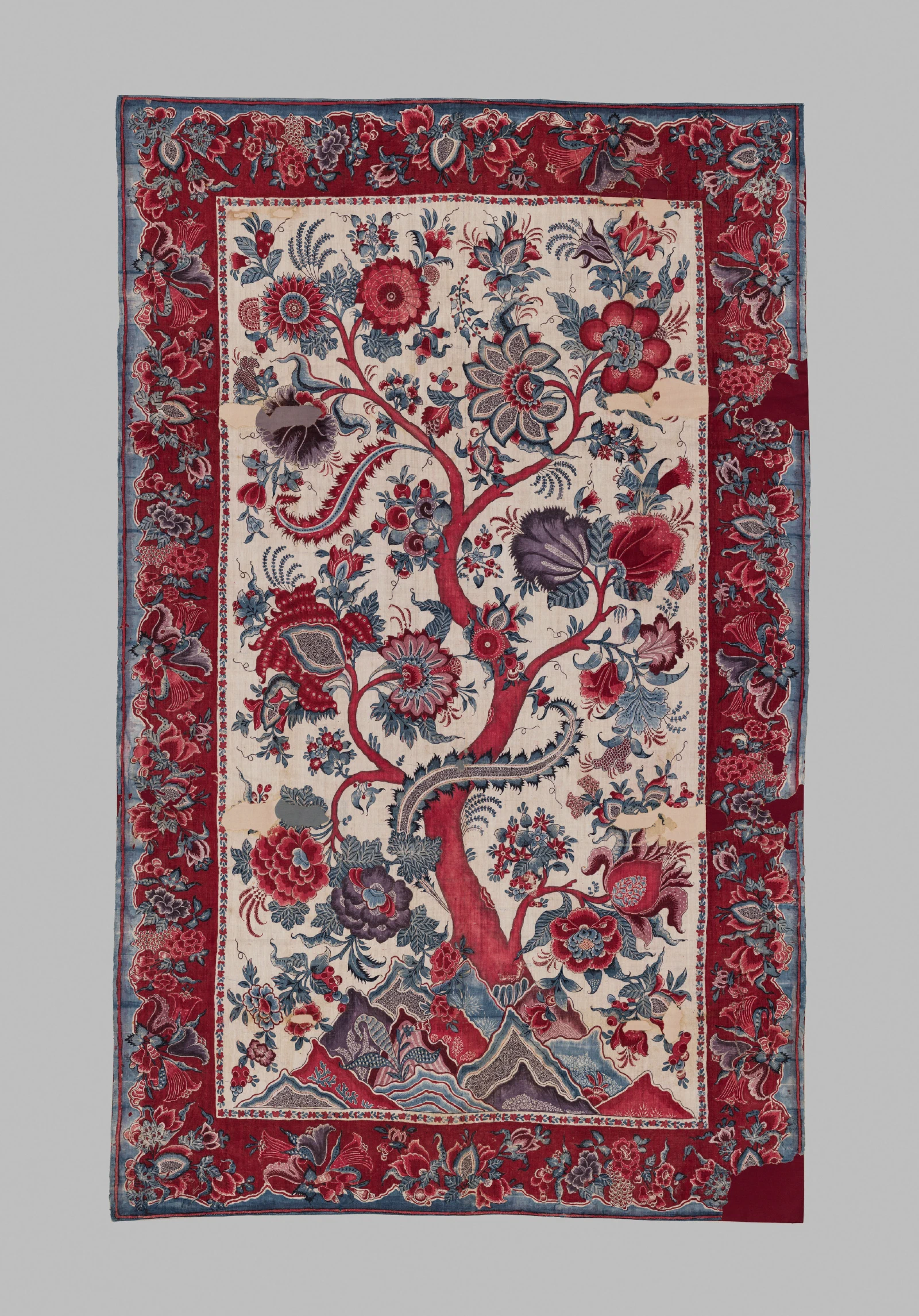
The technical advantage
Cotton was cultivated and spun in the Indus world, and the subcontinent’s edge in cloth lasted for millennia afterward. Part of it was spinning and weaving skills concentrated in hereditary communities. The larger part was chemistry.
Cotton fiber does not readily accept dye. Turning it a fast red or a deep blue that survives washing requires mordants, metallic salts that bind dye to fiber, applied in sequence with resists that block color where it is not wanted. Indian dyers developed multi-stage mordant and resist processes for indigo blue and madder red centuries before European workshops could reproduce them, which is why early modern European buyers could purchase the cloth but not the methods. Painted and block-printed cottons from the Coromandel Coast and Gujarat went to Southeast Asia, the Red Sea, and East Africa long before they reached Europe, and each market received patterns designed for it.
Regions
The technique is organized geographically, and the map is dense. Banaras produces brocade with gold and silver thread. Kanchipuram and Dharmavaram weave heavy silk with contrast borders. Ikat, in which the yarn is tie-dyed to a pattern before weaving so that the design emerges only as the cloth is made, appears as patola in Gujarat, bandha in Odisha, and pochampally in Telangana. Bengal produced jamdani, a supplementary-weft muslin fine enough to attract centuries of exaggerated stories. Kashmir produced the shawls that gave English the word cashmere and gave Paisley, Scotland, the pattern it is now named after.
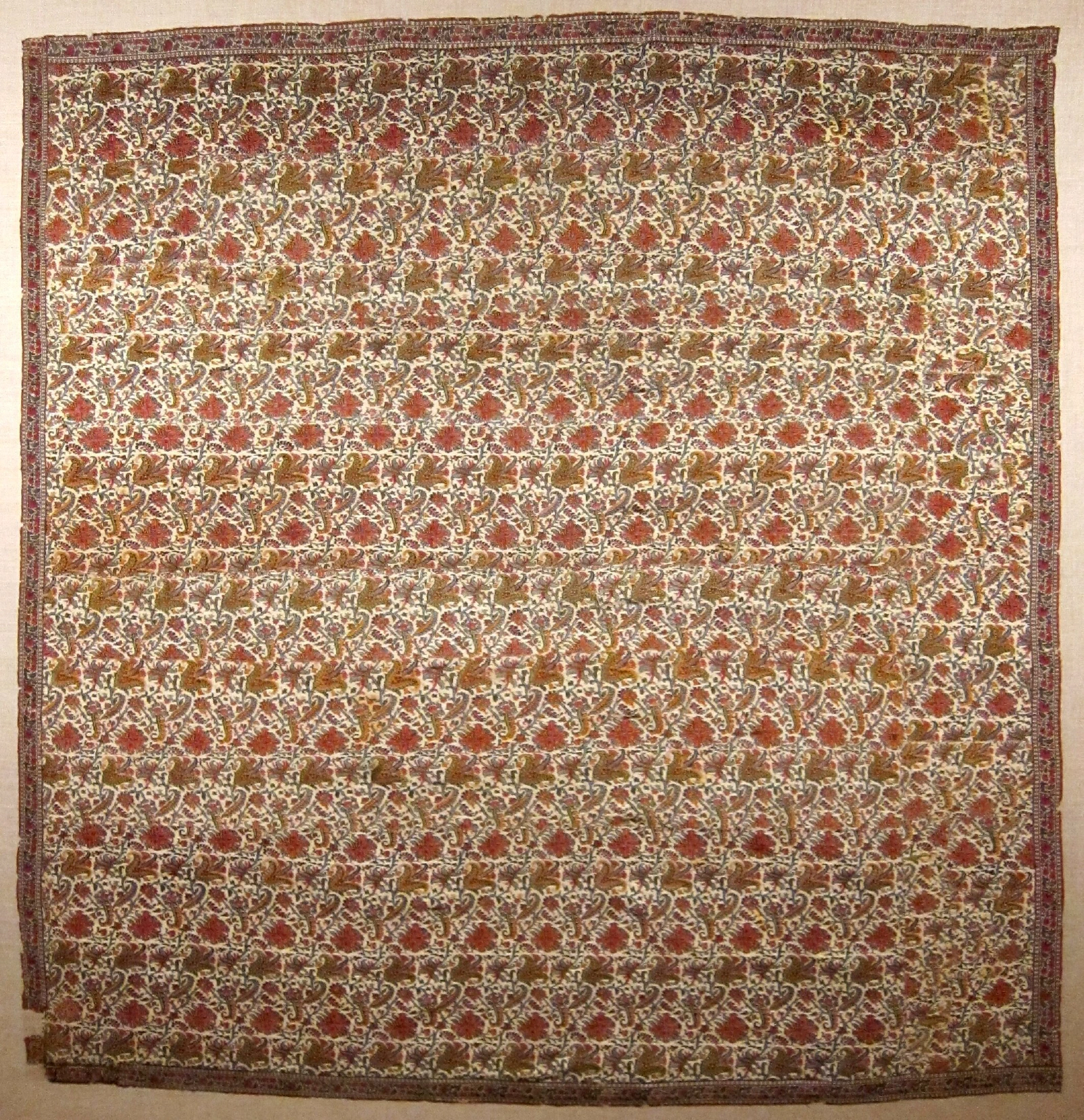
Beyond weaving: block printing and bandhani tie-dye across Rajasthan and Kutch, phulkari embroidery in Punjab, kantha quilting in Bengal that recycles worn saris into new cloth, chikankari whitework in Lucknow, mashru and ajrakh in Gujarat and Sindh, backstrap weaving across the Northeast with designs tied to specific communities.
The sari is not one garment. It is a family of drapes, worn in dozens of regional styles, and the version most people picture, the nivi drape with a fitted blouse and petticoat, was standardized relatively recently and spread through photography, cinema, and nationalist respectability politics. Much of what looks timeless in Indian clothing is younger than the railway.
What the trade did
By the seventeenth century, Indian cotton was the principal manufactured good moving in Indian Ocean commerce, and European companies entered that trade as latecomers, buying into an existing system. The volume of imported Indian calico into England was disruptive enough that Parliament restricted it in the early eighteenth century to protect domestic wool and silk producers, a straightforwardly protectionist response to a superior competitor.
British mechanization then reversed the flow. Spinning and weaving machinery, cheap coal, and eventually tariff structures that favored British cloth in Indian markets turned India from the world’s largest cloth exporter into an importer of yarn and cloth and an exporter of raw cotton. Weaving communities in Bengal and elsewhere lost their market. How complete that collapse was, and how much of it is attributable to policy rather than to technology, remains genuinely contested among economic historians; that the direction reversed is not.
That reversal is why cloth became the central symbol of the independence movement rather than an incidental one. Gandhi’s khadi program asked people to spin and wear hand-produced cloth, boycott imported textiles, and treat the spinning wheel as both an economic argument and a daily discipline. The wheel was adopted as the flag of the Indian National Congress, and the tricolor adopted in 1947 replaced it with the Ashokan wheel. The original manufacturing rules privileged hand-spun, hand-woven khadi, but a 2021 amendment to the Flag Code also permitted machine-made flags and polyester bunting.
Now
Handloom weaving remains one of the largest sources of non-agricultural employment in rural India, and it is under permanent pressure from powerlooms, synthetic yarn, and imported fabric. The state has responded with reserved product categories, cooperatives, geographical-indication tags for named traditions, and revival programs, with mixed results. Some traditions have found a viable high-value market; others survive on subsidy or are worked by weavers whose children will not continue.
The revival movement has its own complications. Design intervention that makes a tradition sell can also flatten it, replacing local repertoire with what metropolitan buyers expect a handloom to look like. Intermediaries capture a large share of the price gap between what a weaver earns and what a sari costs in a city showroom. Craft is also caste: many weaving, dyeing, leatherworking, and metalworking communities are precisely those the caste system locked into hereditary occupation, so a call to preserve traditional livelihoods can amount to a call for someone else’s children to stay in place.
None of that makes the cloth less remarkable. It does mean the question of what to do about it is an economic and political, rather than an aesthetic, one.