
Art & Architecture
Almost every form in Indian art arrived from somewhere, and almost every form in Indian art is unmistakably Indian. The two statements are not in tension, and the search for a pure indigenous origin usually says more about the searcher than the object.
Before stone
The oldest surviving images in the subcontinent are painted rock shelters, of which Bhimbetka in Madhya Pradesh is the best known, with figures of animals, hunts, and dances accumulated over a very long span. The Indus cities produced seals, painted pottery, and a small number of extraordinary objects, including the bronze figure usually called the Dancing Girl and the stone bust called the Priest-King, names given by excavators rather than by anyone who made them. Both names encode guesses about a society whose script remains unread.
Between the Indus cities and the first surviving monumental stone lies a long gap in the material record. Vedic religion was built with brick, timber, and fire altars rather than durable image-temples, which is one reason the earliest Indian art history is not a continuous sequence.
Mauryan and Buddhist beginnings
Monumental stone reappears under the Mauryas in the third century BCE. Ashoka’s polished sandstone pillars carry edicts in Prakrit and a technical finish that has never been fully explained; the lion capital from Sarnath became the emblem of the Republic of India in 1950, which makes a Buddhist monument the signature of a state that is constitutionally secular.
Buddhist practice then drove several centuries of the most ambitious building anywhere in the subcontinent. The stupa at Sanchi and its carved gateways translate narrative into stone without depicting the Buddha’s body at all, marking him instead by a tree, a wheel, an empty seat, a pair of footprints. Rock-cut monasteries and prayer halls at Bhaja, Karle, and elsewhere reproduce timber architecture in living rock, complete with imitation wooden rafters that hold nothing up.
The figure of the Buddha appears in human form around the first and second centuries CE, in Gandhara in the northwest and Mathura in the Gangetic plain. Gandharan sculpture, produced under the Kushans in a region long exposed to Hellenistic and Iranian art, gives the Buddha wavy hair and heavy classical drapery. Mathura’s version is fleshier and works from local traditions. Scholars have argued for a century about which came first, and the argument is less interesting than the fact that two regions solved the same theological problem differently at nearly the same moment.
The cave sites
Ajanta, in the Deccan, holds excavated halls and monasteries painted between roughly the second century BCE and about 480 CE under Satavahana and Vakataka patronage. The murals survive in fragments and are still the finest ancient painting in India, mostly jataka stories of the Buddha’s previous lives, rendered with a sense of volume, gesture, and crowded court life that no text conveys.
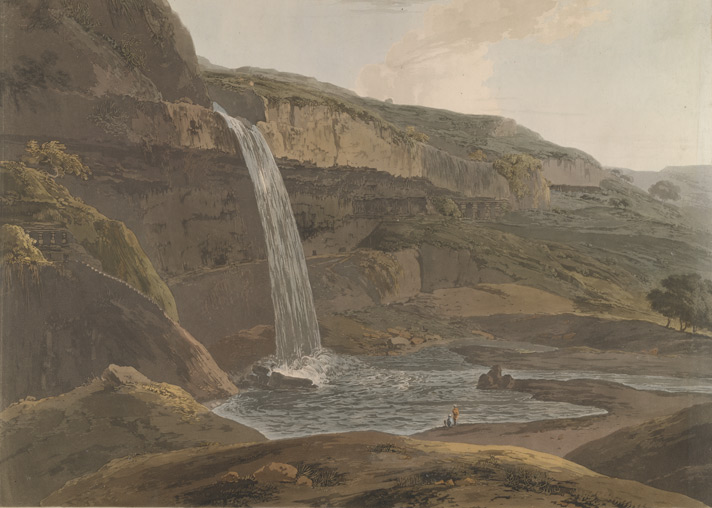
Ellora, which dates to roughly the sixth to tenth centuries, features Buddhist, Hindu, and Jain excavations along the same escarpment. Its Kailasa temple was cut downward out of the rock face rather than built upward from the ground: courtyards, towers, bridges, and elephants, all of it subtraction, with no possibility of correcting a mistake. Elephanta, in Bombay harbor, contains a three-headed Shiva that is among the most imposing sculptural objects in the country.
Temples
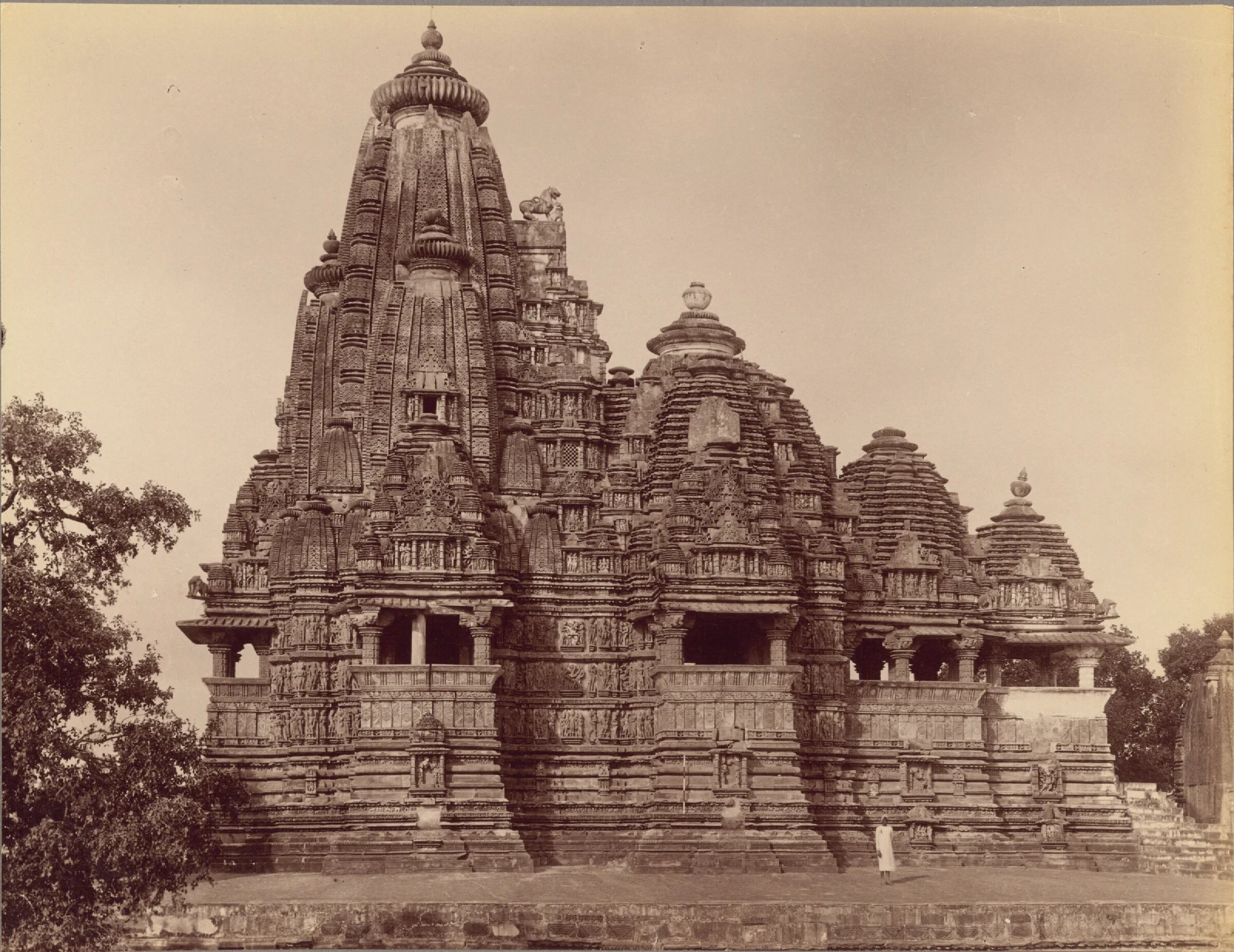
From roughly the Gupta period onward, the freestanding stone temple becomes the central architectural problem, and regional schools address it in visibly different ways. The northern nagara mode builds a curved spire above the shrine, as at Khajuraho, Bhubaneswar, and Konark. The southern Dravida mode stacks diminishing stories into a pyramid, as in the Pallava shore temples at Mahabalipuram and the Chola great temple at Thanjavur; later, under Vijayanagara and the Nayakas, the visual weight shifts outward to enormous gateway towers, so the boundary becomes taller than the sanctum. The vesara forms of the Deccan, and the Hoysala temples at Belur and Halebidu, with their star-shaped plans and soapstone carving worked almost to the density of ivory, sit between the two.
Temples were not only religious buildings. A large South Indian temple held land, employed hundreds, lent money, ran schools, staged performances, and redistributed grain. The Agamas and Tantras provided the ritual manuals governing the construction and installation of images.
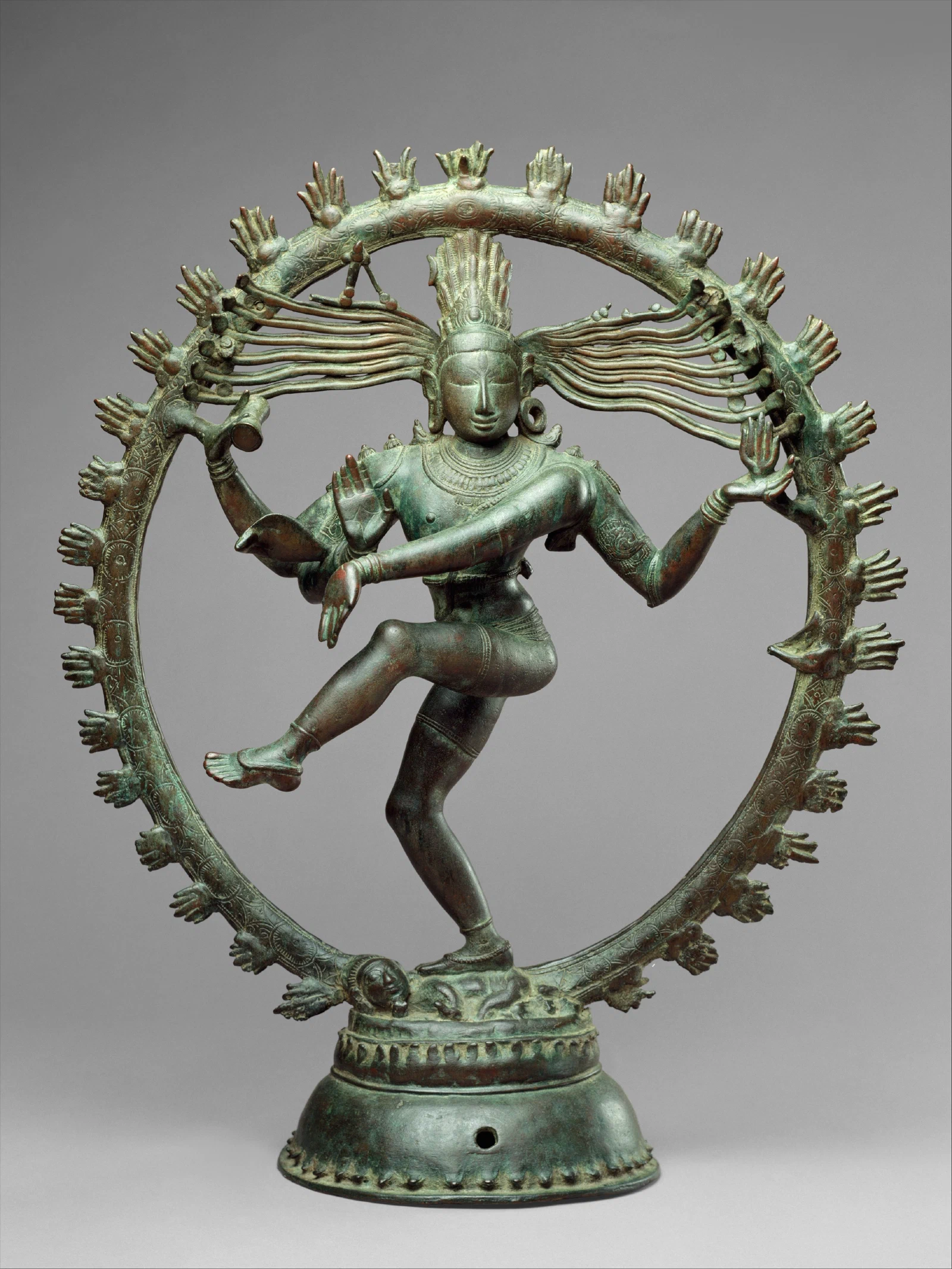
The Chola bronzes are the other great achievement of the southern schools: lost-wax castings made for processional use, of which the dancing Shiva is the most recognizable object in Indian art. They were made to be carried, dressed, and seen in motion by lamplight, which is worth remembering in a museum vitrine.
Sultanate, Mughal, and regional courts
From the thirteenth century, Sultanate patrons made arches, domes, and vaults central to monumental building at a new scale, along with a preference for calligraphy and geometry over figural sculpture on religious buildings. Arched forms had existed earlier in India, often as corbelled or rock-cut forms rather than the voussoir construction used in much later Islamic architecture. What followed was neither replacement nor fusion in any simple sense: the Qutb complex in Delhi was built with material and labor from dismantled temples, while later Sultanate architecture in Bengal, Gujarat, Malwa, and the Deccan developed distinct regional idioms that freely borrowed local structural habits.
Mughal building consolidated a Persianate vocabulary at an enormous scale, from Humayun’s tomb through Akbar’s Fatehpur Sikri to the Taj Mahal, and organized it around the geometric garden divided by water channels. Mughal painting, formed in an atelier where Persian masters trained Indian artists, produced manuscript illustration, portraiture, and natural-history studies of an accuracy nobody had asked for before. Rajput and Pahari courts developed their own painting traditions, and the Kangra and Basohli schools turned devotional poetry into some of the most concentrated small-format paintings anywhere.
The Taj Mahal is no less Indian because its builders worked in a Persianate vocabulary, any more than a Gothic cathedral is less French for its Roman arches.
Colonial and modern
Colonial building imported neoclassical and Gothic forms and then hybridized them. The Indo-Saracenic style grafted domes, chattris, and arches onto European plans for railway stations, colleges, and courts, an architecture of rule dressed as continuity. Bombay’s Victoria Terminus, now Chhatrapati Shivaji Maharaj Terminus, is the emblematic case: Gothic stone remade around an Indian railway.
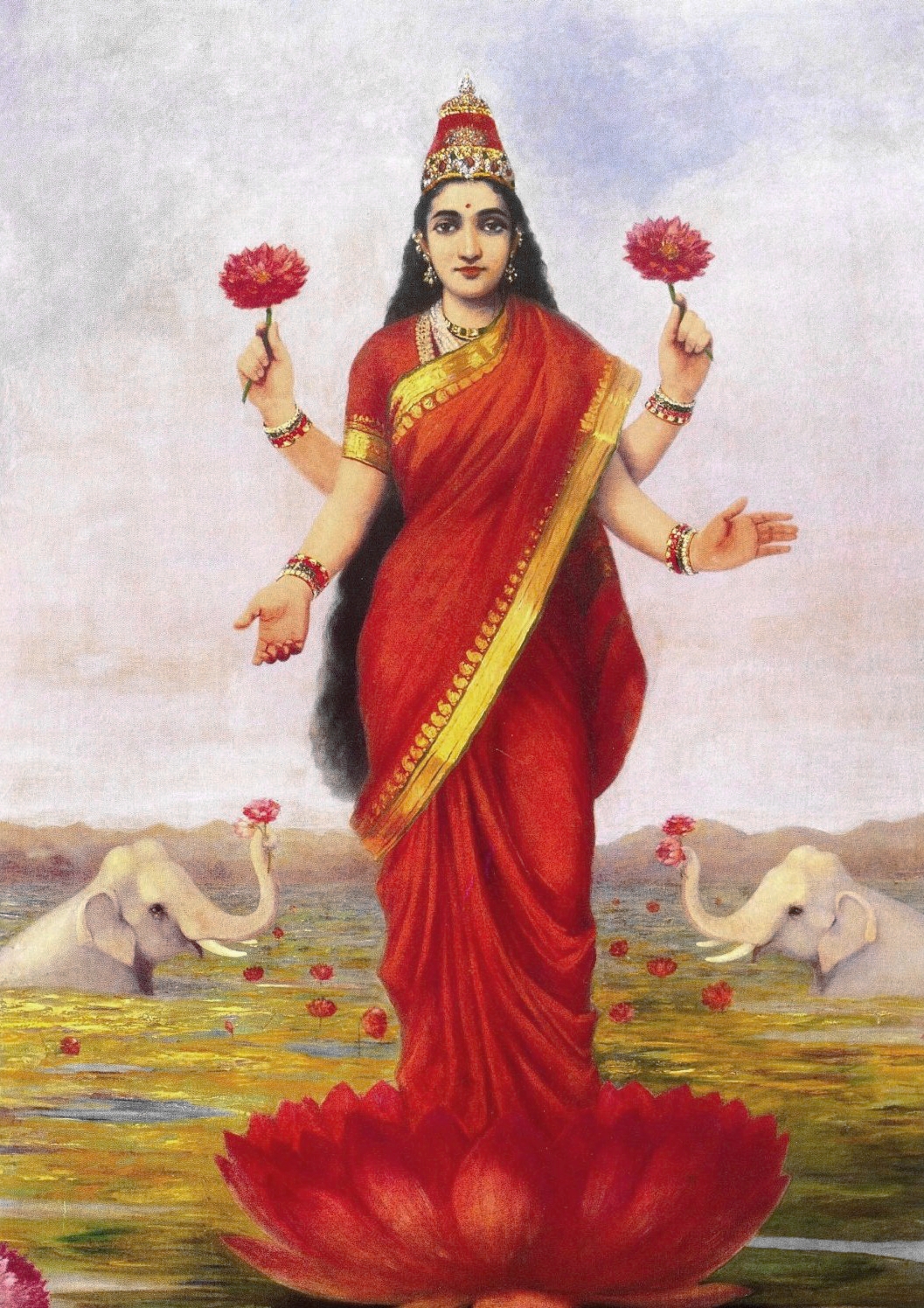
Painting followed a parallel track. Raja Ravi Varma applied European oil techniques and academic realism to Hindu mythological subjects, then reproduced the results as lithographs, helping standardize popular printed forms of Hindu deities across regions. The Bengal School under Abanindranath Tagore consciously rejected that European technique in favor of a revived Asian idiom; later modernists, including the Progressive Artists’ Group formed in Bombay in 1947, rejected the rejection.
After Independence, architecture became state policy. Le Corbusier’s Chandigarh built a new capital for a partitioned Punjab in raw concrete. Louis Kahn built at Ahmedabad. Indian architects then worked out what a modern building here should actually do: Charles Correa on climate, open-to-sky space, and low-income housing; Balkrishna Doshi across institutions and settlements; Laurie Baker on cost, brick, and the argument that most of what a building spends money on is unnecessary.
The largest built environment in the country was designed by none of them. Informal settlements, incrementally extended houses, and unauthorized construction house a very large share of urban India, built without architects and largely without permission. Any account of Indian architecture that stops at the monuments has described a small fraction of what exists.