
The Northeast
Northeast India is where the standard account of the country breaks down. Its languages mostly belong to families that dominate nowhere else in India, its religious composition is unlike the rest of the country’s, much of it was administered as a frontier rather than a province, and it is joined to the rest of the republic by a corridor a few dozen kilometers wide.
The corridor
Partition left the region hanging. Before 1947, Assam was connected to Bengal across a broad front; afterward, East Pakistan occupied that ground, and the connection narrowed to the strip of West Bengal between Nepal, Bangladesh, and Bhutan, roughly twenty kilometers across at its narrowest. It is universally called the Chicken’s Neck.
Almost the entire boundary of the eight states is international, shared with China, Myanmar, Bangladesh, Bhutan, and Nepal. That single geographic fact explains an enormous amount: why the central government has treated the region primarily through a security lens, why economic integration with the rest of India is expensive, why the region’s natural trading partners are across national borders it cannot easily use, and why New Delhi reacts sharply to anything affecting the corridor.
The eight states are Assam, Arunachal Pradesh, Manipur, Meghalaya, Mizoram, Nagaland, Tripura, and Sikkim, the last of which was grouped with the others only from 2002. Assam holds the Brahmaputra valley and most of the population; the others are largely hill states.
Peoples
The region contains several hundred distinct communities and languages. Most belong to the Tibeto-Burman group, unrelated to the Indo-Aryan languages of the plains; Khasi in Meghalaya is Austroasiatic; Assamese and Bengali are Indo-Aryan; and the Ahom who ruled Assam for six centuries spoke a Tai language. Many of these communities have historical, linguistic, and kinship connections running east and north into upland Southeast Asia and Tibet rather than west into India.
Social organization differs from the Indian norm in ways that matter. Several communities in Meghalaya, including the Khasi, Jaintia, and Garo, are matrilineal, with descent and property passing through women. Village and clan authority remains substantive rather than ceremonial in much of the hill country. Caste, in the form it takes across most of the subcontinent, is not the organizing structure of hill society, though the Brahmaputra valley’s Assamese society is a different case.
Christianity is the majority religion in Nagaland, Mizoram, and Meghalaya, the result of nineteenth- and twentieth-century missionary work in areas colonial administration had deliberately sealed off from the plains. Indigenous religious traditions persist alongside it, as does the Vaishnava tradition established in Assam by Sankaradeva in the sixteenth century, whose satra monasteries produced the Sattriya dance recognized as classical in 2000. Manipur has its own Meitei Vaishnava synthesis alongside the older Sanamahi tradition.
The frontier, administered
The Ahom kingdom ruled the Brahmaputra valley from the thirteenth century for roughly six hundred years and defeated repeated Mughal attempts at conquest, most famously at Saraighat in 1671. It fell to the Burmese invasion in the early nineteenth century, and the British acquired Assam from Burma by the Treaty of Yandabo in 1826.
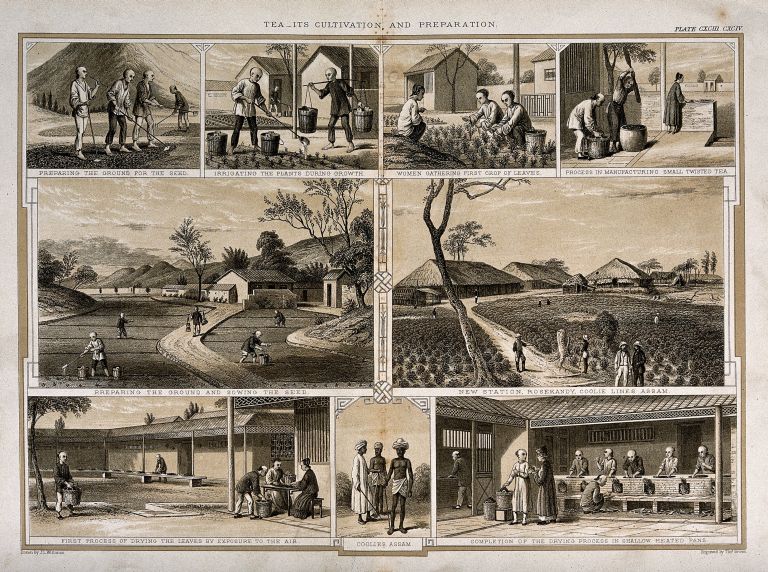
Colonial administration then did two things that shaped everything afterward. It developed the valley intensively, planting tea from the 1830s, striking oil at Digboi, and importing large numbers of laborers from central and eastern India for the tea gardens, whose descendants form a substantial population in Assam today, with a distinct and often disadvantaged position. And it separated the hills from the plains administratively, using the Inner Line under an 1873 regulation to restrict entry into designated hill areas, governing them lightly and indirectly, and leaving them largely outside the legal and revenue systems applied elsewhere.
Independent India inherited both. The Sixth Schedule of the Constitution created autonomous district councils with legislative powers over land, forests, and customary law in the region’s tribal areas, and Inner Line Permit requirements still apply in several states. These are real constitutional asymmetries, not administrative curiosities.
Insurgency and accord
The Naga movement is the oldest armed conflict in the republic. A Naga National Council under A.Z. Phizo asserted independence in the late 1940s, armed conflict followed through the 1950s, and Nagaland was created as a state in 1963 without ending it. The Shillong Accord of 1975 split the movement; the National Socialist Council of Nagaland was formed and then split in 1988. A ceasefire was agreed in 1997, and the various parties signed a framework agreement in 2015, the contents of which were not made public, and whose implementation remains unfinished. Talks continue, decades on, around demands including a separate constitution and the integration of Naga-inhabited areas across state lines, which other states will not concede.
Mizoram is the counterexample. The Mizo National Front’s revolt began in 1966, partly triggered by the administration’s failure during a famine following a mass flowering of bamboo, and the Indian Air Force bombed Aizawl, the only time independent India has used air power against its own citizens on its own territory. Twenty years of conflict ended with the Mizoram Accord of 1986, under which the insurgent leadership entered electoral politics and formed the state government. It has held, and Mizoram has been among the most peaceful states in India since.
Assam, Manipur, and Tripura each generated its own insurgency over sovereignty, autonomy, land, and demographic change, with the United Liberation Front of Asom in Assam and a range of valley- and hill-based groups in Manipur. Violence has declined substantially in the region since its peak, and a series of accords have brought major groups into the political process, most in the past decade.
The instrument used throughout is the Armed Forces (Special Powers) Act of 1958, which grants the army broad powers of search, arrest, and use of lethal force in areas declared disturbed, with prosecution requiring central sanction. It has been the central grievance of civil society across the region for sixty years. Irom Sharmila’s hunger strike against it in Manipur ran for sixteen years from 2000, sustained by force-feeding in custody. A Supreme Court–ordered inquiry into extrajudicial killings in Manipur, and the killing of civilians by security forces in Nagaland’s Mon district in 2021, kept the issue alive. The act’s application has been progressively withdrawn from many districts, and it remains in force in others.
Citizenship, which is the live argument
The region’s defining political question is not sovereignty but who counts as local, and it long predates current national politics.
Migration into Assam from what is now Bangladesh, under colonial encouragement, during Partition, and after the 1971 war, produced a durable anxiety among Assamese speakers about becoming a minority in their own state. That anxiety drove the Assam Movement from 1979, led by the All Assam Students’ Union, a mass agitation whose worst episode was the Nellie massacre of 1983. It ended with the Assam Accord of 1985, which set 24 March 1971 as the cutoff date for citizenship in Assam, a date different from that applying elsewhere in India.
Implementing that cutoff produced the National Register of Citizens, updated under Supreme Court supervision and published in 2019, which excluded roughly 1.9 million people. The law provides for appeals to the Foreigners’ Tribunals. Still, as of 2026, the excluded residents had not received the rejection slips needed to begin those appeals, and the register had not been formally notified, leaving their status unresolved rather than sending them through the tribunals immediately. The exercise satisfied nobody: many long-settled residents, disproportionately poor and often unable to produce documents, remain at risk, while critics who had demanded the register complained that too few names had been excluded.
The Citizenship (Amendment) Act of 2019 then created a fast-track to citizenship for certain non-Muslim migrants from three neighboring countries. Opposition in the Northeast was intense but rested on different grounds from opposition elsewhere in India: not primarily the religious discrimination that mobilized protest nationally, but the prospect of regularizing any migrants at all, which the region’s movements had spent forty years resisting.
Manipur is in the current crisis. Violence between the majority Meitei community of the valley and the Kuki-Zo communities of the hills broke out in May 2023 over questions of Scheduled Tribe status, land, forest rights, and access to reserved benefits. It produced hundreds of deaths, mass displacement, a functional partition of the state along ethnic lines, and an extended internet shutdown. It is a reminder that the region’s conflicts are frequently between communities over land and recognition rather than between a united region and Delhi.
Looking east
Policy has tried to reframe the region’s position as an advantage rather than a liability. The Look East policy, restyled Act East in 2014, presents the Northeast as India’s land bridge to Southeast Asia, with road, rail, and waterway projects toward Myanmar and Thailand and through Bangladesh. Progress has been real but slow, and it depends on Myanmar’s political stability, which, since the 2021 coup, has been the opposite.
Meanwhile, the Free Movement Regime, which allowed people living near the Myanmar border to cross a short distance without documents in recognition of communities split by a line drawn without them, has been restricted since 2024 in favor of border fencing. That decision runs directly against the region’s own social geography, and it is opposed in Mizoram and Nagaland for exactly that reason.
Treating the Northeast as a single region is necessary for orientation but inadequate for almost everything else. Nagaland and Tripura have less in common than France and Poland do.