
The Company & the Raj
The East India Company was chartered on the last day of 1600 as a trading venture with shareholders in London. A hundred and sixty years later, it held the right to collect taxes from thirty million people, and within another century, it governed most of the subcontinent. The fact that a company did this is the most worth holding on to, because it explains a great deal about how they accomplished it.
Trade first
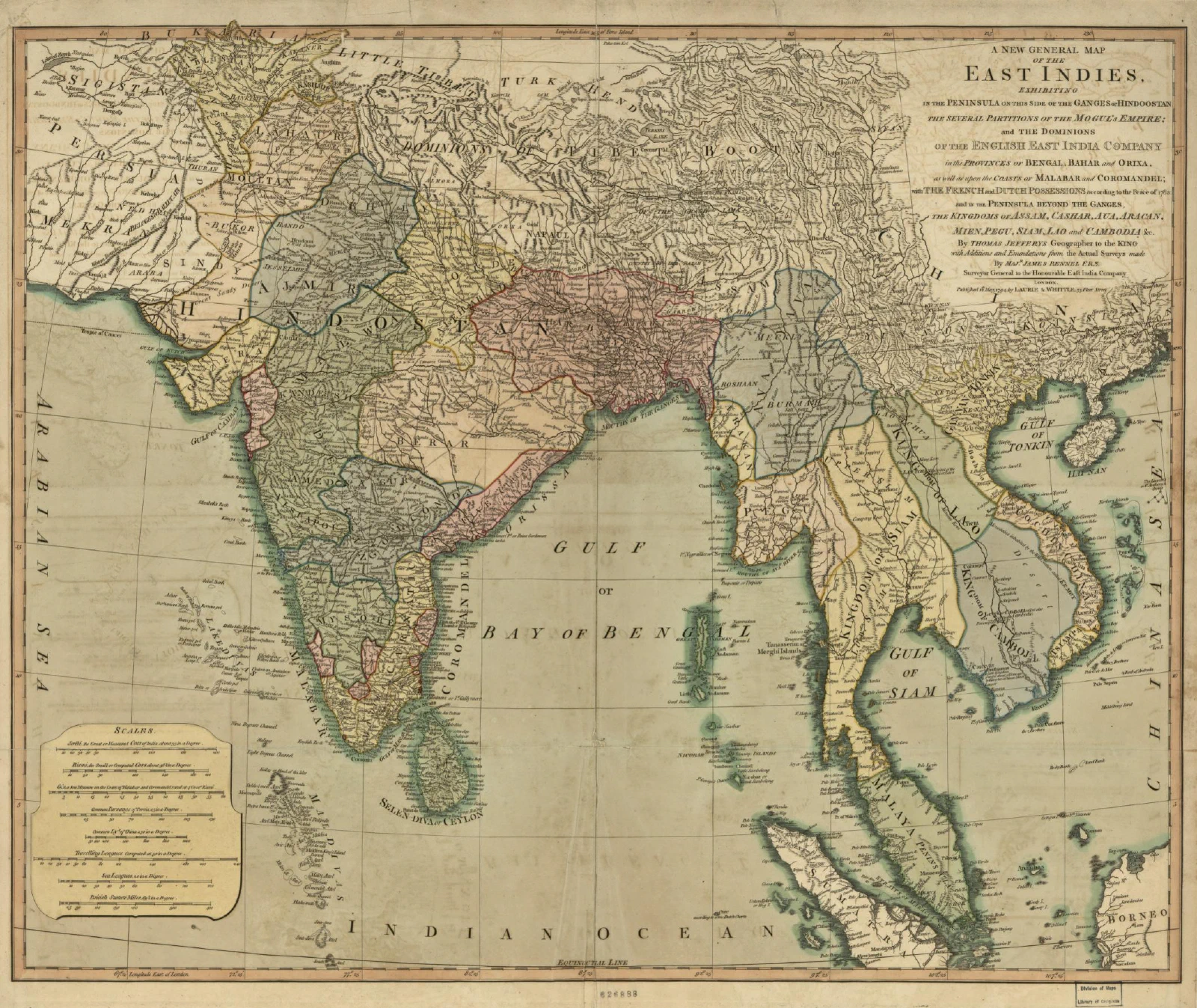
For its first century and a half, the Company was one commercial actor among several, and not the strongest. It obtained permission to establish a factory at Surat in 1613, acquired Madras in 1639, received Bombay in 1661 as part of a Portuguese dowry to Charles II and leased it from the Crown, and founded Calcutta in 1690. The Dutch, Portuguese, and French were competitors, and the Mughal authorities were sovereign; when the Company tried to use force in Bengal in the 1680s, it was defeated and had to apologize.
What it traded was mainly Indian: cotton textiles above all, along with silk, indigo, salt, and pepper, bought with silver because Europe made little that India wanted. Indian cloth was so successful in England that Parliament restricted its import in the early eighteenth century to protect domestic producers.
Trade to territory
The Mughal central authority weakened after 1707, and the Company’s fortified trading posts sat within a competitive multi-state system with mercenary armies for hire and bankers willing to finance them. Its rivalry with the French in the Carnatic in the 1740s and 1750s taught it that European-drilled infantry, disciplined artillery, and reliable pay made a small force disproportionately effective, and that intervening in succession disputes was cheaper than fighting.
Plassey, in 1757, was the lesson applied. Robert Clive defeated the Nawab of Bengal, Siraj-ud-Daula, in an engagement decided substantially by the defection of the nawab’s commander, Mir Jafar, who had been bought in advance. It was less a battle than a coup, and it installed a client.
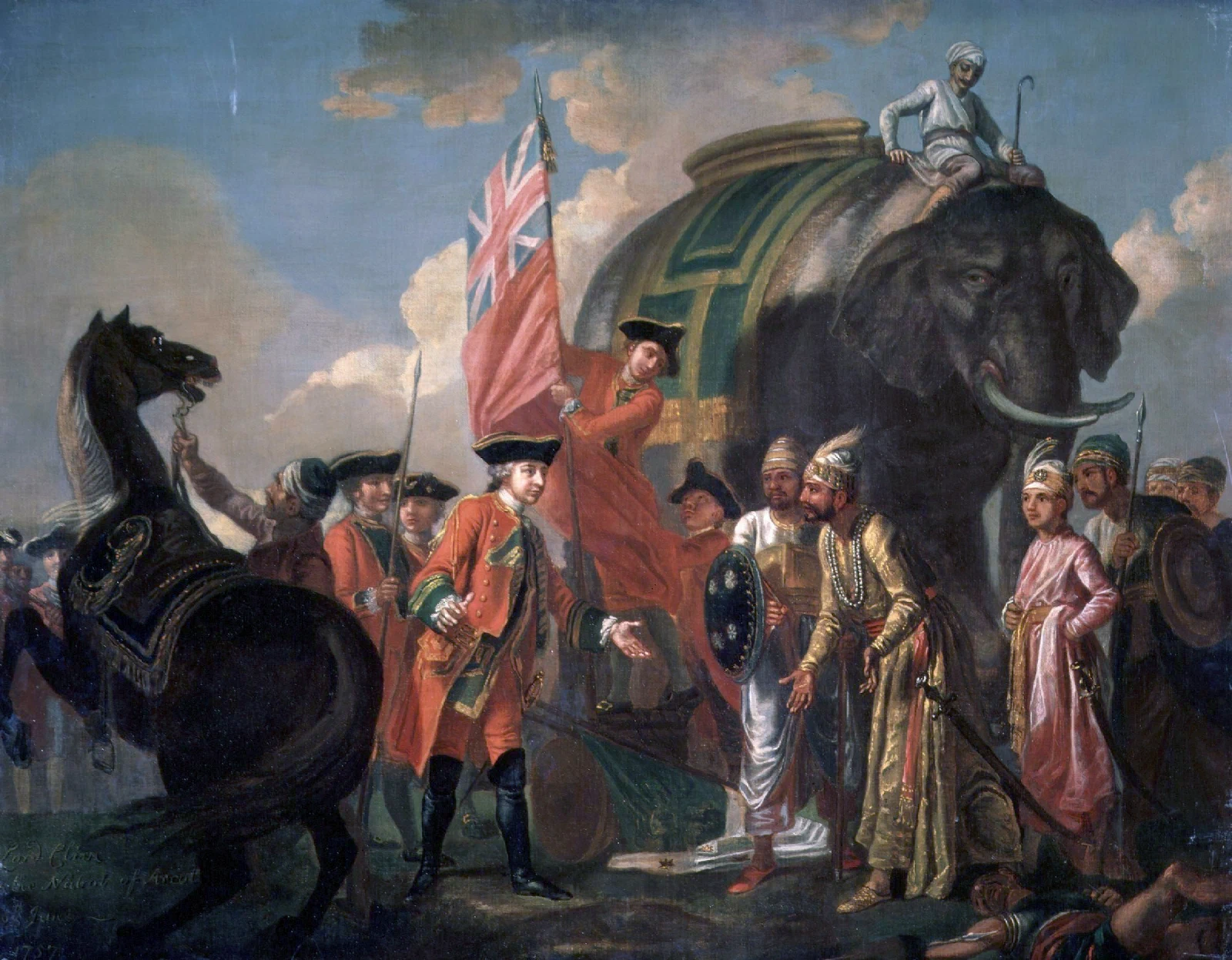
Buxar, in 1764, was the real military victory, defeating the combined forces of the Nawab of Awadh, the deposed Nawab of Bengal, and the Mughal emperor. The Treaty of Allahabad in 1765 followed, and it is the pivotal document of the period: the emperor granted the Company the diwani, the right to collect the revenue of Bengal, Bihar, and Orissa. A trading company now had the tax base of the richest province in India, and could buy Indian goods with Indian taxes rather than with silver from London.
The consequences were immediate and terrible. Company servants extracted private fortunes by maintaining revenue demand through the crisis, and the Bengal famine of 1770 killed a catastrophic share of the province’s population while revenue collection continued and, in some districts, increased. News of the enrichment of returning “nabobs” and of the famine produced political scandal in Britain. Parliament began regulating the Company: the Regulating Act of 1773, Pitt’s India Act of 1784, which established a dual government by the Company and a Board of Control, and the long impeachment of Warren Hastings from 1788, in which Edmund Burke prosecuted the principle that power over foreign peoples carries accountability at home. Hastings was acquitted after seven years.
Land, and who owned it
Governing meant deciding who owed the revenue, and the Company’s answers reshaped rural India more permanently than any battle.
The Permanent Settlement of 1793 in Bengal, under Cornwallis, recognized zamindars, previously revenue intermediaries with customary obligations, as owners of the land in something close to the English sense, fixing their payment to the state in perpetuity. The intended effect was a stable landed gentry with an incentive to improve. The actual effects were that the fixed demand fell in real terms over time, so the state lost, and that rigid collection deadlines forced sales and turned over much of the zamindari class within a generation. That cultivators became tenants with weak rights under layers of subletting.
Elsewhere, the Company tried other models: ryotwari settlements in Madras and Bombay, assessing individual cultivators directly, and mahalwari settlements in the north, assessing villages collectively. All three raised the same underlying problems: cash demand fixed regardless of harvest, assessments frequently set too high, land made mortgageable and therefore losable, and expanded power for moneylenders and absentee holders. Agrarian debt long predated Company rule, but these revenue and property regimes intensified it and changed the conditions under which people could lose their land.
Expansion
Territorial acquisition proceeded by war and by treaty, usually both. Four wars against Mysore ended with Tipu Sultan’s death at Srirangapatna in 1799. Three wars against the Marathas ended their confederacy by 1818. Two against the Sikhs ended with the annexation of Punjab in 1849. Sindh was taken in 1843, and there were disastrous campaigns in Afghanistan and wars in Burma.
Two instruments worked together without fighting. Subsidiary alliances, developed under Wellesley, required an Indian ruler to accept Company troops stationed in his territory, pay for them, surrender foreign relations, and accept a Resident at court; rulers who fell into arrears ceded territory. The Doctrine of Lapse, vigorously applied by Dalhousie in the 1840s and 1850s, held that a princely state without a natural heir lapsed to the Company, thereby rejecting the long-established Indian practice of adoption; Satara, Jhansi, and Nagpur went this way. Awadh was annexed outright in 1856 on grounds of misgovernment, alienating a province that supplied a large proportion of the Company’s own sepoys.
What the Company built, and what it cost
The record is genuinely mixed, and that’s the point.
Railways from 1853, the telegraph, canal irrigation in Punjab and the Gangetic doab, uniform criminal law, the trigonometrical survey, universities in the three presidency towns from 1857, and a professional civil service were all real and consequential. So was English-language education, promoted after Macaulay’s Minute of 1835 declared Indian learning worthless in terms that remain shocking, and which produced the professional class that later led the national movement.
Social legislation is the most contested area. The abolition of sati in 1829 under Bentinck, pressed by Rammohan Roy and Indian reformers as much as by the British, and the Widow Remarriage Act of 1856 are cited as reforms. Critics note the selectivity: the Company intervened where it was politically cheap and avoided interference where it was not.
Against this: the railways were built under a guaranteed-return model that transferred risk to Indian revenues and were routed to serve export and military needs; the tariff structure favored British manufactures; and Indian handloom weaving, once the largest export industry in the world, lost its markets. How much of that deindustrialization was due to mechanization, and how much to policy, remains a matter of debate among economic historians. However, it is no longer seriously argued that India’s share of world manufacturing did not fall dramatically across this period. Dadabhai Naoroji’s “drain of wealth” analysis and R.C. Dutt’s economic history made the case in the nineteenth century that a systematic transfer of resources out of India was occurring, and the framework shaped nationalist economics thereafter.
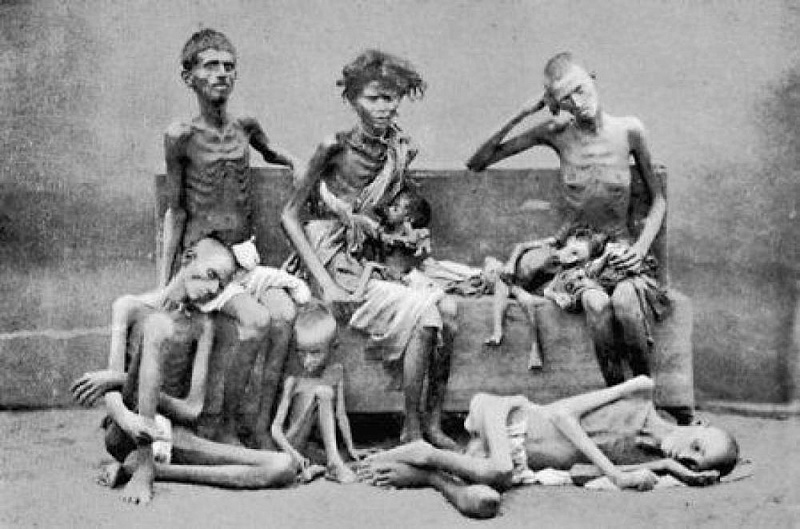
Famine is the hardest part of the ledger. Recurrent famines through the nineteenth century killed millions, and the administration’s commitment to non-interference in grain markets, to keeping exports flowing, and to relief conditional on labor at minimal wages made them worse than they needed to be. The administration eventually rewrote the Famine Codes after inquiries and codified both relief and its limits.
1858
The 1857 rebellion ended the Company. The Government of India Act of 1858 transferred the Government of India’s territories and armies to the Crown, abolished the Board of Control, created a Secretary of State for India in the Cabinet, and made the Governor-General a Viceroy. Queen Victoria’s proclamation promised non-interference in religion, respect for the treaties of the princely states, and admission of Indians to office without discrimination on grounds of race or creed; the first two were largely honored, the third mostly not. Victoria was proclaimed Empress of India in 1876.
The Company itself was wound up in 1874. It had governed a subcontinent for a century, and the arrangement that replaced it kept the machinery and changed the letterhead.