
The Rebellion of 1857
In May 1857, sepoys of the Bengal Army mutinied at Meerut, marched on Delhi, and proclaimed the aged Mughal emperor, Bahadur Shah Zafar, their sovereign. Within weeks, much of northern India was in revolt. Within eighteen months, it was over, the East India Company was abolished, and the character of British rule had changed permanently.
The name
“Sepoy Mutiny” describes it as a military disciplinary failure. “The Indian Rebellion” or “the Revolt of 1857” is often described as a broader uprising. “The First War of Independence” is V.D. Savarkar’s title for his 1909 history and marks the opening of the national movement.
None is neutral, and the evidence supports parts of each. It began as a mutiny and remained one in places. In Awadh and parts of the Doab, it became a general rural revolt with substantial civilian participation. It was not national: most of the subcontinent stayed quiet, and many Indians fought against it. The most defensible description is that it was a large, uneven, and partly coordinated rebellion with several distinct constituencies whose grievances converged in one year.
What caused it
The sepoys’ own grievances were long-standing. The Bengal Army recruited heavily from high-caste communities in Awadh and Bihar, and its ranks resented declining allowances, foreign-service obligations, blocked promotion, and a widening social distance from officers whose predecessors had spoken their languages and taken part in their customs. The General Service Enlistment Act of 1856, requiring recruits to serve overseas, ran counter to caste prohibitions on crossing the sea. The ratio of Indian to European troops was very high, and the army had mutinied before, in smaller episodes, without anyone concluding.
Annexation created a political constituency for revolt. The Doctrine of Lapse had dispossessed rulers at Satara, Jhansi, and Nagpur. The annexation of Awadh in 1856 was the decisive one: it deposed a dynasty, dismantled a court economy on which a great many people depended, imposed a new revenue settlement that damaged the taluqdar landholders, and did all of this in the province from which the Bengal Army recruited a large share of personnel. Soldiers’ families were directly affected.
Revenue and land grievances ran deeper than any dynasty. Rigid cash assessments, land sales for arrears, and the rise of moneylenders and outside purchasers had built up rural anger across the north, which is why the revolt in Awadh took on the character of a peasant war and why moneylenders’ account books were among the first things burned.
Religious anxiety was real and not merely a pretext. Missionary activity had expanded, some officials proselytized openly, and legislation on sati, widow remarriage, and convert inheritance rights suggested a state willing to legislate on religion. Rumors circulated widely that the government intended to carry out mass conversion.
The cartridges were the trigger, and the story is almost too neat to be true, which is why it is worth stating exactly. The new Enfield rifle used paper cartridges with grease on them that had to be bitten open. The soldiers believed the grease to contain tallow from cows and lard from pigs, which would defile Hindu and Muslim soldiers alike at a single stroke. The authorities’ handling was a masterpiece of incompetence: the rumor was substantially correct regarding some early consignments, the initial denials were not credible, and the eventual concession permitting soldiers to grease their own cartridges came after the belief had hardened. Mangal Pandey attacked his officers at Barrackpore in March 1857 and was executed. Sepoys at Meerut who refused the cartridges were court-martialled and shackled, and on 10 May their comrades rose, killed their officers, and rode for Delhi.
The course
Delhi fell to the rebels on 11 May, and Bahadur Shah Zafar, an eighty-two-year-old poet with no army and no revenue, was proclaimed emperor. That proclamation gave the revolt a legitimating symbol that Hindu and Muslim rebels alike could invoke, and it is a large part of what made this more than a mutiny.
Revolt spread across the Gangetic plain. At Kanpur, Nana Sahib, whose adoptive claim to a Maratha pension had been refused, besieged the European garrison, granted terms, and the surrendering party was attacked at the river; surviving women and children were later killed at the Bibighar in circumstances that became the central atrocity of British memory and the standing justification for reprisals. At Lucknow, the Residency was besieged for months. At Jhansi, Rani Lakshmibai, whose adopted heir had been denied recognition under the Doctrine of Lapse, led the defense and was killed in action in 1858; she became the revolt’s most enduring Indian heroine. In Bihar, the octogenarian landholder Kunwar Singh led an effective campaign. In Awadh, the revolt was broadest and lasted longest, sustained by taluqdars and villagers rather than by soldiers alone.
Its limits were as important as its reach. Punjab, annexed only eight years earlier, stayed loyal and supplied troops, partly because Sikh soldiers had no attachment to a restored Mughal emperor. Bengal proper was quiet, its landed class content with the Permanent Settlement. The Bombay and Madras armies did not rise. Most princely states stayed loyal, Hyderabad conspicuously so, and the Gurkha regiments and the newly raised Punjab levies were central to the reconquest. Nationalist historiography has never been entirely comfortable with this, and it is the strongest argument against reading 1857 as a war of national independence.
There was also no common program. Rebels shared what they were against far more than what they were for: restoring a Mughal emperor, restoring a Maratha claim, restoring the Nawab of Awadh, and abolishing the revenue settlement are not one project.
The suppression
Delhi was retaken in September 1857 after bitter fighting, Lucknow finally in March 1858, and the last resistance in central India was crushed by mid-1858.
The reprisals were systematic and deliberately theatrical. Villages were burned along the lines of march, summary executions were conducted on the authority of junior officers, and mutineers were blown from the mouths of cannon, a punishment chosen for its symbolic destruction of the body. Delhi was sacked, much of it depopulated, and areas around the Jama Masjid were demolished; the city’s Mughal cultural world, including its poets, did not recover. Ghalib, who lived through it, described the aftermath in letters that are among the most powerful accounts of the period. The British did not keep estimates of the numbers killed in reprisal, and modern estimates run very high.
Bahadur Shah Zafar was tried, exiled to Rangoon, and died there in 1862. His sons were shot after surrendering. Nana Sahib disappeared.
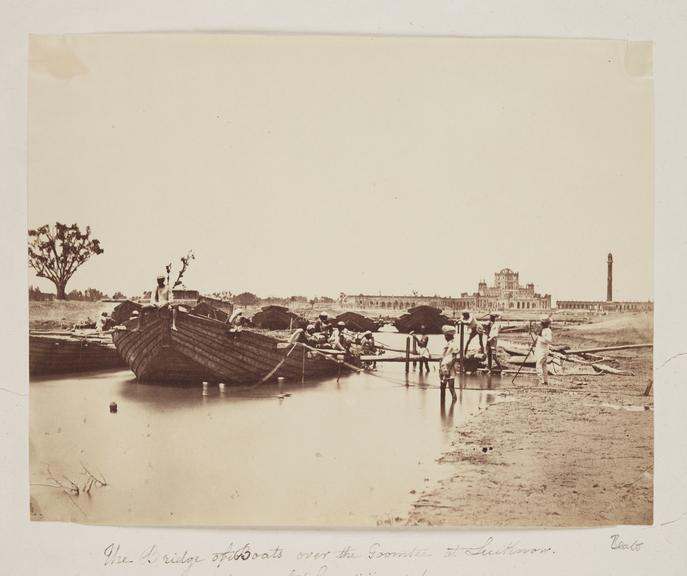
Felice Beato reached India in 1858 and photographed the ruins and the sites of the notable episodes, in some cases arranging remains for effect. The result is one of the earliest extensive photographic records of a conflict anywhere, made entirely from the winners’ side.
What changed
The Company was abolished. The Government of India Act of 1858 transferred everything to the Crown, and Victoria’s proclamation promised religious non-interference and the security of the princely states. Annexation stopped: the surviving princely states were guaranteed, and about a third of the subcontinent’s territory remained under indirect rule until 1947, which is why Independence involved integrating several hundred of them.
The British rebuilt the army around the assumption that it might turn again. The proportion of European troops sharply increased, artillery was kept in European hands, and recruitment shifted toward communities designated “martial races,” principally Punjabis, Sikhs, Gurkhas, and Pathans, and away from the Awadh and Bihar heartland that had risen. Regiments were deliberately mixed or deliberately segregated to make the combination difficult.
The tone of the rule changed most of all. The confidence of the reforming, improving, sometimes Indophile administrator of the earlier nineteenth century gave way to a more distant and more explicitly racial order, with a settled belief that Indians were not to be trusted with power and an official caution about interfering in religion that hardened into a policy of governing through identified communities. A good deal of what followed, including the categorization of caste in the census and the eventual establishment of separate electorates, followed from the lesson the British drew from 1857.
Indians took a different lesson and took it slowly. The Indian National Congress was founded in 1885 by loyalists working within the system, and it took decades before the rebellion was reclaimed as a founding event. Savarkar’s 1909 book, banned before publication, did that work. By 1957, the Government of India was commemorating a centenary, and the figures of 1857 had become national ones.