
Partition
Independence and Partition happened in the same week and are frequently discussed as one event, which flatters the first and evades the second. Somewhere between a few hundred thousand and two million people were killed, and ten to twenty million were displaced, in a few months, mostly by their neighbors.
How the demand arose
The idea that Indian Muslims constituted a separate nation was not old. Separate electorates, conceded in 1909, had already institutionalized the notion that Muslims were a distinct political constituency requiring distinct representation, and the following decades of provincial politics operated on that basis.
Muhammad Ali Jinnah had been, in his early career, a member of the Congress and a constitutionalist known as an ambassador of Hindu-Muslim unity. His shift over the 1920s and 1930s reflected a judgment that a future democracy under a permanent Hindu majority would leave Muslims structurally powerless, and that constitutional safeguards would not hold. The Muslim League’s poor showing in the 1937 provincial elections, and Congress’s refusal to share power in the provinces it won, hardened that judgment considerably.
The Lahore Resolution of 1940 called for the creation of independent states in the Muslim-majority areas of the northwest and the east. What it actually meant was deliberately unspecified. Ayesha Jalal’s influential argument is that Jinnah used the demand as a bargaining position to secure parity within a loose Indian federation, and was outmaneuvered into accepting the thing he had asked for in its most damaging form. Others read the demand as sincere from the start. What is not in dispute is that neither Jinnah nor anyone else was proposing the transfer of populations that actually occurred.
The last decade
The Second World War broke the constitutional process. The Viceroy declared India a belligerent without consulting Indian opinion; Congress provincial ministries resigned in protest; the Cripps Mission of 1942 offered post-war dominion status with a right of provinces to opt out, which Congress rejected and which conceded the principle of partition in advance. The Quit India movement of August 1942 was suppressed with the Congress leadership imprisoned for the duration, leaving the field to the League at exactly the moment its support was growing. The Bengal famine of 1943 killed around 3 million people, while the war economy, provincial export restrictions, and official priorities all worsened the situation.
The 1945–46 elections showed a polarized electorate: Congress dominant in general seats, the League winning the overwhelming majority of Muslim seats and able to claim, with justification, that it now spoke for Muslim India.
The Cabinet Mission Plan of 1946 was the last serious attempt at a united India, proposing a weak federal center with provinces grouped into three sections. Both parties accepted parts of it and interpreted the grouping provisions in incompatible ways, and it collapsed. Jinnah then called Direct Action Day for 16 August 1946. In Calcutta, it produced several days of killing that ran into the thousands, followed by retaliatory violence in Noakhali, then in Bihar, then in the United Provinces and Punjab. From that point, the question was no longer whether to partition but how fast.
Five weeks
Mountbatten arrived as Viceroy in March 1947 and quickly concluded that a settlement had to be reached before the situation became uncontainable. The plan announced on 3 June provided for partition, and he brought forward the transfer date to 15 August 1947, about 10 months earlier than previously intended.
Cyril Radcliffe, a British lawyer with no prior knowledge of India, chaired the boundary commissions for Punjab and Bengal. He arrived in July, had about five weeks, worked from census returns and maps, and chaired commissions whose Indian members deadlocked along party lines, leaving him to decide. He never visited the districts he divided.
He completed the awards before 15 August but did not publish until 17 August. Independence was therefore celebrated by people who did not yet know which country they were living in, and the violence in Punjab was already underway. Radcliffe destroyed his papers and refused to accept his fee.
What happened
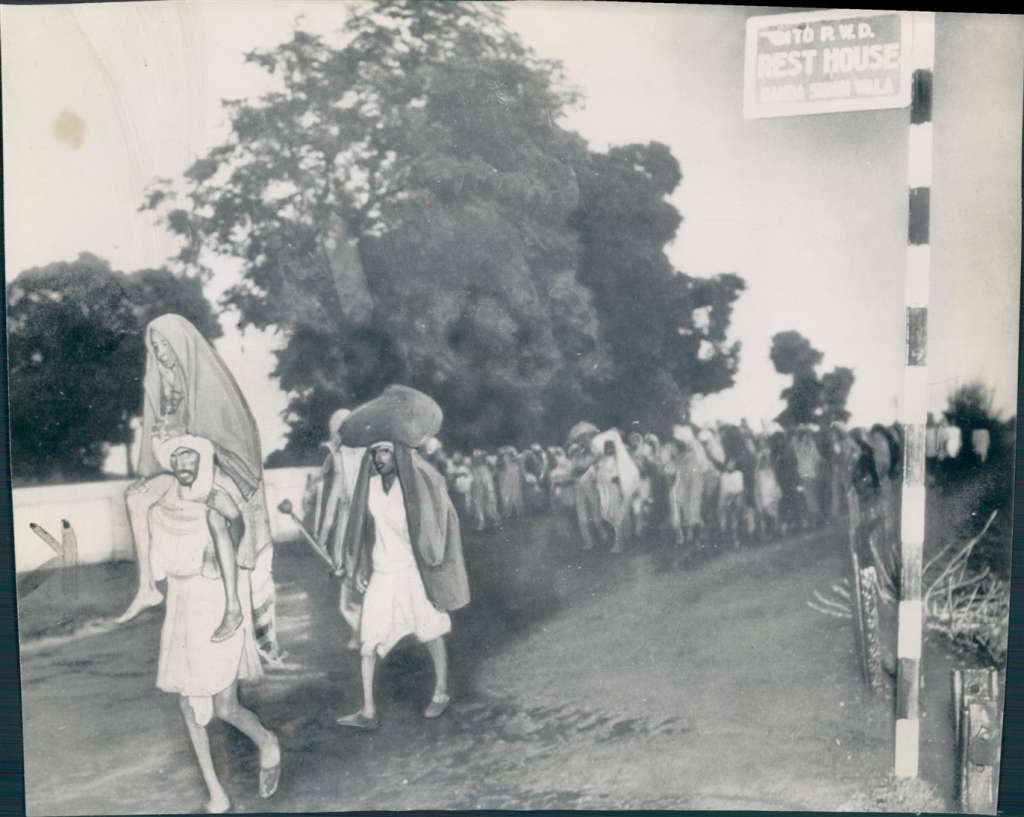
Punjab was the worst. It was a province with intermixed Hindu, Muslim, and Sikh populations, a large body of demobilized soldiers with military training, and organized militias on all sides. When the boundary became known, both directions of migration turned into a rolling massacre: villages attacked and burned, refugee columns ambushed, trains arriving at their destinations with everyone aboard killed. The Punjab Boundary Force, assembled to keep order, was far too small and was disbanded within weeks.
Bengal’s partition was less immediately murderous than Punjab’s. Gandhi’s presence and fast in Calcutta helped stop one outbreak of violence, but different demographics, migration routes, local politics, and the longer timeline of displacement also mattered. Migration in the east was slower, longer-lasting, and continued for decades, meaning the eastern refugee experience was one of protracted attrition rather than a single catastrophe.
Estimates of the dead range from around two hundred thousand to two million, and the range itself is a fact worth noticing: nobody was counting. Between ten and twenty million people crossed the new borders, making Partition one of the largest forced migrations in recorded history.
The violence against women was systematic rather than incidental. Tens of thousands were abducted, raped, forcibly converted, and married to their captors. Very large numbers were also killed by their own families to prevent capture, and some killed themselves for the same reason, acts that were subsequently memorialized in some communities as honorable sacrifice, which is its own commentary. India and Pakistan then agreed on a program to recover abducted women. They legislated for it in 1949, and the recovery operations returned many women to families and countries that no longer wanted them, sometimes years later, sometimes separating them from children born in the interim, and generally without asking them.
The states, and the loose ends
The partition divided British India. It did not, by itself, dispose of the roughly five hundred and fifty princely states. The government told these states that paramountcy would lapse and they should accede to one dominion or the other. Most did, under the effective pressure applied by Vallabhbhai Patel and V.P. Menon. Three did not go smoothly. Junagadh was a Hindu-majority princely state whose Muslim ruler acceded to Pakistan in 1947. India disputed the accession, assumed control of the state after political unrest and the ruler’s departure, and held a plebiscite in 1948 in which voters overwhelmingly favored accession to India. Hyderabad, a large Hindu-majority princely state with a Muslim ruler who sought independence, was annexed by India in September 1948 during Operation Polo. The operation was followed by large-scale communal violence, particularly against Muslims, documented by the Sunderlal Committee, whose report remained unpublished for decades. Kashmir, a Muslim-majority princely state with a Hindu ruler, acceded to India in October 1947 after tribal forces from Pakistan invaded the state. The accession triggered the first India-Pakistan war and a dispute that remains unresolved.
Assets, currency reserves, and the army were divided; the civil services were divided; the irrigation system of Punjab was divided from its headworks, which produced the Indus Waters Treaty thirteen years later.
Gandhi spent Independence Day fasting in Calcutta rather than celebrating in Delhi. In January 1948, he fasted again, in Delhi, to force the Indian government to transfer to Pakistan the cash balances it was withholding and to demand protection for the city’s Muslims. On 30 January, he was shot by Nathuram Godse, a Hindu nationalist who regarded him as too accommodating toward Muslims.
After
Refugee resettlement reshaped both countries. Delhi’s population changed composition almost entirely, its Muslim population falling sharply and Punjabi refugees arriving in enormous numbers. Karachi, Lahore, and the cities of West Punjab changed in the same way in reverse. Calcutta absorbed refugees from the east for decades, and Bengal’s eastern border produced further mass movement in 1950, in 1964, and above all in 1971, when the war that created Bangladesh sent close to ten million people into India.
Citizenship itself had to be invented under these conditions, through permit systems and evacuee property law that determined who belonged where, a process Vazira Zamindar has traced in detail and which shows that the border took years to become real for the people living across it.
The literature of Partition is the most reliable account of what it was. Saadat Hasan Manto’s stories, above all, Toba Tek Singh, Amrita Pritam’s poem addressed to the Punjabi poet Waris Shah, Bhisham Sahni’s Tamas, and later the oral histories collected by Urvashi Butalia and by Ritu Menon and Kamla Bhasin, which recovered the experience of women that the official record had no interest in.
Official commemoration came late and remains awkward, for a reason that is not hard to identify: in both India and Pakistan, the founding story is independence, and the killing was done by neighbors rather than by an imperial power, which makes it a much harder thing to put in a textbook.