
Constitution & Federalism
India is federal because power is constitutionally divided, parliamentary because the executive must retain the confidence of the elected house, and unusually centralized because the Union can do things that many federations reserve for their constituent states. None of those descriptions cancels the others. The system was designed amid Partition, the integration of princely states, food scarcity, and fear of territorial fragmentation. Its strong center was a choice made under pressure, not an accidental departure from a purer model.
The settlement made in the Assembly
The Constituent Assembly first met in December 1946. Its members were elected indirectly by provincial legislatures or nominated by princely states rather than chosen through universal suffrage; the Muslim League boycotted the opening sessions, and Partition changed the body’s membership. That limited mandate did not make the debates perfunctory. Over nearly three years, committees and the full Assembly argued through citizenship, minority protections, language, representation, property, judicial review, and the division of power.

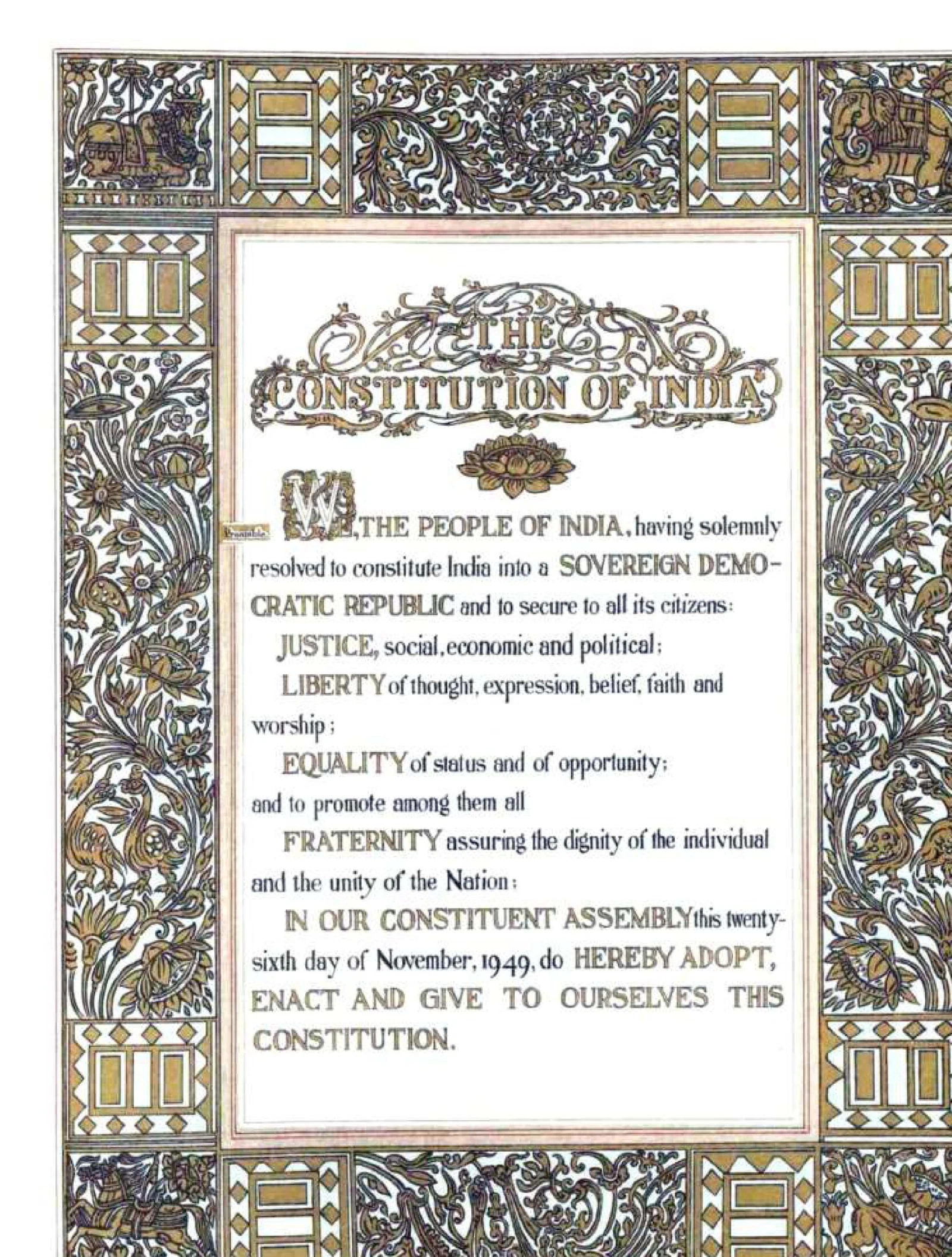
B.R. Ambedkar chaired the seven-member Drafting Committee and was the document’s most formidable defender, but calling him its sole author obscures the institutional process and the work of the constitutional adviser B.N. Rau, committee chairs, Assembly members, and staff. The Assembly adopted the Constitution on 26 November 1949; its principal provisions came into force on 26 January 1950. The text combined enforceable Fundamental Rights with non-justiciable Directive Principles, parliamentary government with judicial review, and political equality with provisions intended to repair inherited social exclusion.
It also refused the looser federation that the Cabinet Mission had once proposed. The Constitution calls India a Union of States, a language Ambedkar explained as denying both a compact among sovereign states and a right to secede. Yet the states have their own elected legislatures and ministries, public services, taxation powers, and constitutional fields of lawmaking. They are not regional offices of Delhi.
A federation with a strong Union
The Seventh Schedule distributes subjects through three lists. Parliament legislates on Union matters such as defense, foreign affairs, currency, and much of interstate commerce. State legislatures control fields including police, public order, public health, and agriculture. Both may legislate on Concurrent subjects such as criminal law, forests, marriage, and education; a valid Union law ordinarily prevails when the two conflict. Residuary subjects not assigned to a list belong to Parliament.
The lists are only the beginning. Parliament can legislate in a State field under specified conditions, including during a national emergency, upon a Rajya Sabha resolution based on national interest, or upon a request from two or more states. It may create new states, alter boundaries, or change names by ordinary law after obtaining the affected state legislature’s views, but not necessarily its consent. The Union appoints state governors, controls the nationwide armed forces, and has much greater access to broad-based taxation and borrowing.
Those powers do not make state politics decorative. Police, land, hospitals, schools, electricity distribution, agriculture, and local government are part of everyday life in states. Regional parties have repeatedly shaped national coalitions, and state governments administer many Union schemes while modifying or supplementing them. A policy announced in Delhi becomes several different policies once budgets, bureaucracies, courts, and electoral incentives in the states act on it.
Unequal by design
Indian federalism is asymmetric. The Fifth Schedule creates a special framework for Scheduled Areas in much of central and peninsular India; the Sixth Schedule gives autonomous councils legislative and judicial functions in specified tribal areas of the Northeast. Several states have or have had tailored provisions under Article 371 and related articles. Union Territories range from territories governed largely through an administrator to Delhi and Puducherry, which have elected legislatures but remain subject to unusual forms of Union authority.
The Rajya Sabha represents the states, but not equally. Seats are allocated broadly by population, so it is not a chamber in which a small state can balance a large one, as in the United States Senate. Its special federal powers matter—it can authorize Parliament to legislate on a State subject and create all-India services—but most governments are made and unmade in the Lok Sabha.
Asymmetry has often been the price of keeping different constitutional histories inside one Union. It can protect local autonomy; it can also create ambiguity about who is accountable. The balance changes when a border region becomes a state, a state becomes a Union Territory, an autonomous council gains authority, or a governor and an elected ministry interpret their powers differently.
Courts, emergency, and amendment
The Supreme Court and High Courts enforce Fundamental Rights and review legislation and executive action. Since Kesavananda Bharati in 1973, Parliament’s power to amend the Constitution has been limited by the judicially created basic structure doctrine: an amendment may alter constitutional provisions but may not destroy foundational features such as democracy, judicial review, secularism, or federalism. The doctrine grants judges extraordinary authority, but it arose from a real problem: whether a temporary parliamentary supermajority could legally remove the conditions for future democracy.
The Constitution also contains emergency powers shaped by the breakdowns of the late colonial period. During a national emergency, the Union can assume greater legislative and executive authority. Article 356 empowers the President to impose President’s Rule in a state when its constitutional government can no longer function. Successive central governments repeatedly used this power to dismiss elected state governments until the Supreme Court’s 1994 S.R. Bommai decision subjected such proclamations to judicial review. They strengthened the principle that legislative majorities should be tested on the floor of the assembly rather than inferred by governors.
Amendments themselves have several routes. Some institutional changes pass by ordinary parliamentary majority; Article 368 generally requires a special majority, and specified federal changes also require ratification by at least half the state legislatures. The Constitution is therefore neither an untouchable founding document nor an ordinary statute. It has been amended often while remaining recognizably the same political settlement.
Money and the third tier
No division of subjects works without money. The Union collects several of the most productive taxes and shares revenue with the states according to recommendations made every five years by a Finance Commission. Grants, centrally sponsored schemes, borrowing rules, and disaster assistance give the Union further leverage. The Goods and Services Tax, introduced in 2017 following a constitutional amendment, pooled much indirect tax authority in a GST Council composed of Union and state representatives. It made a common market more workable while ensuring that tax policy now requires continuous intergovernmental bargaining.
The 73rd and 74th Amendments, passed in 1992 and brought into force in 1993, gave constitutional status to rural panchayats and urban municipalities, required regular elections, and established reservations, including for women and Scheduled Castes and Tribes. They did not transfer a uniform package of staff, revenue, or functions. State governments decide much of what local bodies can actually do, which is why a village council may control meaningful development funds while a large municipal corporation still depends on the state for transport, policing, land, and money.
The most accurate description is therefore not centralized or federal, but negotiated federalism under unequal conditions. Constitutional text matters. So do electoral mandates, party alignment, fiscal dependence, administrative capacity, and whether courts can make the other institutions obey a judgment. The system survives by making conflict routine rather than by eliminating it.