
Environment
India’s environmental problems are interconnected with its development, which is why they resist the framing usually applied to them. The argument is rarely developed against nature in the abstract. It is about who receives the electricity, the minerals, the road, the clean air, or the protected forest, and who is asked to move.
Air
Air pollution is the environmental problem that kills the most Indians, and estimates attribute well over a million deaths a year to it. The Indo-Gangetic plain is the worst-affected region on earth by most measures, and Delhi is only its most reported city; Kanpur, Lucknow, Patna, and dozens of smaller towns record comparable or worse levels with a fraction of the attention.
The sources are diffuse and mostly mundane: vehicle exhaust, coal and biomass burning for power and industry, brick kilns, construction and road dust, waste burning, and household cooking fuel. Seasonal crop-residue burning in Punjab and Haryana adds a sharp autumn spike to the north Indian winter. It receives a disproportionate share of blame for its annual contribution because it is visible, geographically concentrated, and politically convenient to name.
The winter inversion does the rest. Cold, still air traps emissions near the ground across the whole plain, which is why this is a regional airshed problem that no individual city can solve within its own boundaries. The National Clean Air Programme set reduction targets from 2019; the harder work, moving households off solid cooking fuel, cleaning up industry and brick production, controlling construction dust, and providing alternatives to residue burning, proceeds unevenly and rarely produces the kind of announcement that closing schools during a smog episode does.
Heat and water
Heatwaves have become longer, more frequent, and more humid, and humidity is what makes them lethal because the body cools by evaporating sweat, and it cannot do so when the air is already saturated. The exposed population is enormous: agricultural laborers, construction workers, street vendors, and anyone in a tin-roofed room without electricity. Heat action plans exist in many cities, pioneered in Ahmedabad after a severe event in 2010, and their coverage and enforcement vary widely.
Water scarcity is largely a groundwater story, covered in more detail alongside rivers, and its drivers are policy rather than rainfall: subsidized power for pumping, procurement guarantees that reward water-intensive crops in dry regions, and no effective limit on extraction from a shared aquifer. Punjab grows paddy on a water budget it does not have because the state buys the rice.
Cities face the same arithmetic. Chennai’s reservoirs ran effectively dry in 2019 in a city that also floods severely, which is the diagnostic pairing: a place that has destroyed its wetlands and lake beds will experience both problems, because the same absorptive landscape managed both.
The Himalaya
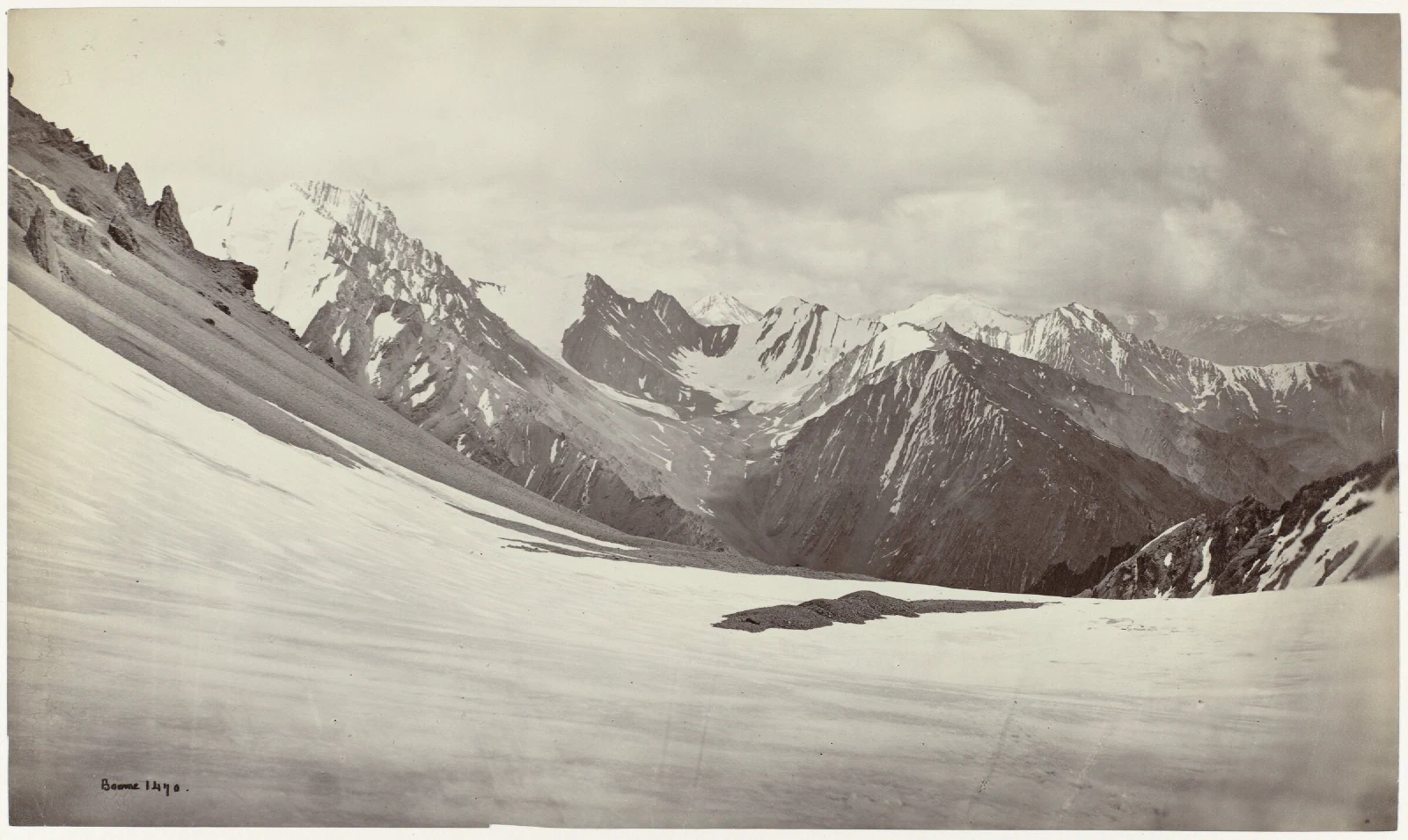
The range is young, still rising, seismically active, steep, and now warming faster than the global average. Glaciers are retreating across most of the range, and the meltwater question is genuinely two-sided: more melt in the short term, less stored water later, with the largest effects on dry-season flow rather than on annual totals.
The immediate hazard is not gradual. Glacial lakes dammed by unstable moraine can burst, sending destructive floods down valleys with little warning; South Lhonak Lake in Sikkim did exactly that in 2023, destroying a large hydropower dam downstream. The Chamoli disaster in Uttarakhand in 2021 killed workers at two hydropower projects. Joshimath, a town on an old landslide deposit, began visibly subsiding in 2023, with construction and tunneling among the suspected contributors.
The policy problem is that road widening, tunneling, and hydropower construction are proceeding rapidly across exactly this terrain, for real reasons: tourism, pilgrimage traffic, and border infrastructure. Slope cutting and debris disposal on unstable ground increase landslide risk in an area already primed for them.
Forests, and who lives in them
India’s conservation architecture is genuinely strong on paper. The Wildlife Protection Act of 1972, Project Tiger from 1973, and the Forest Conservation Act of 1980 built a protected-area network and made diverting forest land legally difficult. Tiger numbers, having fallen very low, have recovered substantially, and India retains large mammal populations, including the world’s Asiatic lions in Gir and a growing elephant and rhinoceros presence, in a country of this population density. That is a real achievement with few parallels.
It was built on exclusion. Colonial forest law had already converted community woodland into state property and criminalized customary use, and independent India kept that structure, adding protected areas and relocating those residents. Millions of forest-dwelling people, disproportionately Adivasi, lived with insecure or unrecognized rights to land they had occupied for generations.
The Forest Rights Act of 2006 was an attempt to correct this, recognizing individual and community rights over forest land and giving village assemblies a say in the diversion of forest land for other uses. Its implementation has been patchy, community rights have been recognized far less often than individual ones, and forest departments have frequently resisted it. Its provisions have nonetheless been consequential: the Dongria Kondh village assemblies of Odisha’s Niyamgiri hills rejected bauxite mining on land they hold sacred in 2013, after the Supreme Court held that they had the right to decide.
Conservation and rights are often presented as opposites, but they are not. The evidence that habitat survives better where the people living in it have secure tenure and a stake in protecting it is reasonably strong.
Energy and emissions
India is among the largest greenhouse gas emitters in absolute terms. Still, it remains below the global average per person, at roughly half that average in recent datasets, and its historical cumulative contribution is far below that of the industrialized economies. Both framings are accurate, both are deployed selectively, and India’s negotiating position, that it should not be asked to constrain growth on the same schedule as countries that emitted their way to wealth, follows directly from the second.
The commitments are real. India pledged to be net zero by 2070 at the Glasgow conference in 2021, has built renewable capacity, especially solar, faster than most projections anticipated, and has initiated the International Solar Alliance. It has also continued to expand coal, which supplies the majority of its electricity, employs large numbers of people, and underwrites the railway’s and several state governments’ finances.
The binding constraints are unglamorous: transmission to move power from where the sun and wind are to where the demand is, storage to handle intermittency, and the finances of state electricity distribution companies, which are chronically loss-making because tariffs are politically set below cost for agriculture and households. Fixing distribution finance is a bigger lever on the Indian energy transition than any generation target.
The movements and the law
India has a long tradition of environmental mobilization that is fundamentally about livelihood rather than aesthetics. Chipko in the Himalayan foothills in the 1970s, in which villagers, many of them women, obstructed the commercial felling of forests they depended on. The campaign that stopped a dam in Kerala’s Silent Valley in the 1980s. The Narmada Bachao Andolan against displacement by the Sardar Sarovar dam. Fisher movements against coastal industrialization. Each began with people defending the resource base on which they lived.
The legal machinery is substantial. The Environment (Protection) Act of 1986 followed the Bhopal gas disaster of 1984, which killed thousands and whose compensation and remediation remain unresolved four decades later. The Supreme Court expanded environmental protection through public interest litigation, reading a right to a healthy environment into the constitutional right to life. The National Green Tribunal, created in 2010 as a specialist court, has ordered closures and remediation with real effect.
Enforcement is the weak point. Environmental clearance depends on impact assessments commissioned by project proponents, whose quality is frequently poor, and a 2020 draft notification proposing to allow post-hoc regularization of projects that began without clearance drew large-scale public opposition. Meanwhile, expert recommendations that would restrict development in ecologically sensitive regions, notably the Gadgil and Kasturirangan reports on the Western Ghats, have sat largely unimplemented under sustained opposition from state governments; the landslides that have repeatedly hit Kerala’s hill districts, including Wayanad in 2024, have repeatedly drawn attention to them.