
Christianity in India
Christianity accounts for about 2.3% of India’s population, or roughly 28 million people. A community is documented on the Malabar coast by the sixth century, and its tradition places its origin in the first, so Christianity in India long predates European colonial rule. Treating every Indian Christian community as a colonial import erases that history.
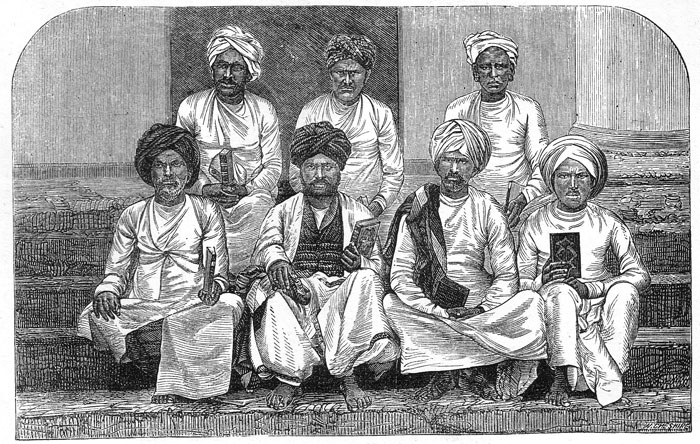
The Thomas Christians
Tradition holds that the apostle Thomas landed on the Malabar coast in 52 CE, founded churches, and was martyred near Mylapore in present-day Chennai. Historians cannot verify that account, and the arguments for and against it are old and unresolved.
What is documented is that a Christian community with East Syriac liturgical and ecclesiastical connections existed on the Malabar coast well before any European arrival. The Alexandrian merchant known as Cosmas Indicopleustes described Christians in India in the sixth century. The community used Syriac as its liturgical language, received bishops from the Church of the East in Mesopotamia, and possessed copper-plate grants of privileges from local Hindu rulers. A separate migration tradition centers on Thomas of Cana, associated with the endogamous Knanaya community.
Their social position is what surprises people. The Saint Thomas Christians were not a marginal group. Hindu rulers integrated the Saint Thomas Christians into Kerala’s caste order at a high rank, granted them land and trading privileges, and recognized them as a respectable community rather than as outsiders. Christianity in Kerala is, therefore, an old Indian religion with a caste position, and that fact shapes everything about the later story.
The Portuguese rupture
Vasco da Gama reached Calicut in 1498, and the Portuguese found, to their considerable confusion, Christians who had never heard of the Pope. What followed was an attempt to bring an ancient church under Latin authority.
The Synod of Diamper in 1599 imposed Roman liturgy, discipline, and hierarchy on the Malabar church and ordered the destruction of Syriac books judged heretical. Resentment accumulated for half a century and broke out in 1653 as the Coonan Cross Oath, when a large body of Saint Thomas Christians swore not to submit to the Portuguese archbishop. The community split, and the fractures from that moment produced the plural landscape that exists today: the Syro-Malabar and Syro-Malankara churches in communion with Rome, and the Malankara Orthodox, Jacobite, Mar Thoma, and other bodies outside it, with litigation between some of them continuing to this day.
Portuguese Christianity elsewhere was more coercive. Goa was administered as Portuguese territory with the Goa Inquisition operating from 1560 until the early nineteenth century. Its formal jurisdiction was over baptized Christians, including converts accused of retaining Hindu or Muslim practices and descendants of Iberian Jews or Muslims suspected of practicing their former faiths in secret. Portuguese civil and ecclesiastical authorities separately restricted non-Christian worship and destroyed temples in territories under direct control. Goan Catholic culture, with its distinctive music, architecture, cuisine, and Konkani liturgy, grew from that history rather than around it.
Not all Catholic missions worked that way. Francis Xavier arrived in 1542 and worked among the Paravar fishing communities of the Tamil coast. Roberto de Nobili, in Madurai from 1606, adopted the dress, diet, and manner of a Brahmin ascetic, learned Sanskrit and Tamil, and argued that caste observance was a social rather than religious matter, an approach that produced converts, a long controversy in Rome over the Malabar Rites, and a mission that reproduced caste inside the church.
Protestant missions
The first sustained Protestant mission began at the Danish trading post of Tranquebar in 1706, where Bartholomäus Ziegenbalg learned Tamil, translated the New Testament, argued that Indian religion deserved serious study, and established schools and a printing press. William Carey at Serampore from 1793 built on the same combination of translation, printing, and education, producing scriptures and grammars in numerous Indian languages.
The East India Company initially resisted missionaries, correctly judging them a threat to political stability, and admitted them only after the British Parliament renewed and revised its charter in 1813. Once admitted, mission organizations built schools, colleges, hospitals, orphanages, and presses at a scale that reshaped Indian education and made a lasting contribution to the standardization of several Indian languages in print.
Conversion followed the education only partly. Many mass movements of the nineteenth and early twentieth centuries, in which whole communities entered the church together, occurred among Dalit and Adivasi groups in Andhra, Tamil Nadu, Punjab, and central India. Motives varied and included religious conviction, schooling, new institutions and networks, and the prospect of dignity or distance from an oppressive social hierarchy.
The Northeast
The region is a separate story. American Baptist and Welsh Presbyterian missions worked in the hills from the nineteenth century, in areas where colonial policy had restricted plains contact through the Inner Line, and the results were unusually complete. Nagaland, Mizoram, and Meghalaya are Christian-majority states, and church institutions carry real social and political authority there. Missionaries wrote scripts for several languages, so literacy, print, and Christianity arrived together and are hard to separate in the region’s history.
Institutions and independence
Indian Christianity organized itself increasingly on Indian terms in the twentieth century. The Church of South India, formed in 1947, united Anglican, Methodist, Congregational, and Presbyterian bodies and was the first union anywhere to bring episcopal and non-episcopal churches into one structure; the Church of North India followed in 1970. Indian theologians developed distinct traditions, including Dalit theology, which reads scripture from the position of the caste-oppressed and is one of India’s genuine contributions to global Christian thought.
Christian institutions remain important in education and healthcare far beyond their demographic share, serving students and patients of all religions.
Two live problems
Caste did not disappear at the church door. Converts brought their caste with them, and separate seating, separate cemeteries, and endogamy have been documented in Indian churches for centuries. Dalit Christians, a large majority of the community, have organized against discrimination within the church as well as outside it.
Their sharpest grievance is legal. A Presidential Order of 1950 restricted Scheduled Caste status to Hindus; the Government of India later amended the order to include Sikhs and then Buddhists, but not Christians or Muslims. A Dalit who converts to Christianity, therefore, loses access to reservations in education, employment, and legislatures, while losing none of the social discrimination that justified them. The position has been challenged for decades and remains before the courts and under official review.
Conversion is a political question. Several states operate Freedom of Religion Acts that require official notice of conversion and prohibit conversion by force, fraud, allurement, or marriage, with the definition of allurement broad enough to cover the provision of education or medical care. Enforcement falls mainly on Christian and Muslim activity, and prosecutions have frequently followed complaints by third parties rather than by any alleged convert.
Violence has punctuated the last three decades: the murder of the Australian missionary Graham Staines and his two sons in Odisha in 1999, the Kandhamal violence in the same state in 2008, which killed dozens and displaced tens of thousands, and a persistent pattern of attacks on prayer meetings and churches recorded by Christian organizations and civil liberties groups. The underlying anxiety, that conversion changes the demographic and political balance sits uneasily beside a constitutional right to propagate religion that the Constituent Assembly debated and deliberately retained.