
Indian Secularism
India is a secular republic in a sense that has almost nothing to do with the American arrangement, and confusing the two makes the whole subject unreadable. There is no wall of separation here. State governments administer major temples and appoint their trustees, the state funds pilgrimages and religious education, and family law is divided among four religious systems. The operating principle is state engagement with religious communities, not state abstention from religion.
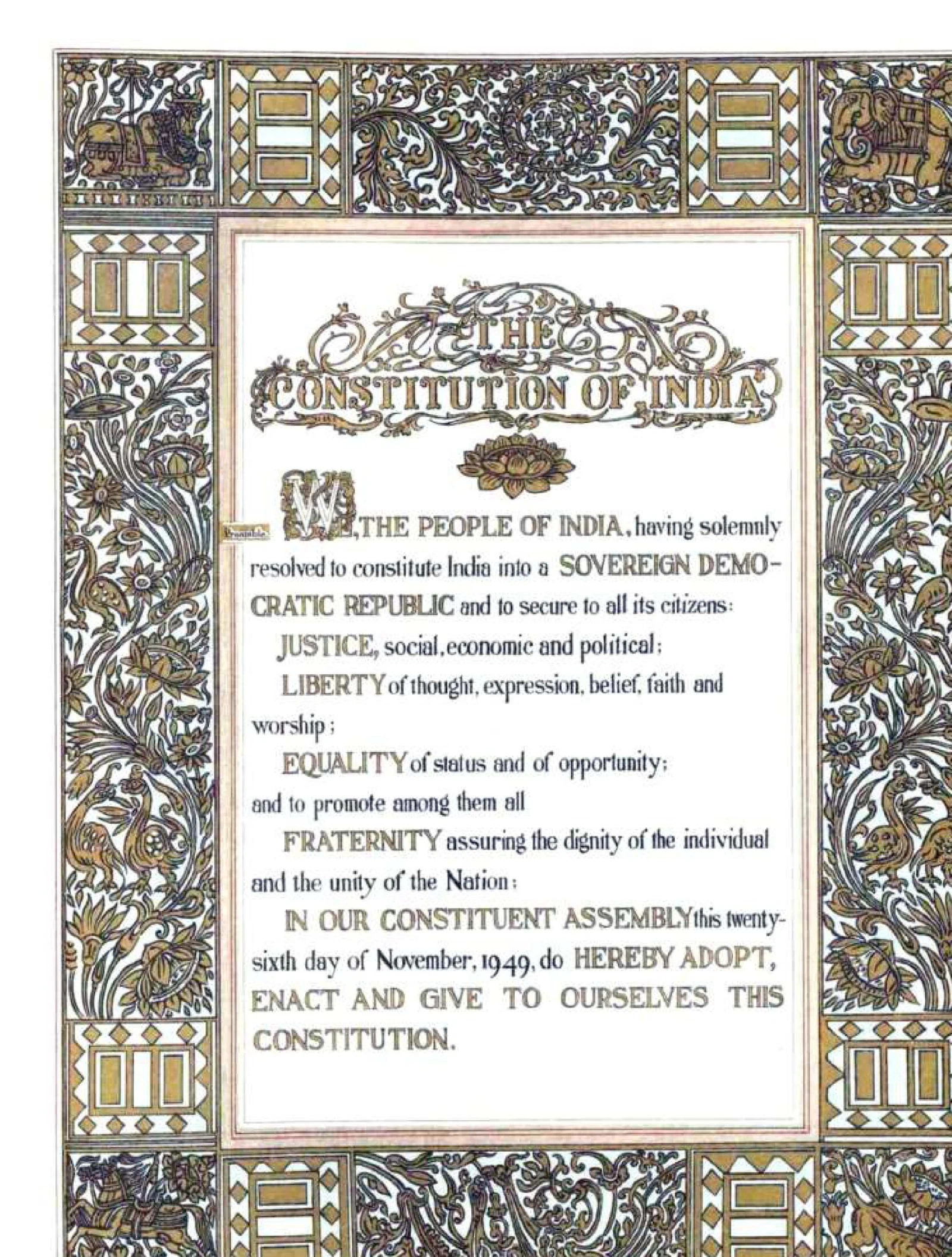
What the Constitution actually says
The word “secular” was not in the original text. It was inserted into the Preamble by the 42nd Amendment in 1976, during the Emergency, which is an awkward provenance for a principle now treated as foundational. The substance, however, had been there since 1950.
Articles 25 to 28 guarantee freedom of conscience and the right to profess, practice, and propagate religion, subject to public order, morality, health, and the state’s power to regulate secular activity associated with religious practice and to legislate for social welfare and reform. Articles 14 and 15 prohibit discrimination on grounds including religion. Articles 29 and 30 give religious and linguistic minorities the right to conserve their culture and to establish and administer educational institutions, a protection with real financial and regulatory consequences.
Two features of that list are worth noticing. The right to propagate religion was contested in the Constituent Assembly and was included, which is why conversion is a constitutional question in India rather than merely a social one. And the explicit reservation of the state’s power to reform religious practice was deliberate: the framers intended the state to intervene in religion, specifically to abolish untouchability and open temples, and the caste question is the reason the Indian model is built the way it is.
The Supreme Court held in S.R. Bommai (1994) that secularism forms part of the Constitution’s basic structure, meaning it cannot be amended away, and that a state government acting on a sectarian basis may be dismissed.
Four family laws and a civil one
Marriage, divorce, maintenance, inheritance, adoption, and guardianship are governed by the personal law of the parties’ religious community. Hindu law was codified in a set of statutes in 1955 and 1956, and those statutes apply to Buddhists, Jains, and Sikhs as well, despite objections from some in each of those traditions. Muslim personal law was given statutory application in 1937 and remains substantially uncodified. Christians and Parsis have their own marriage and divorce legislation. The Special Marriage Act of 1954 provides a civil alternative available to anyone, at the cost of a notice period that, in practice, exposes inter-religious couples to family and vigilante pressure.
The codification was itself asymmetric, and honestly so. Nehru and Ambedkar pushed the Hindu Code Bills through fierce opposition, substantially reforming Hindu marriage and inheritance; comparable reform of Muslim personal law was not attempted, on the argument that it should come from within the community rather than be imposed on a minority. Whether that was prudence or a failure of nerve has been argued ever since.
Two cases define the modern dispute. In Shah Bano (1985), the Supreme Court granted maintenance to a divorced Muslim woman under the general criminal code; the government, facing protest, passed legislation in 1986 that was widely read as reversing the outcome, and the episode is generally treated as a turning point that damaged the credibility of the secular settlement on all sides. In Shayara Bano (2017), the Court held that instant triple talaq is invalid, and Parliament went further in 2019 by making its pronouncement a criminal offense, a step critics regard as punishing a practice the Court had already voided.
Article 44 lists a uniform civil code among the directive principles, as an aspiration rather than an obligation. The argument over it is genuinely difficult: a common code would advance gender equality against religious personal laws that disadvantage women, and it is also promoted by a political movement whose interest in it is not primarily about women’s rights, and it would override Hindu, Christian, Parsi, and Adivasi customary law as well as Muslim law. Goa retained a Portuguese-derived common civil code after 1961. Uttarakhand enacted its own state code in 2024 and brought it into force in January 2025, becoming the first state in independent India to enact and implement a new UCC; notably, it exempts the state’s Scheduled Tribes, which concedes at the outset that “uniform” is doing less work than the word suggests.
The state inside the temple
Several states administer Hindu religious endowments directly through statutory departments, appointing trustees, controlling revenue, and managing large temples. This arrangement descends from colonial legislation and, before that, from the ordinary expectation that a ruler oversees religious institutions. It sits oddly with any separation principle and is defended because these endowments are enormous public trusts with a long history of mismanagement.
It also produces a real, though not absolute, asymmetry that critics on the Hindu right emphasize: several states directly administer large numbers of Hindu temples, while churches are generally managed by their denominations and mosques and gurdwaras by statutory or community bodies such as waqf boards and the SGPC. The state, therefore, regulates the other institutions as well, but usually through a different structure. State control of temples is a burden rather than a privilege, and the patchwork is hard to justify from first principles.
The state also funded the Haj pilgrimage for decades, ending the subsidy in 2018 following a Supreme Court direction, and supports religious education and institutions across communities in various forms.
Judges deciding what religion requires
The most consequential and least defensible piece of Indian secular doctrine is the essential religious practices test. Because the Constitution protects religious practice but permits regulation of secular activity connected with it, courts had to decide which practices count. They resolved this by asking whether a practice is essential to the religion and answering that question themselves, based on scripture and expert evidence.
The result is a body of case law in which judges determine whether a particular observance is integral to a faith, and therefore protected, or merely customary, and therefore regulable. Courts have ruled on the status of practices across Hindu, Muslim, Sikh, Parsi, and Christian traditions. Scholars across the political spectrum have criticized the doctrine for putting the state in the position of theologian, which is precisely what a secular state is supposed to avoid, and for privileging textual over lived religion.
Sabarimala shows the difficulty. In 2018, the Supreme Court held that excluding women of menstruating age from the temple violated constitutional equality. Protesters across Kerala responded with mass demonstrations, and the judgment had significant electoral consequences, prompted review petitions, and led the Court to refer broader questions to a larger bench. The case set the equality guarantee against a claim of religious autonomy, with women on both sides of the argument, and no reading of secularism resolves it cleanly.
Where it is strained
Anti-conversion laws, styled Freedom of Religion Acts, operate in several states and typically require prior notice to a district official and prohibit conversion by force, fraud, allurement, or, in recent versions, marriage. They apply in practice overwhelmingly against Christian and Muslim activity, and prosecutions and mob action have followed.
The Places of Worship Act of 1991 froze the religious character of places of worship as it stood on 15 August 1947, expressly excluding the disputed site at Ayodhya. Its purpose was to close off further claims of the same kind. Litigation seeking surveys of other mosques has since tested it, and the Supreme Court’s 2019 Ayodhya judgment, which awarded the disputed site for a temple while holding the 1992 demolition of the mosque unlawful, is read as a settlement by some and as a precedent by others.
Cow protection legislation, drawing on a directive principle framed in agricultural terms, has been enacted with varying severity across most states, and its enforcement has been accompanied by vigilante violence.
The critique
Indian secularism has serious critics on more than one side, and they are not all arguing in bad faith.
From the Hindu right, the charge is that the model is not neutral but a system of minority appeasement, in which Hindu institutions are regulated and reformed while minority personal laws and institutions are left alone.
From a different direction, T.N. Madan and Ashis Nandy have argued that secularism as an ideology is an import poorly matched to a society where religion is not a private matter, and that the older, non-ideological practice of everyday tolerance may in fact be a firmer foundation than the constitutional apparatus.
From the left and from within the tradition, the criticism is that the model has been applied inconsistently, that the state has too often traded principle for community-leader support, and that the failure to build gender equality into personal law is a fifty-year default whose cost is borne by women.
What is not in serious dispute is that the arrangement was designed for a specific problem: holding together a country with a large religious majority, a very large religious minority, and a caste hierarchy that the state was constitutionally obliged to dismantle. Whether it is holding is the live question in Indian public life, and no page can settle it.