
Zoroastrianism
Fewer than sixty thousand Zoroastrians remain in India, roughly half the number counted in the 1940s. That small community produced a disproportionate share of the country’s industry, philanthropy, law, and nationalist politics, and it is now facing a decline that its own institutions cannot agree on how to address.
The religion
Zoroastrianism derives from the teachings of Zarathushtra, whose date is disputed over a very wide range, and who composed the Gathas, the oldest layer of the Avesta, in an archaic Iranian language closely related to Vedic Sanskrit. That linguistic kinship is not incidental: the Iranian and Indo-Aryan traditions descend from a common ancestor, and the relationship between the Avestan and Vedic religious vocabularies is one of the foundational observations of comparative Indo-European scholarship. In a notable inversion, a word cognate with Sanskrit deva denotes hostile beings in the Iranian tradition, while a cognate of asura names the supreme god.
The theology centers on Ahura Mazda, the wise lord, and on a cosmic opposition between truth and falsehood in which human beings are moral agents whose choices matter to the outcome. The ethical formula is compact and memorable: good thoughts, good words, good deeds. Fire is venerated as the purest symbol of the divine presence rather than worshipped in itself, and the tradition’s emphasis on purity, the sanctity of the elements, and individual moral accountability shapes both its ritual and its funerary practices.
Zoroastrian traditions were closely associated with the pre-Islamic Iranian empires and received explicit state patronage under the Sasanians; how confidently the Achaemenids or Parthians should be labeled Zoroastrian remains debated. After the Arab conquest of Iran in the seventh century, the religion gradually became a minority faith there, where a small community persists.
The migration
Parsi tradition, preserved in the Qissa-i Sanjan, a Persian narrative poem written in Gujarat in the sixteenth century, tells of ancestors leaving Iran after the Islamic conquest, sailing to Gujarat, and landing at Sanjan, where a local ruler granted them refuge on conditions including that they explain their faith, adopt the local language, and refrain from proselytizing.
The story’s most repeated element is the sugar in the milk: presented with a full vessel of milk to indicate that the land had no room, the Zoroastrian priest stirred in sugar to show that his people would sweeten it without displacing anything. It is a good story, and it has done enormous work in the community’s self-understanding, positioning Parsis as grateful guests who contribute rather than compete.
Historians place the arrival somewhere between the eighth and tenth centuries and think it likely occurred in stages rather than as a single voyage. The community established itself in Gujarat’s coastal towns, farmed and traded, and maintained its priesthood, calendar, and sacred fires.
Bombay
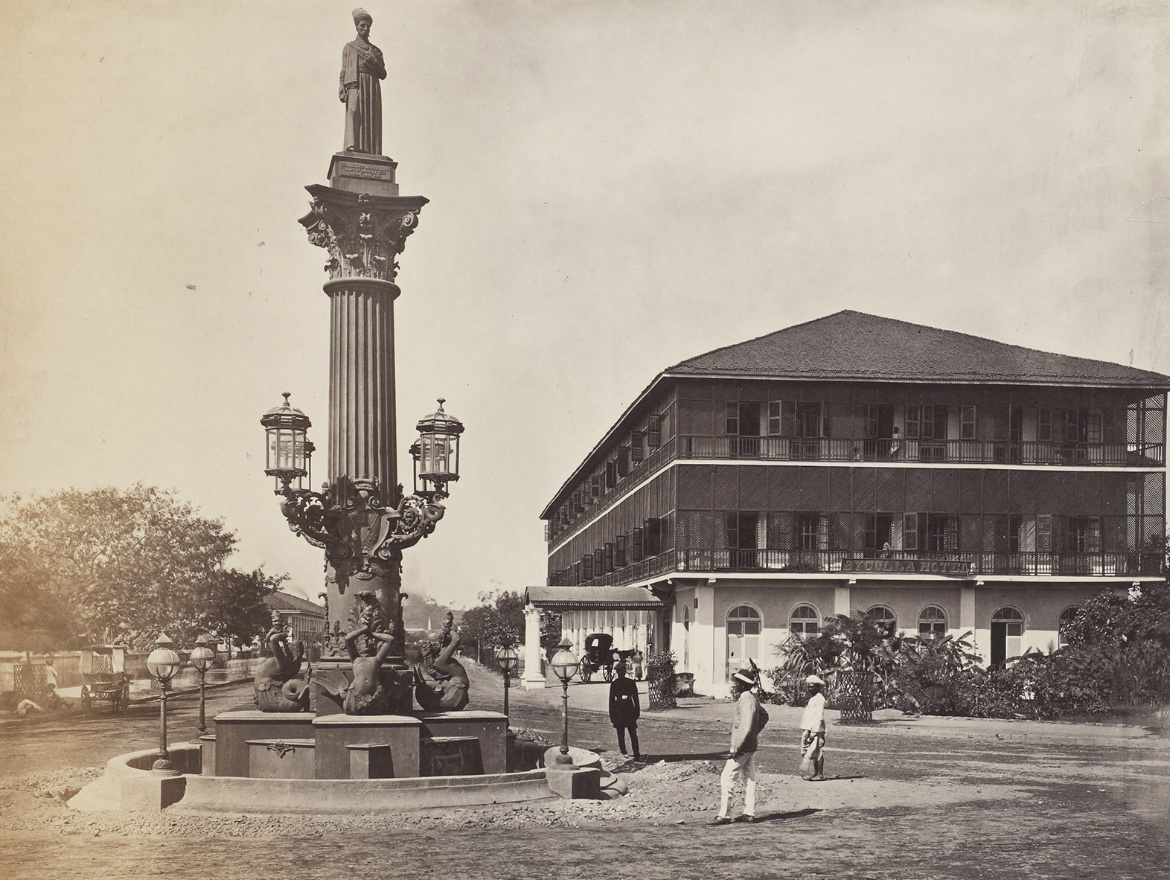
The decisive move was to Bombay. Parsis migrated to the English settlement from the seventeenth century onward. They became central to its commercial life, as shipbuilders, brokers, traders in cotton and opium with China, and later as industrialists.
The Wadia family built ships for the Royal Navy at the Bombay dockyard. Jamsetji Jejeebhoy’s China trade financed hospitals, schools, and waterworks, and produced the first Indian baronetcy. Jamsetji Tata founded the enterprise that became India’s largest industrial group, developed the plan for an Indian steel works, and helped endow the Indian Institute of Science. He died in 1904; his son, Dorab, and other successors incorporated Tata Iron and Steel in 1907 and brought the Jamshedpur plant into production in 1912. Tata philanthropy, structured so that charitable trusts own the majority of the holding company, remains unusual anywhere in the world. Ardeshir Godrej built another industrial house.
The political contribution was equally large. Dadabhai Naoroji, the “Grand Old Man of India,” developed the drain-of-wealth analysis of colonial economics, presided over the Indian National Congress, and became the first Indian elected to the British House of Commons in 1892. Pherozeshah Mehta was a founder of the Congress. Bhikaiji Cama unfurled a version of an Indian flag at an international socialist congress in Stuttgart in 1907. Later came Homi Bhabha, who built India’s nuclear program; the field marshal Sam Manekshaw; the conductor Zubin Mehta; and, at a tangent, Farrokh Bulsara, born to a Parsi family and known professionally as Freddie Mercury.
The reasons for that outsized role are debated: early adoption of English education, a community structure that effectively pooled charitable capital, the absence of caste restrictions on occupation, a position as a small minority trusted by the colonial power and not threatening to anyone, and simple compounding advantage. Parsi philanthropy is the part that is not debated. It built a disproportionate share of Bombay’s hospitals, schools, libraries, and housing colonies, and much of it was open to all communities.
The Iranis are a distinct and later group: Zoroastrians who migrated from Iran in the nineteenth and twentieth centuries, whose cafés became an institution in the lives of Bombay, Hyderabad, and Pune.
Fire and the towers
The ritual centers on consecrated fires maintained in fire temples, graded by the elaborateness of their consecration, with the highest grade represented by a small number of Atash Behrams in India; the oldest, at Udvada in Gujarat, is said to descend from a fire brought by the original migrants. Non-Zoroastrians are not admitted to the temples.
Funerary practice is the most distinctive and now the most difficult element. Because earth, fire, and water are sacred and a corpse is a source of pollution, the dead have traditionally been exposed on the raised structures called dakhma, or towers of silence, to be consumed by vultures.
That system collapsed for an unexpected reason. From the 1990s, South Asian vulture populations crashed by well over ninety percent, poisoned by residues of the veterinary anti-inflammatory drug diclofenac in cattle carcasses. Without vultures, the towers stopped working. The community has responded with solar concentrators to accelerate desiccation, with captive vulture breeding proposals, and with a growing number of families choosing cremation or burial, which traditionalists reject. It is a genuine religious crisis produced by a pharmaceutical side effect.
The demographic question
The population has fallen for a century, and the causes are well documented rather than mysterious: late marriage, high rates of non-marriage, small family size, emigration, and a very high proportion of older adults. Parsis have among the highest education levels and lowest fertility of any community in India.
Conversion is not accepted by the orthodox position, which holds that religion is one a person is born into, and this is where the internal argument is fiercest. Children of Parsi men who marry outside the community are generally accepted; children of Parsi women who do so frequently are not, a rule that is patrilineal rather than doctrinally required and that has been challenged in Indian courts and contested by reformers. North American Zoroastrian communities have moved further toward acceptance of intermarriage and conversion than Indian institutions have.
The Government of India has funded a program since 2013 intended to encourage larger Parsi families through fertility treatment and advocacy, which is an unusual thing for a secular state to do and reflects how the community is regarded. Whether any of these arrests will cause the decline is doubtful. What is not doubtful is that India holds the largest surviving concentration of Zoroastrian life anywhere, and that this has been true for roughly a thousand years.