
Judaism in India
India’s Jewish communities have almost nothing in common with each other. They arrived at different times by different routes, spoke different languages, followed different customs, and for most of their history did not regard one another as the same people. Treating them as a single Indian Jewry is a modern convenience.
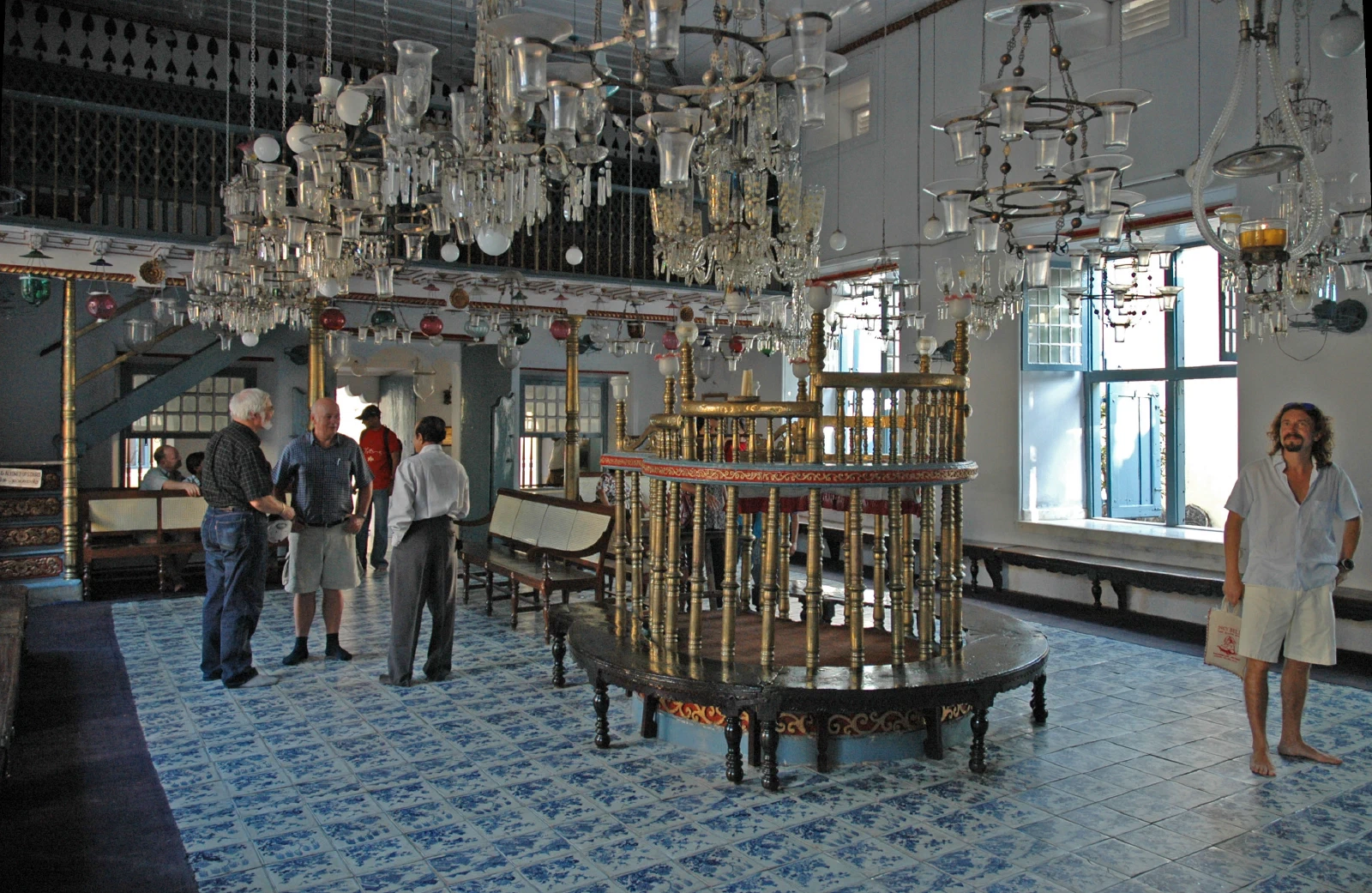
Cochin
The Jews of Kerala are the oldest documented community. Their foundational possession is a set of engraved copper plates, granted by a Chera ruler to a leader known as Joseph Rabban, conferring hereditary privileges, trade rights, and honors of a kind normally reserved for high-status subjects. The plates are usually dated to the tenth or eleventh century and establish that a Jewish community was settled, prosperous, and formally recognized on the Malabar coast a thousand years ago.
The community spoke Judeo-Malayalam, developed its own liturgical customs and a distinctive body of Malayalam-language songs by women, and traded in pepper and spices. It was also internally stratified, along lines that mirrored the surrounding caste order more than anything in Jewish law: the Paradesi or “foreigner” Jews, whose ancestors arrived later from Iberia and West Asia, maintained a separate synagogue and, for a long period, would not intermarry with or count in a quorum the older-established Malabari Jews. Indian Jewish history is not exempt from Indian social history.
The Paradesi Synagogue in Kochi, built in 1568 beside the Mattancherry Palace, is the best-known Jewish building in India, floored with hand-painted Chinese tiles, none of which are identical.
The Bene Israel
The Bene Israel of the Konkan coast, south of Bombay, are the largest of the historic communities and the one whose origins are least documented. Their own tradition tells of a shipwreck off the coast, of a small number of survivors who lost their books, and of the retention of a few core observances, the Sabbath, circumcision, dietary restriction, and the Shema, without rabbinic literature or a priesthood.
They lived as village oil-pressers, and their Marathi-speaking neighbors knew them as Shanwar Teli, Saturday oil-pressers, because they did not work on the Sabbath. That name is the best evidence of what the community actually was: an Indian village caste-like group defined occupationally, which happened to be Jewish.
Contact with wider Jewish practice came late. Cochin Jews, and later Christian missionaries who translated Hebrew scripture into Marathi, and then Baghdadi arrivals, reconnected the Bene Israel with normative Judaism from the eighteenth century onward. Many moved to Bombay, entered the colonial army, later took clerical and professional employment, and built synagogues there. When large numbers of people emigrated to Israel after 1948, the rabbinate initially raised questions about their personal status, and a public campaign and a government decision in the early 1960s resolved the matter in their favor.
The Baghdadis
The Baghdadi Jews were the most recent and the most commercially prominent of the older communities: Arabic-speaking merchants from Baghdad, Basra, Aleppo, and elsewhere in West Asia who established themselves in Surat, Bombay, and Calcutta from the late eighteenth century, trading across the Indian Ocean.
The Sassoon family is the emblematic case, moving from Baghdad to Bombay in the 1830s and building textile mills, docks, warehouses, schools, hospitals, libraries, and synagogues, with a commercial network reaching Shanghai and London. Baghdadi philanthropy left a visible mark on both cities.
The community’s social position was ambiguous in a revealing way. Baghdadi Jews largely identified with the British, educated their children in English, and for a long period sought classification as European rather than Indian, keeping their distance from the Bene Israel. The colonial racial hierarchy did not entirely accommodate them, and the ambiguity remained unresolved until decolonization rendered it moot.
The Bnei Menashe
The Bnei Menashe of Manipur and Mizoram are different in kind. Communities among the Kuki-Chin-Mizo peoples came to identify themselves from the twentieth century as descendants of a lost tribe of Israel, following a period in which Christianity had already reshaped the region’s religious life. They adopted Jewish practice, and an Israeli chief rabbi recognized their claim in 2005 on the basis that they should undergo formal conversion, after which several thousand have emigrated to Israel.
Most historians do not accept the claim as a matter of descent. What is not in doubt is that the community’s practice is now genuinely Jewish and sustained. A comparable movement, the Bene Ephraim, exists among Telugu-speaking communities in Andhra Pradesh.
Departure
Almost all of it ended within a generation. After the establishment of Israel in 1948, the great majority of Cochin Jews and Bene Israel emigrated, as did most Baghdadis, some to Israel and others to Britain, Australia, Canada, and the United States. The motives were mixed: religious and Zionist conviction, the economic uncertainty of the immediate post-independence years for commercially exposed minorities, and the pull of family who had already gone.
A few thousand Jews remain in India, concentrated in Mumbai, with small numbers in Kolkata, Kochi, Ahmedabad, Pune, and the Northeast. Synagogues in Kochi and Kolkata are maintained primarily as heritage buildings, some with support from the state and descendants abroad.
The exception worth naming
Indian Jewish communities experienced remarkably little organized antisemitism, and the point is made often enough that it deserves both endorsement and a caveat. The endorsement: over centuries, Jewish communities here held land grants, built synagogues openly, served in armies and administrations, and were not subjected to the expulsions, ghettoization, blood libels, or pogroms that characterize the European record. India also took in Jewish refugees from Europe in the 1930s and 1940s.
The caveat is the Portuguese. The Goa Inquisition prosecuted people of Jewish descent, among others, and Iberian Jews who had fled to India found the machinery they had escaped rebuilt on the Malabar coast; Portuguese forces attacked the Kerala community’s settlement at Cranganore in the sixteenth century, which is part of why it consolidated at Cochin under the protection of the local raja. And in 2008, the Chabad House in Mumbai was deliberately targeted during the attacks on the city, killing the rabbi, his wife, and others. The generalization holds. It is not unqualified, and self-congratulation should stop short of the exceptions.