
Jainism
Jainism holds that reality contains countless souls, that every one of them, human, animal, insect, and in some accounts plants and elemental beings, has moral standing, and that violence toward any of them binds the soul more tightly to the cycle of rebirth. Ahimsa, non-violence, follows from this as a metaphysical rather than an ethical consequence, and Jain practice imposes exceptionally demanding disciplines around it: vegetarianism as a floor, filtering water, avoiding root vegetables, and monastics sweeping the ground ahead of their feet. Some Shvetambara monastics wear a muhapatti, a cloth before the mouth; Digambara and Shvetambara practices differ in important ways.
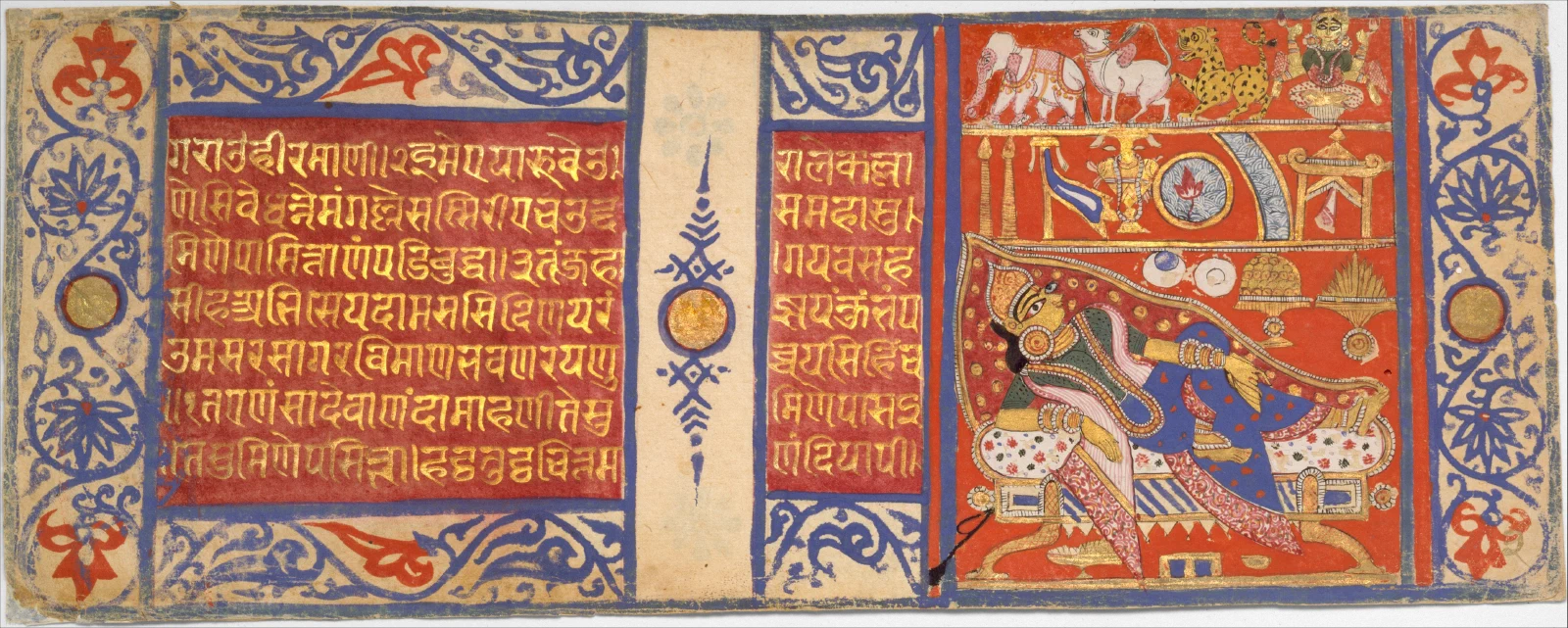
Mahavira, traditionally 599–527 BCE, is the twenty-fourth and last tirthankara of the current cycle; Jain tradition holds that the teaching is beginningless rather than founded. The two main orders, Digambara and Shvetambara, split in the early centuries CE over issues including monastic clothing and the question of whether women can achieve liberation.
The philosophical contribution most worth knowing is anekantavada, the doctrine of many-sidedness. Reality is too complex for any single viewpoint to capture, so every statement about it is true only from a particular standpoint, and dogmatism is an epistemological error before it is a moral one. The Jain tradition illustrates this with the parable of the blind men and the elephant, which the Buddhists and the Vedantins also use, and whose origin is genuinely disputed, the earliest surviving version being in the Pali Udāna. The parable’s own point applies neatly to the argument about who owns it.
Karma as a substance
The feature that most distinguishes Jain metaphysics is its account of karma. In most Indian systems, karma is a moral law of consequence. In Jainism, it is an extremely subtle matter that is physically attracted to the soul by its activities and adheres to it, weighing it down and obscuring its innate qualities of infinite knowledge, perception, bliss, and energy.
That literalism drives the whole practice. If karmic matter physically accumulates through action, then liberation requires both stopping the inflow and burning off what is already attached, which is why Jain asceticism is directed at reducing activity itself and why austerity and fasting are understood as actively destroying accumulated karma rather than merely earning merit. It also explains why intention matters but does not fully excuse: harm done carelessly still binds, which produces an ethics of continuous vigilance rather than of good motives.
In this scheme, the universe has no creator and no beginning. It operates by its own laws through vast cycles of ascending and descending time, and liberated souls rise to the top of it and remain there. Jainism is atheistic in the specific sense that it has no god who made or governs the world, while venerating the tirthankaras, who are entirely beyond intervening in anything.
The vows and the two orders
Practice is organized around five vows: non-violence, truthfulness, not taking what is not given, chastity, and non-attachment. Monastics take them in their full form; lay Jains take limited versions, an arrangement that makes the tradition workable for a merchant community while preserving a demanding monastic core. Lay life is further shaped by dietary rules, periodic fasting, and the annual observance of Paryushana, which ends with a day of asking forgiveness from everyone one may have harmed.
The Digambara and Shvetambara orders separated over the early centuries CE. Digambara, “sky-clad,” monks renounce clothing entirely; Shvetambara, “white-clad,” monks wear white robes. The disagreement extends beyond dress: Digambaras hold that women cannot attain liberation in a female body and that the original canon was lost. In contrast, Shvetambaras hold that women can preserve a canon of texts that the Digambaras do not accept. Both maintain nunneries, and Jain nuns substantially outnumber monks.
The tradition’s most demanding practice is sallekhana, the voluntary fast to death undertaken by someone who judges the body no longer capable of supporting religious life. Jains distinguish it sharply from suicide, which is an act of passion, whereas this is meant to be a deliberate, publicly declared, and gradual withdrawal. A 2015 Rajasthan High Court ruling held it unlawful; the Supreme Court stayed that decision, and the question remains open.
What Jains built
Jain patronage produced some of the finest architecture in India. The marble temples at Mount Abu, particularly the Dilwara group, are carved to a fineness that is genuinely difficult to believe at first sight. The temple city on Shatrunjaya Hill in Gujarat sits atop a ridge with hundreds of shrines. Ranakpur’s temple is organized around a forest of carved pillars, no two alike. At Shravanabelagola in Karnataka, a monolithic statue of Bahubali, carved from a single rock in the tenth century, is ritually bathed during a ceremony held roughly every 12 years.
Jains also preserved libraries. The manuscript collections at Jaisalmer, Patan, and elsewhere, maintained for centuries as an act of merit, are among the most important repositories of Indian textual material of any tradition, and a considerable amount of non-Jain literature survives only because Jain libraries kept it.
Now
Jains are less than 0.5% of India’s population, concentrated in Gujarat, Rajasthan, Maharashtra, and Karnataka, and historically in trade, finance, and gem dealing, partly because agriculture involves unavoidable harm to soil organisms. They record the highest literacy rate of any religious community in the census and are among the most prosperous.
Their influence on Indian thought runs far beyond their numbers. Gandhi grew up in Gujarat among Jains, was close to the Jain scholar Shrimad Rajchandra, and drew his conception of ahimsa substantially from that tradition before turning it into a technique of mass politics. The idea that non-violence is a discipline requiring active practice rather than mere abstention, and that it applies to means as strictly as to ends, entered Indian political life through this door and left India through the same one.